

A shifting south: What remains of Lebanon’s territory under a new security reality?
The question is no longer where Israeli forces will stop, but which parts of southern Lebanon will remain under Lebanese control if Israel succeeds in imposing its new security vision.



 Messenger
 Whatsapp
 Threads
 Email
Email
 Print
Print
 X
X
 Facebook
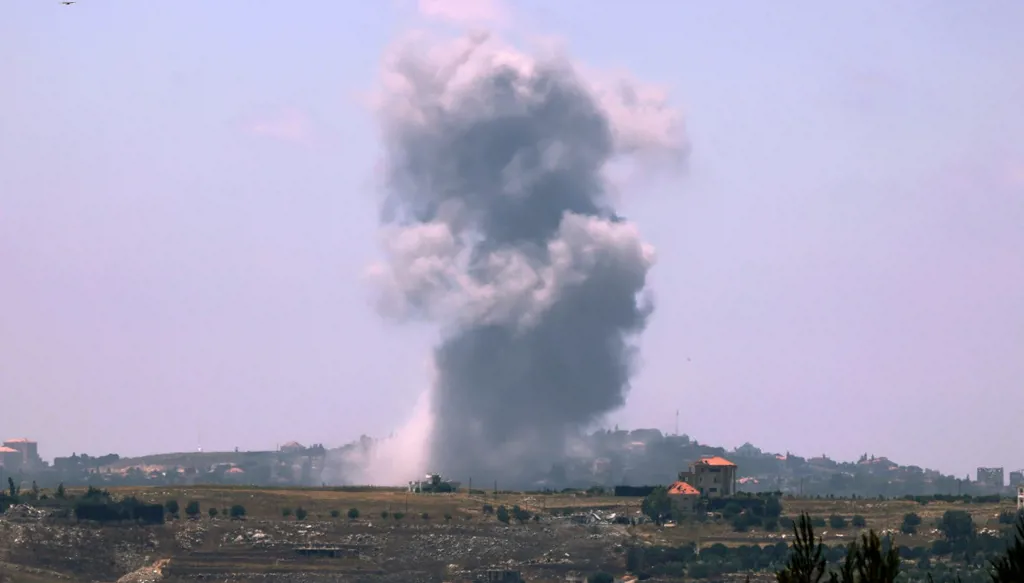


The battle taking place today in southern Lebanon is not merely a confrontation over a hill, a valley, or a border village. What is happening goes far beyond that.
It is a battle over the maps themselves, and over the lines that will separate Israeli and Hezbollah influence in the phase after the war, and over the shape of the south that may emerge from under the rubble if Israel succeeds in turning its military gains into permanent political realities.
At a time when the negotiations taking place in Washington are faltering and military warnings are accumulating on the ground, indicators are increasing that Israel is no longer thinking in terms of returning to the prewar situation, but rather in terms of imposing a new security reality that goes beyond Resolution 1701 and the Litani River, reaching areas that until recently were considered part of Hezbollah strategic depth.
A diplomatic source involved in the Lebanese Israeli negotiations taking place in Washington revealed to Annahar newspaper that a comprehensive ceasefire agreement has been on the table since the May 15 session, but two main attempts to approve it have been blocked in recent weeks. The source adds that the current effort is focused on preventing the failure of a special agreement for a pilot area around Beaufort Castle, known as Qalaat al Shaqif, which is considered an initial test for any future security arrangements.
This area is of exceptional importance because it could become the first model for later Israeli withdrawals. Its failure, however, could open the door to the entrenchment of new field realities that would allow Israel to retain advanced positions, placing Nabatieh itself in the danger zone and threatening to turn it into the next link after towns that have come under Israeli control or military influence.
For this reason, the upcoming round of negotiations starting on June 22 appears decisive. While diplomatic circles speak of a growing belief in the necessity of Israel returning to the so called yellow zone, implementation of this path remains conditional on agreement over the pilot area, its monitoring mechanisms, and guarantees.
In contrast, southern Lebanese circles are increasingly concerned that Jabal Amel may be facing a harsh historical moment that could redraw its balances and security boundaries under the pressure of military realities and regional understandings.
However, what is taking place in the negotiation rooms is only a reflection of what is being discussed inside the Israeli military establishment itself.
According to Israeli reports, the army is facing two strategic options known internally as Oranim Minor and Oranim Major. Oranim is a Hebrew term meaning pine trees and is used as a symbolic code name for military plans and operations, and here it is used in Israeli reporting to describe two possible escalation scenarios.
The first option, Oranim Minor, is based on consolidating current gains and turning them into a real security belt that prevents the return of threats to the northern border. The second option, Oranim Major, opens the door to a very different phase, advancing north toward Nabatieh and Zahrani, expanding west toward Tyre and Sidon, and ultimately redrawing the entire security geography of southern Lebanon.
When the Litani is no longer enough
Perhaps what most reinforces these concerns are the warnings issued by the Israeli army in recent days to residents of areas around Tyre and Sidon, calling on them to evacuate. Such warnings are not usually read as mere precautionary measures, but rather as an indication that the areas concerned may have been included in the potential battlefield or in the bank of military targets.
Accordingly, bringing the outskirts of Tyre and Sidon into the circle of warnings suggests that the southern coast is no longer outside Israeli operational calculations if a decision is taken to move to a broader phase of the war.
At the heart of these calculations lies the Wadi Saluki. This valley is not just a geographical feature. It is one of the most deeply rooted locations in Israeli military memory since the 2006 July War, when it became a symbol of the failure of the Israeli advance and of the combat capability demonstrated by Hezbollah in exploiting the southern terrain.
When the Israeli army today speaks about achieving operational control north of Wadi Saluki, it is not announcing permanent occupation so much as it is declaring the collapse of one of the natural defensive nodes that has long formed part of Hezbollah’s field depth.
Operational control here means the ability to move, observe, and target, and to prevent the adversary from freely using the area, which gives Israel a broader margin to impose new realities on the ground.
But the most significant development is the shift from the Litani to the Zahrani. For nearly two decades, the Litani River has been the reference point for any political or military discussion regarding southern Lebanon after Resolution 1701.
Today, however, the mere discussion of the Zahrani as a potential security line reveals the scale of change in Israeli thinking. The Zahrani is not located in the border strip or in the traditional zone of confrontation, but rather forms the southern gateway to Nabatieh and the junction that connects the south to Beirut and the Bekaa.
Here, Nabatieh enters the heart of the scene. The city is not just a major population center, but one of the most important pillars of the political, social, and logistical structure of the environment that supports Hezbollah.
Therefore, the approach of Israeli operations toward its surroundings is not seen as an ordinary field advance, but as an indicator of the war shifting from the peripheries to the central nodes in the south.
The striking paradox is that Israel acknowledges that the most serious threat is no longer rockets or tunnels, but drones. The current war has gradually turned into an open technological race, in which Israel seeks to push drone operating platforms deeper into Lebanese territory, while Hezbollah seeks to maintain its ability to inflict attrition and keep the front active.
Amid all this, the statement by the commander of the 13th Battalion in the Golani Brigade about his forces being ready to reach Beirut if ordered has drawn attention.
This statement may be closer to a message of deterrence and psychological pressure than to an actual operational plan, but it reveals something more important. The Israeli military establishment is trying to convince both its adversaries and its allies that it is no longer willing to return to the pre war balance.
If Zahrani represents in Israeli calculations an advanced security line, Beirut remains the political and psychological ceiling of the war. When an Israeli field officer speaks about readiness to reach the Lebanese capital, he is not necessarily drawing up an executable military plan, but sending a message that goes beyond the battlefield into politics and strategy.
Beirut here is not a direct military target so much as it is a symbol of the maximum extent the war could reach if existing restraints collapse and proposed settlements fail.
Through this signal, Israel is attempting to suggest that the limits of confrontation are no longer confined to the border strip or south of the Litani, and that it is theoretically prepared to go much further than in previous rounds of conflict if it deems its security no longer guaranteed by traditional means.
The question being raised today is no longer where Israeli forces will stop, but which south will remain for Lebanon if Israel succeeds in imposing its new security vision.
Between negotiations that are faltering in Washington, military plans expanding on the ground, and new maps being tested by fire, the conflict no longer appears to be about stopping the war alone, but about the nature of the peace that will follow it, who will draw its boundaries, and where its actual lines will end.
Disclaimer: The opinions expressed by the writers are their own and do not necessarily represent the views of Annahar.