

Inside Lebanon’s Washington negotiations: A fragile diplomatic gamble under fire
Ahead of new U.S.-hosted talks, Lebanon faces mounting pressure over security, sovereignty, and escalating Israel-Hezbollah tensions.



 Messenger
 Whatsapp
 Threads
 Email
Email
 Print
Print
 X
X
 Facebook
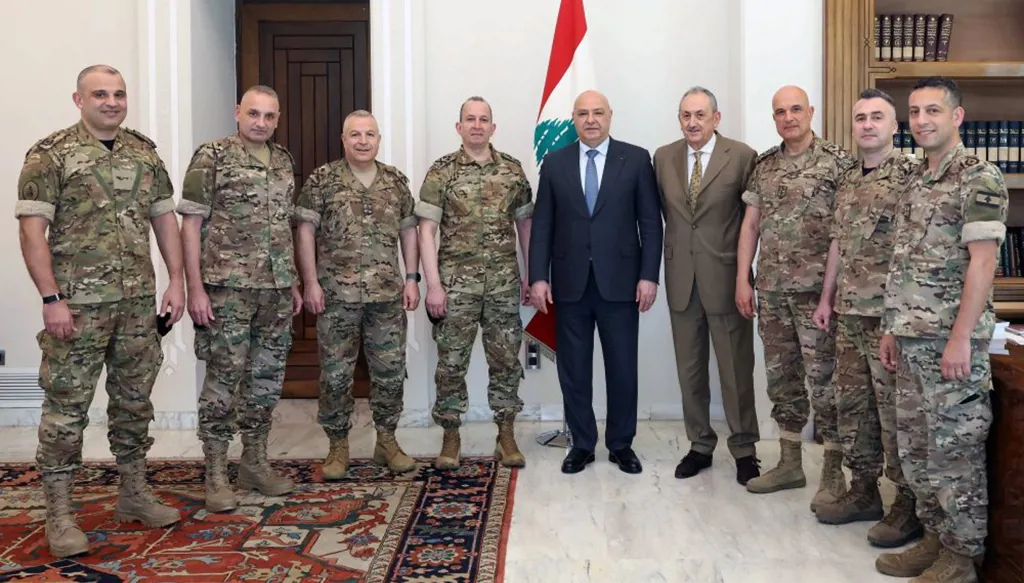


Although the program for the upcoming fifth round of Lebanese-Israeli-American negotiations in Washington, tentatively scheduled for June 22, 23, and 24, has not yet been finalized or definitively announced, it is almost certain—according to Annahar—that both diplomatic and military negotiations will take place at the U.S. State Department. This would further heighten tensions surrounding the atmosphere and outcomes of the next round amid this integration.
To this end, President Joseph Aoun chaired a meeting yesterday afternoon attended by the head of the Lebanese negotiating delegation, Ambassador Simon Karam, Army Commander General Rodolphe Haykal, and the military negotiators.
The meeting reviewed the deliberations of the negotiation rounds held in Washington on May 29 and June 2 and 3 with the American and Israeli sides at both the Pentagon and the U.S. State Department. It was reported that President Aoun provided Ambassador Karam and the officers’ delegation with necessary directives for the upcoming meeting expected to be held in Washington during the week starting June 22.
However, the key issue shedding light on the reality facing the Lebanese negotiating delegation under Ambassador Simon Karam across successive rounds was highlighted by a diplomatic source well-versed in the negotiations’ developments and depth.
The source explained President Aoun’s initiative after the last round to disclose that Ambassador Karam halted the negotiations and refused to resume them until the Lebanese delegation secured the minimum demands under the prevailing difficult conditions.
In outlining the challenges faced by the Lebanese delegation and its objectives to reach the fundamental goals of the negotiation track—amid a stark imbalance of power that places Israel in a field-superior position—the diplomatic source told Annahar that the balance of power on the ground led to what is referred to as the “Washington Declaration,” stressing that no party can achieve gains beyond what was already secured during negotiations held in the American capital.
The source detailed the major complexities as follows:
Firstly: It is clear, according to the source, that both Israel and Iran support attempts to redistribute influence in Lebanon and link the Lebanese and Iranian tracks at the expense of Lebanon’s interests.
Secondly: The Israeli approach adopted in the south and the formula of the suburb for the north of Israel to ensure protection, according to the source, could lead to a catastrophe in Jabal Amel and produce a new Iranian guardianship over Lebanon with Israeli approval, similar to Hafez Assad’s guardianship. The source notes that neither the Israeli nor Iranian sides oppose the outbreak of a new civil war in order to keep Lebanon a shared sphere of influence.
Thirdly: There are “juvenile” attempts in the country, as described by the source, involving parties that were major players during the former Syrian guardianship, aiming to undermine the Washington track in favor of the “illusion of the Iranian path.”
Fourthly: Those involved have so far managed to thwart two key attempts to implement a comprehensive ceasefire on the table since the May 15 round and are now seeking to block the agreement on implementing a basic test area around Beaufort Castle, which would prevent Nabatieh from falling and being annexed to Bint Jbeil and other occupied towns.
The source added that a third attempt will be made to carry out this experiment, and that appropriate measures will be taken depending on the behavior of these disruptors.
Amid these developments, a meeting last Wednesday brought together the political assistant to Parliament Speaker Nabih Berri, MP Ali Hassan Khalil, and the President’s advisor Andre Rahal, to discuss details related to the items in the declaration issued from the Washington negotiations.
In his recent statements, President Aoun told Reuters: “We are determined to go to a new round of negotiations,” adding that if this round is delayed, “the Israelis will bear the responsibility.”
He clarified that the “Washington Declaration” did not include freedom of movement for Israel, but rather the right of both parties to self-defense, confirming that the leverage he is negotiating with stems from his constitutional position and supportive American backing.
He added: “We do not accept Iran dictating what we should do. We are a sovereign state; it has no right to speak on our behalf. If Hezbollah chooses to remain in a state of war, it will harm the community it claims to defend.”
Aoun thanked Saudi Arabia for lifting the ban on Lebanese exports to the Kingdom, announced yesterday, adding that this decision is evidence that Lebanon remains central to the Kingdom’s interests and that Saudi Arabia has not abandoned Lebanon.
Saudi Arabia had announced the reopening of its markets to Lebanese exports, signaling a recovery of some lost trust that is hoped to be further restored. The decision coincided with the return of Saudi envoy Prince Yazid bin Farhan to Beirut yesterday morning, and it was widely welcomed politically, officially, and economically.
Regarding Syria, and in an implicit response to remarks by U.S. President Donald Trump about Syria’s contribution to disarming Hezbollah, Aoun stated that President Ahmad Al-Sharaa has a sense of responsibility and awareness and will not be drawn into the Lebanese quagmire.
On Israeli positions, Israeli Prime Minister Benjamin Netanyahu announced that “we are delivering strong blows to Hezbollah and eliminating hundreds of its members weekly,” while the Israeli Ministry of Foreign Affairs stated that Hezbollah launched drones toward Israel last night and this morning, calling it a flagrant violation of the ceasefire.
Israeli raids intensified on the south and western Bekaa and later extended to a remote area in the Nahleh-Baalbek mountains, where a fatality was reported. It was also reported that Hezbollah shot down an Israeli drone, prompting the Israeli air force to bomb it after it fell.