

How Iran turns survival into victory against the United States
From the Strait of Hormuz to stalled negotiations, Tehran's playbook relies on outlasting its adversaries rather than defeating them outright.



 Messenger
 Whatsapp
 Threads
 Email
Email
 Print
Print
 X
X
 Facebook
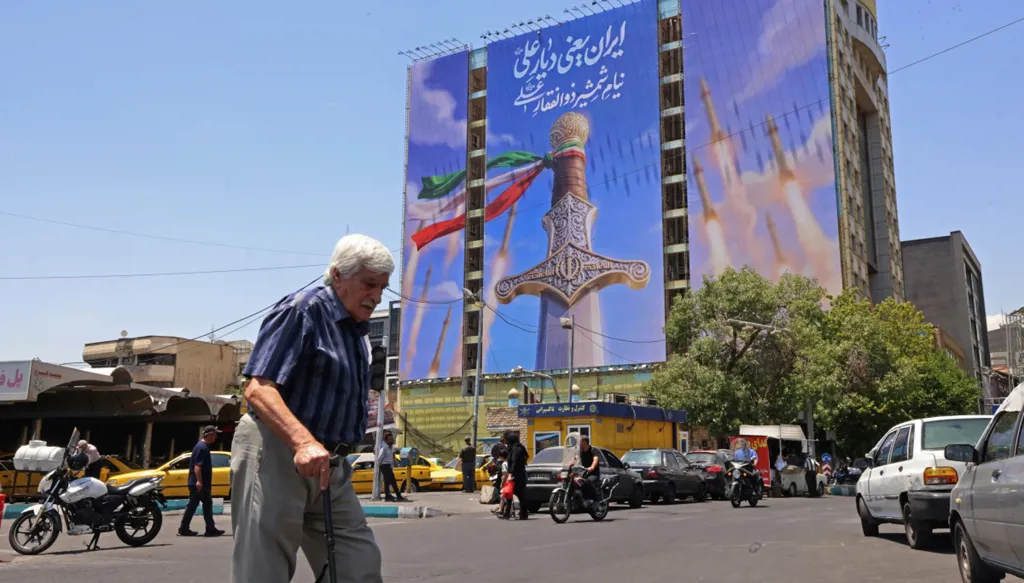


The recent American military "surge" against Iran on Tuesday, Wednesday, and Thursday reflects President Donald Trump's new approach to negotiations with Tehran.
Iran, for its part, seeks to exploit time as much as possible throughout the arduous negotiation process with the United States. It also uses the issue of ships transiting the Strait of Hormuz as military, diplomatic, and domestic moral leverage, promoting the idea that endurance itself constitutes victory.
The United States, meanwhile, has dealt devastating blows to Iran on several military and economic fronts. The opening strikes of the war that erupted on February 28 resulted in the death of former Supreme Leader Ali Khamenei, along with more than 12 senior figures in Iran's military and political leadership.
Endurance at Any Cost
Nevertheless, Iran is fighting a losing war if one evaluates it strictly through the lens of costs and gains. Its strategy is rooted in the principle of achieving a moral victory, even if it comes at the brink of collapse. What matters to Tehran is endurance, regardless of the price paid or the magnitude of losses sustained across various fronts.
In other words, Iran is denying the United States a "clean" victory. It is enough for Tehran to continue maneuvering within a state of neither war nor peace with President Donald Trump, dragging out the process until deadlines begin piling up on the president's calendar. These include the World Cup, which has kicked off in the United States, the congressional midterm elections early next November, and the 250th anniversary of the founding of the United States on July 4. These milestones are politically significant for the president and his party, making the successful conclusion of the Iran mission increasingly important.
So far, despite President Trump's repeated declarations that Iran has suffered a crushing defeat, the fundamentally different concepts of victory and defeat held by Washington and Tehran have prevented a clear outcome.
Political propaganda and an ideological culture that glorifies death without accounting for its cost continue to feed the regime's narrative machine, elevating myths to the point of obscuring undeniable facts.
Survival generates myths
By any conventional assessment, America and Israel emerged victorious. But according to an ideological framework built on myths and legends, Iran won simply because its regime survived. In practice, it collapsed and disappeared from the conscience of the majority domestically, yet the balance of power on the ground kept the "sick man" in power.
The regime's disregard for the immense losses suffered by both the state and its institutions prevents it from reaching the threshold of acknowledging defeat.
This explains the complexities of the confrontation between the United States and Iran. President Donald Trump appears to have stepped back from the option of a large-scale war and instead embraced a strategy combining negotiations, blockade, and calibrated military deterrence, which has been employed in moderation in recent days.
Ironically, this is precisely what reassures Iran and encourages it to continue betting on its ability to absorb enormous material losses stemming from the American blockade of its ports, as well as the intermittent strikes carried out since the truce was announced.
There is little doubt that Iran has begun exploiting its ability to obstruct passage through the Strait of Hormuz by imposing levies on passing ships, while also blackmailing the region through targeted operations. In this sense, Iran does not behave like a normal state, but rather like a mafia-style entity that practices extortion and uses armed force as a tool to achieve it.
Need for a change in approach
From this perspective, President Trump's mistake lies in not going all the way to alter the equation fundamentally. Attempts to extract concessions through negotiations, coupled with threats of force or its limited application, have repeatedly failed because they allow Tehran the opportunity to catch its breath and reorganize its sources of leverage both domestically and across the region.
This pattern can be seen in Hezbollah's return to fighting despite the heavy daily losses it continues to endure, as well as the expansion of Israeli control in southern Lebanon. The group pays a steep price and imposes tremendous burdens on its support base at multiple levels. It is highly likely that Israel will advance to the outskirts of Sidon, more than 50 kilometers from its border.
More alarmingly, if the fighting continues, Israel could move toward controlling all Shiite civilian centers in southern Lebanon. This would constitute a genuine catastrophe. Yet Hezbollah, much like its Iranian patron, continues to raise the banner of victory.
In summary, President Donald Trump is making a grave mistake by immersing himself in the game of negotiations and allowing time to become a decisive factor. In this game, time is working clearly in Iran's favor.
Disclaimer: The opinions expressed by the writers are their own and do not necessarily represent the views of Annahar.