

Petraeus’ return to Baghdad signals a new U.S. push on Iraq’s armed factions
As Washington reshapes its Iraq strategy, the focus shifts to disarming militias, strengthening state authority, and linking U.S. support to concrete security and reform steps.



 Messenger
 Whatsapp
 Threads
 Email
Email
 Print
Print
 X
X
 Facebook
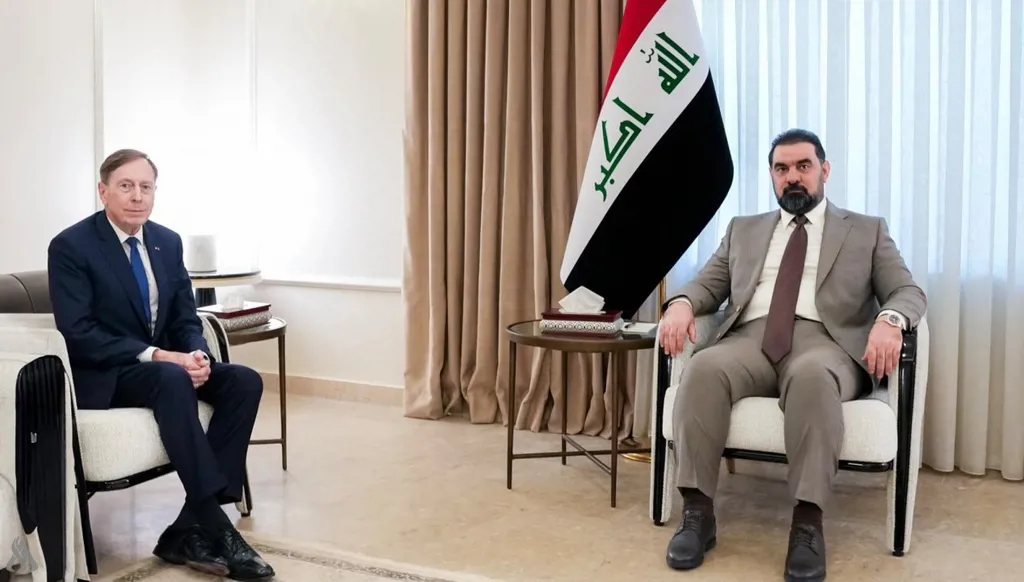


In mid-May, a plane landed in Baghdad carrying one of Washington’s most prominent figures in Iraq after the fall of Saddam Hussein’s regime. It was not the first time General David Petraeus returned to the capital since ending his most significant mission as commander of U.S. forces in Iraq in mid-September 2008, but this time it triggered widespread speculation about its objectives.
This was especially the case given that, according to Annahar’s sources, he is expected to repeat the visit soon, with the main focus being the issue of factional weapons.
Washington has not announced that Petraeus is on an official mission. However, a U.S. State Department spokesperson described the retired general as “an ordinary citizen.”
Neither Petraeus himself nor the Iraqi government confirmed any official nature for his tour of prominent Iraqi leaders during his last visit, which lasted five days.
Nevertheless, observers of recent U.S.-Iraqi relations see Petraeus’ move as part of shaping a decisive American vision aimed at supporting Ali Faleh Al-Zaidi’s government in confining arms to the state.
From Savaya to Barrack: American Changes Reflect on Iraq
This comes in parallel with fundamental changes in the nature of communications between Washington and Baghdad. The Iraqi file has become the responsibility of Tom Barrack, appointed as a presidential envoy to Iraq and Syria and seen as close to President Donald Trump’s thinking, after Mark Savaya’s earlier appointment as envoy did not materialize.
In Iraq, Al-Zaidi managed to launch his government, though still not completely, for a key reason tied to the most sensitive current issue facing it: the gains of the factions regarding the handover of weapons.
The announcement of procedures to receive arms from “Asa'ib Ahl al-Haq” and the “Imam Ali Brigades,” both part of the “Popular Mobilization Forces,” has added further speculation about their distancing from Iranian influence during a sensitive phase amid the U.S.-Iran confrontation.
At the same time, other Iran-aligned factions, most notably “Kata'ib Hezbollah” and the “Nujaba Movement,” have declared their firm position on retaining their weapons, linking this to demands, primarily the withdrawal of U.S. and Turkish forces from Iraq.
As for the “Peace Companies” (Saraya al-Salam) of Sadrist Movement leader Muqtada al-Sadr handing over their arms to the government, this is viewed in Washington as a positive step supporting state authority, without overlooking its role in scoring points against Sadr’s rivals within the Shiite political landscape.
Whether Petraeus is undertaking the task of preparing a new U.S. plan to enable the Iraqi government to confine arms, or merely paving the way for it, prominent American research centers we consulted say that Iraq will witness pivotal developments in this file soon.
These steps are part of calculated policies designed to prevent any measures from escalating into armed confrontations that could undermine progress achieved so far, taking into account the political or economic gains that factions might obtain by handing over weapons, and whether this could pressure other rejecting factions, especially ideological ones.
What are the Main Points of U.S. Policy in Iraq?
According to Al-Nahar’s sources in Washington, U.S. policy toward Iraq is based on the following main points:
Addressing the issue of disarmament — or voluntary handover — and confining weapons to the state as a condition for continued American acceptance of the new government. This is seen as conditional U.S. support in exchange for tangible steps on the weapons file, not mere promises or unfulfilled commitments. This political support is accompanied by financial pressure related to the dollar and oil revenues.
Pressuring the government to isolate factions that refuse to hand over their weapons, while offering economic incentives to forces that join the state project without maintaining active militia influence, especially within sensitive sovereign and security ministries.
Containing factions through the “Petraeus mission”, drawing on his experience in the Sunni Awakening project in 2007, despite the different conditions and sectarian and regional contexts in both cases.
The main objective is to weaken the military independence of factions refusing to hand over their weapons, preventing them from posing a continued threat to U.S. and allied interests, whether inside Iraq or in the region, starting from Iraqi territory.
This is particularly relevant given that hundreds of attacks have occurred since the U.S. and Israel began their war on one side and Iran on the other. The objective is also to reduce Iran’s ability to use Iraq as a regional deterrence platform.
The sources add that the Trump administration will make any visit by Al-Zaidi to the White House conditional on “tangible achievements” and clear results in confining arms, administrative reform, and anti-corruption efforts, in exchange for support for economic and development plans.