

"Ashab al-Yamin" Islamist Movement: Europe's new security challenge
From Telegram channels to international investigations, the shadowy movement has become the focus of allegations linking it to Iran-backed networks operating across Europe.



 Messenger
 Whatsapp
 Threads
 Email
Email
 Print
Print
 X
X
 Facebook
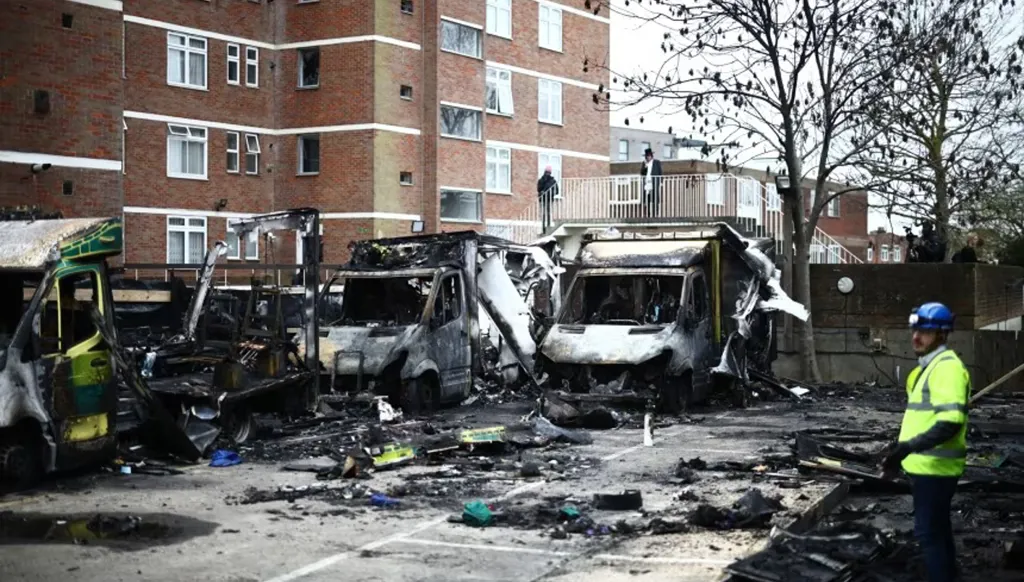


The "Ashab al-Yamin" transformed within a few months from an obscure name that first appeared on Telegram into the subject of security and judicial investigations in Europe and the United States. It has also become part of the diplomatic confrontation between the West and Iran following a joint statement by 22 countries accusing Iranian entities of involvement in cross-border activities and linking some of them to the movement.
Despite intensive media coverage, the movement's true nature remains the subject of debate among investigators and security agencies. While it presents itself as a new organization that emerged in response to the war against Iran, the United States views it as a front used to conduct operations linked to networks loyal to Tehran. European agencies, meanwhile, continue to investigate its actual structure and external connections.
Origins and Initial Discourse
The movement's name first began to surface in March 2026, weeks after the large-scale US-Israeli attack on Iran on February 28 of the same year.
From its earliest statements, the movement tied its existence to that war, presenting itself as part of the "Resistance Axis" seeking retaliation against the United States, Israel, and their allies.
The group adopted a name derived from the Quranic expression "Right Holders," referring to the righteous or the saved, giving its discourse a clear religious and ideological dimension. Its propaganda messages focused on the idea of avenging the war against Iran, arguing that the confrontation was not confined to the Middle East and could extend to any location connected to Tehran's adversaries.
Unlike traditional organizations, the movement did not announce a known leadership, a clear organizational structure, or specific geographical areas of influence. It emerged primarily through electronic statements and videos claiming responsibility for scattered attacks in Europe, raising early questions about its nature and actual capabilities.
The American Narrative: A Front for 'Kata'ib Hezbollah'
The US Department of Justice's case file remains the most detailed official source addressing the movement to date.
In May 2026, US authorities announced the arrest of Iraqi national Mohammed Baqir Al-Saadi, whom they described as a senior leader in the Iraqi "Kata'ib Hezbollah" with ties to the Iranian Revolutionary Guards and the Quds Force.
The Department of Justice accused Al-Saadi of participating in the planning, coordination, and promotion of a series of attacks and attempted attacks targeting sites in Europe and the United States. He was also accused of overseeing part of the movement's media and propaganda activities as part of what he described as the "psychological warfare" waged by the "Resistance Axis."
According to court documents, these accusations are based on communications and electronic materials that US authorities say demonstrate his coordination with members of "Kata'ib Hezbollah" regarding the publication of the movement's statements and videos claiming responsibility for the attacks.
The most significant aspect of the case is that the US Department of Justice does not regard the "Ashab al-Yamin" as an independent organization. Instead, it describes it as a "front" used by the Iraqi "Kata'ib Hezbollah" and other groups designated as terrorist organizations by the United States to carry out operations and propaganda activities under a new name.
The American narrative suggests that the movement's creation was part of an effort to provide both operational and media cover, enabling attacks outside the Middle East while maintaining a degree of ambiguity regarding the actors behind them.
However, these conclusions remain part of the US prosecution's case. Al-Saadi has pleaded not guilty before the federal court in New York, and no final rulings have yet been issued to confirm or refute the allegations.

Timeline of Attacks
The movement's name has been linked to a series of attacks and attempted attacks across several European countries during March and April 2026.
On March 9, an attack involving explosive materials occurred near a Jewish synagogue in Liège, Belgium.
A few days later, an explosive device targeted a Jewish school in Amsterdam, followed by another attack on the building of the "Bank of New York Mellon" in the same city on March 15.
On March 23, four ambulances belonging to the Jewish organization "Hatzalah" were set on fire in Golders Green, London, while a similar attack targeted a car in a Jewish neighborhood in Antwerp, Belgium.
On March 28, French authorities announced that they had thwarted an attempt to target the "Bank of America" building in Paris.
In April, the list of targets expanded to include institutions and associations linked to Israel or Jewish communities in Britain and the Netherlands.
On April 3, authorities recorded an attempt to target a pro-Israel organization in the Dutch city of Nieuwkerk.
On April 16, the movement claimed it had targeted the Israeli embassy in London with two drones. British authorities later announced that they had found drone debris and materials determined to be non-dangerous.
On April 17 and 18, a Jewish association and a synagogue in London were subjected to deliberate arson attacks.
On April 29, two Jewish men were stabbed in London in an incident the movement later claimed as part of its media propaganda.
US authorities say these incidents form part of approximately 18 to 20 attacks and attempted attacks attributed to the movement during this period.
Front or Operational Network?
Despite the detailed American narrative, European investigations have yet to reach a unified conclusion regarding the movement's nature.
Some security assessments treat it as a loose network relying on local individuals or hired criminals to conduct low-cost operations designed to generate significant media impact. Others view it as an operational alias used to conceal the activities of more organized entities.
This debate is reinforced by the absence of a declared organizational structure, the lack of known leaders or official spokespersons, and the inability to identify a hierarchy resembling that of traditional armed groups.
The rapid spread of operations across several European countries within a short period has also led some researchers to question whether the movement possesses an independent organizational presence or merely serves as a propaganda framework through which various networks claim responsibility under a single banner.
From European Investigations to the 22-Country Statement
For weeks, the movement remained primarily the subject of security and judicial investigations before evolving into a broader political and diplomatic issue.
On June 10, 2026, 22 countries, including the United States, Britain, France, Germany, Canada, and Australia, issued a joint statement accusing Iranian entities of involvement in cross-border activities, including murder, kidnapping, intimidation, and the targeting of Jewish and Israeli institutions in Europe and North America.
The statement linked these activities to the "Ashab al-Yamin", arguing that the attacks attributed to it form part of a broader pattern of operations that the signatory states attribute to entities connected to Iran.
The significance of this development lies in shifting the movement's case from a collection of local investigations to a coordinated international accusation, making it part of the growing debate over the nature of Iranian activities beyond its borders.
Tehran has repeatedly denied Western allegations that it manages or supports such operations abroad, describing them as "political accusations lacking evidence."
Amid competing narratives and mutual accusations, the "Ashab al-Yamin" remains one of the most enigmatic groups to emerge since the outbreak of the regional war in 2026, with ongoing debate surrounding its true nature and the entities operating behind it.