

Trump signals on Syria raise regional alarm over Lebanon’s fragile balance
Hints of possible Syrian involvement against Hezbollah spark concerns in Beirut, Damascus, and beyond, amid fears of escalating regional pressure and shifting alliances.



 Messenger
 Whatsapp
 Threads
 Email
Email
 Print
Print
 X
X
 Facebook
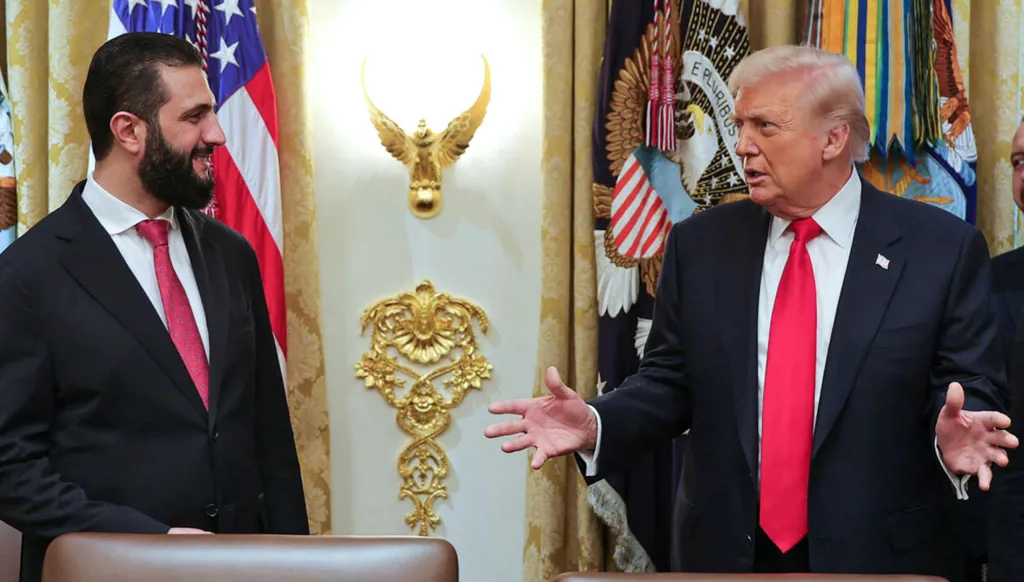


The hint by US President Donald Trump regarding Syria potentially providing assistance that could imply military intervention against “Hezbollah” in Lebanon should not be overlooked.
Previous reports from months ago, based on credible sources, pointed to American pressure behind Syrian military buildups along the border. At the time, Syria stated, “We know nothing about the pressures,” while US envoy Tom Barrack clearly and explicitly denied those reports.
It is no longer merely “newspaper talk.” The narrative now comes from the highest authority in the United States and carries implications that go beyond insinuation. Syria needs Washington’s support and the removal of remaining ambiguities that still obstruct its economic ambitions. Trump presents his “edict” alongside praise for Syrian President Ahmad Al-Sharaa, playing on expectations of a second visit Sharaa is reportedly preparing to make to the White House.
Trump’s statements reflect a tone of frivolity and disregard toward both Syria and Lebanon, and a lack of awareness of the painful history in relations between the two countries during the previous Assad era. Moreover, Syrian intervention is not in Syria’s interest at a time when the country is striving to free itself from immense structural, economic, security, social, and political burdens.
Such a scenario, despite Sharaa’s supportive stance toward President Joseph Aoun’s state plan to monopolize arms, does not serve the Lebanese state, nor does it improve its internal position regarding the “party” that Trump seeks to leverage Damascus against.
Beirut is undergoing an unprecedented sovereignty experience it has not known since the end of the civil war in 1990. The state is attempting to chart its course in guiding and managing the country outside of harmful guardianships.
It is engaged in direct negotiations with Israel, similar to those Syria is conducting with Israel, under the same American pressure and sponsorship. Trump may or may not be aware of the destructive impact his “Syrian” insinuations have on Lebanon’s independence, and the potential revival of a militia that would gain strength from such intervention.
Can Damascus Handle Trump's Pressure?
Trump did not appear to take into account President Assad’s repeated assertions of non-interference in Lebanese affairs and his commitment to establishing a respectful relationship with the Lebanese state. Nor did he consider Syrian political and military statements denying any plans for military intervention, while affirming that high-level coordination continues between the two countries’ authorities to manage border issues and combat smuggling and terrorism. He may also have overlooked what the Lebanese presidency announced last March about receiving assurances from President Sharaa that “Damascus does not intend military intervention.”
The Syrian situation may still be too fragile to withstand external pressure, particularly from the United States and Trump personally. Damascus and Sharaa recognize what Trump’s presidential decision for Syria represents and what it means for a broader breakthrough in Syria’s relations with other countries.
However, Damascus operates within a regional framework of interests shaped by influential actors, most notably Saudi Arabia and Turkey, as key supporters of the new Syria, both of which also maintain advanced relations with Washington and close ties with Trump that he takes into consideration.
Israel would not be comfortable with Trump’s hints, even from the perspective of weakening “Hezbollah” in Lebanon, as it remains wary of the “Sharaa phenomenon” extending beyond borders and of Washington’s sponsorship of a new dynamic appearing from southern Lebanon and southern Syria.
These signals also inadvertently provide a rare advantage to “Hezbollah” itself, as a majority of Lebanese across sects would oppose Syrian intervention regardless of motives, thereby reinforcing the group’s weapons and resistance narrative and restoring its perceived legitimacy, while easing its social isolation within Lebanese society—an isolation that has already begun to intensify even within the Shiite community itself.
Despite what appears to be external noise that departs from logical frameworks, it is necessary for all concerned parties, and those supporting Lebanon and Syria, to quickly dispel Trump’s uncoordinated and improvised signals.