

Critic of Tunisia’s President gets four-year sentence, sparking free speech alarm
Exiled reporter Khaoula Boukrim receives a four-year prison sentence under Tunisia’s controversial cybercrime law, fueling fresh criticism over the state of free speech and independent journalism.



 Messenger
 Whatsapp
 Threads
 Email
Email
 Print
Print
 X
X
 Facebook



Tunisian journalist Khaoula Boukrim, a staunch critic of President Kais Saied, announced that a court in Tunisia had sentenced her in absentia to four years in prison, a ruling that critics say reflects an accelerating campaign targeting freedom of expression and voices critical of the president.
The verdict against Boukrim is the latest measure taken against journalists, following the imprisonment of several media figures, including Ziad El-Hani, Mourad Al-Zeghidi, and Burhan Bsis.
Al-Zeghidi has launched a hunger strike while in detention, demanding his release.
Boukrim, founder of the website "Two Media," said she was informed by her lawyer on Tuesday of two separate sentences issued against her under Decree 54, a cybercrime law enacted in 2022 that imposes strict penalties for online publication offenses.
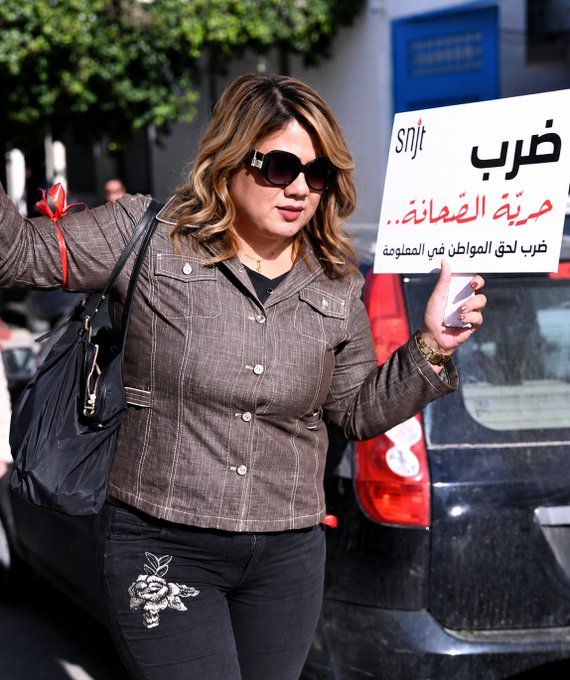
Human rights organizations say the law is increasingly being used to prosecute government critics and restrict freedom of expression, while authorities maintain that it is necessary to combat misinformation and online abuse.
Boukrim left Tunisia for Paris last December, saying, "I was forced to leave Tunisia for Paris when I learned that several cases were being prepared against me because of my critical stance toward the president and his entourage."
She told Reuters by phone, "This sentence is a continuation of the targeting of the free press and strong critical voices."
Human rights groups have warned of growing efforts to silence the remaining independent voices since President Saied dissolved the elected parliament and began ruling by decree in 2022.
Freedom of expression had flourished after the 2011 uprising that toppled former President Zine El Abidine Ben Ali and sparked the Arab Spring.
However, critics say Saied's concentration of power in 2021 and the decrees he later issued dismantled democratic safeguards, including press freedom, one of the most significant gains Tunisians achieved following the revolution.
Leaders of major opposition parties remain in prison alongside dozens of politicians, activists, and businessmen on charges including conspiracy against state security, money laundering, and corruption. They insist the cases are fabricated and intended to silence dissent.
Saied, for his part, says that no one is above accountability, regardless of their name or position. He also maintains that he will not become a dictator and that freedoms remain guaranteed in Tunisia.