

Lebanese army commander’s visit to Islamabad amid escalation: Cooperation or regional messaging?
As Israeli pressure intensifies and Lebanon’s security landscape shifts, the Army Commander’s trip is interpreted through competing political narratives that go beyond military cooperation.



 Messenger
 Whatsapp
 Threads
 Email
Email
 Print
Print
 X
X
 Facebook
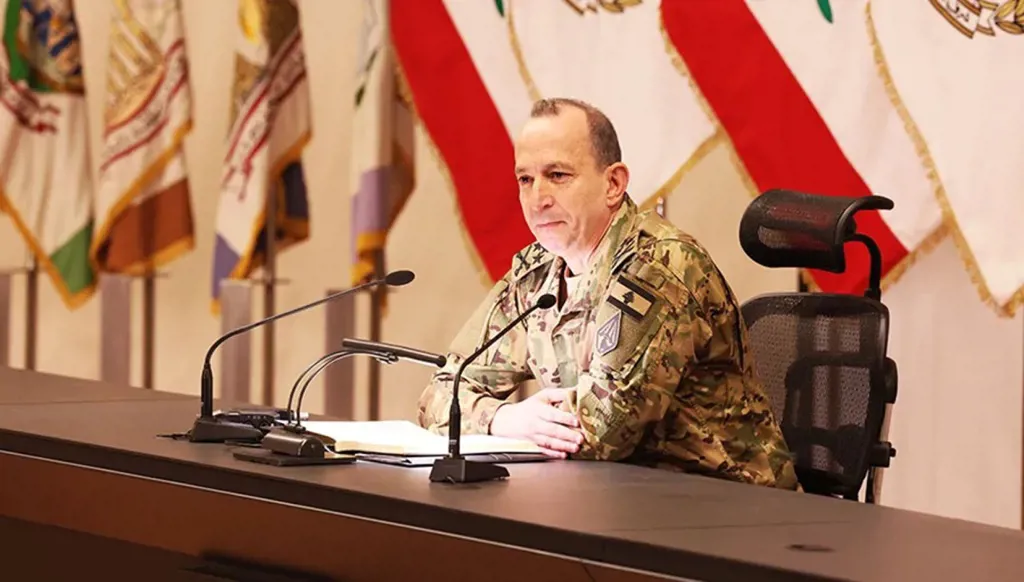


The news of the departure of the Commander of the Lebanese Army, General Rodolphe Haykal, to the Pakistani capital Islamabad at the invitation of the Pakistani Army Commander, Field Marshal Asim Munir, was not an ordinary development in terms of timing or content.
The visit comes at a highly sensitive regional moment, coinciding with rising pressure on Lebanon, the ongoing Israeli attacks in the South, and most recently the targeting of a Lebanese Army vehicle, which led to the martyrdom of two officers and a soldier in an incident that raised political and security questions extending beyond its direct military dimension.
At a time when the Lebanese state is trying to consolidate the ceasefire and limit escalation, many questions have emerged about the background of the Army Commander’s visit.
Why is he going to Pakistan now? Did the visit receive approval from President Joseph Aoun and Prime Minister Nawaf Salam? And does it carry political dimensions that go beyond the framework of traditional military cooperation?
Did Heikal receive the political green light?
According to the current information, it is difficult to imagine that a visit at this level took place without full coordination with the presidency and the prime minister’s office.
The Lebanese military institution has become a key actor in matters related to the security situation in the south, and any external movement by the Lebanese Army Commander at this sensitive stage cannot be separated from the official political umbrella.
Officially, the visit falls within the framework of strengthening military cooperation between the Lebanese and Pakistani armies, exchanging expertise and training, and developing relations between the two institutions. However, the timing gives it additional dimensions that go beyond these traditional titles.
Islamabad has recently emerged as a party which maintains a network of relations and communications with various regional and international powers, amid progress in Iranian American negotiations.
In light of the stalling of several negotiation tracks concerning Lebanon, political circles view the visit as an opportunity to open new channels of communication that may be related to the future of a Lebanese settlement or to the security and political arrangements being discussed regionally.
This assessment becomes even more significant in light of the stalled negotiation rounds that the Lebanese authorities had been relying on over the past months, and the continued American and Israeli pressure related to the future of the south and the mechanisms for implementing security understandings.
For this reason, many find it difficult to treat the Army Commander’s visit as merely a protocol or technical stop, especially since the Pakistani Army Commander Asim Munir is considered one of the most prominent military figures in the political and regional landscape of his country.
On the other hand, political and media circles close to Hezbollah linked Heikal’s visit to recent field developments, particularly the targeting of the Lebanese Army in the south.
According to this view, the Israeli strike that led to the deaths of two officers and a soldier cannot be separated from the broader context of increasing pressure exerted by Tel Aviv on the Lebanese state and its institutions.
Supporters of this interpretation rely on the position of Speaker of Parliament Nabih Berri, who stated that what happened was “not a mistake or a suspicion,” as Israel is trying to suggest, but a deliberate operation carrying clear messages. From this perspective, the incident is seen as an additional pressure message directed at the Lebanese Army at a time when international expectations of its role in the south are increasing.
These circles argue that Israel has been working for some time to separate the Lebanese track from the Iranian American negotiations, out of concern that any progress in that file could produce understandings that would reflect on the Lebanese front.
For this reason, they view with suspicion any new communication channels that could emerge through regional actors who maintain relations with both Washington and Tehran at the same time.
In this context in particular, Heikal’s visit to Islamabad gained exceptional importance. For those who hold this reading, the timing of the targeting of the Lebanese Army alongside the visit of its commander to a country seen as involved in regional communication channels is not merely a coincidence in timing, but may be part of exchanged messages related to the future of a settlement in Lebanon and its position within the broader regional landscape.
However, there is no official information confirming any direct political role for the visit or any link between it and ongoing negotiations in the region. Official sources continue to treat it as a purely military visit within the framework of normal relations between the Lebanese and Pakistani armies.
Nevertheless, the coincidence of the visit with the Israeli escalation against the Lebanese Army, and with the accelerating regional diplomatic activity, makes it difficult to separate it from the broader political context.
Between those who see it as a traditional military cooperation stop and those who consider it part of an evolving regional network of communications around Lebanon, what remains certain is that the Lebanese Army Commander’s trip to Islamabad came at a timing that goes beyond purely military calculations and reflects the extent of the intertwining between the Lebanese arena and surrounding regional developments.
In the Middle East today, movements of military leaders are no longer merely protocol visits, but are often part of a broader political and security landscape in which diplomatic messages overlap with field messages, and the calculations of war intertwine with negotiation tracks.