

Muqtada al-Sadr, Iraq’s influential cleric, moves to dissolve his armed wing in major security shift
The decision to integrate Saraya al-Salam into state forces comes amid mounting pressure to centralize armed groups under Iraqi authority and recalibrate the balance between rival domestic factions and regional powers.



 Messenger
 Whatsapp
 Threads
 Email
Email
 Print
Print
 X
X
 Facebook
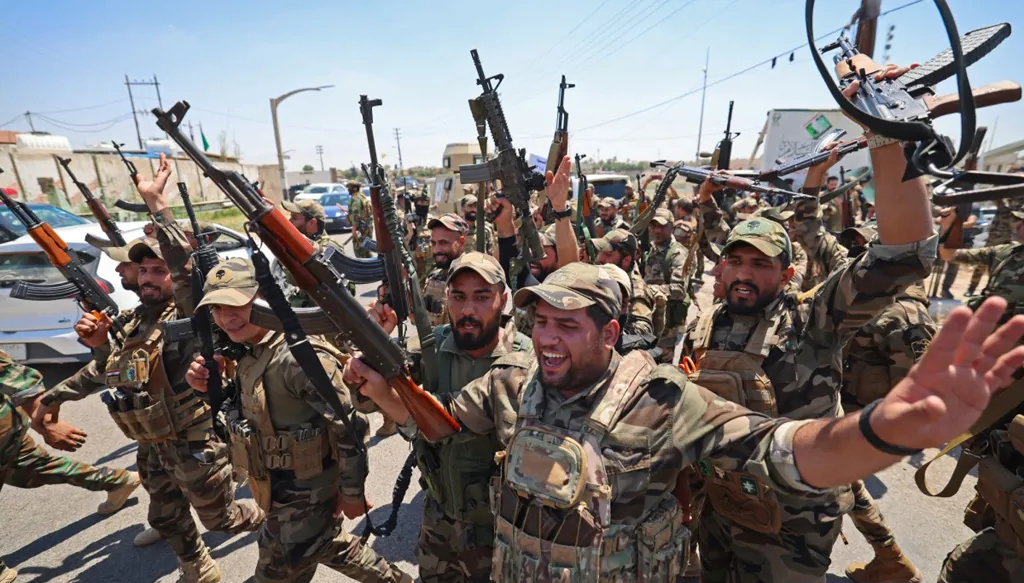


How should Muqtada al-Sadr’s decision to dissolve the “Saraya Salam,” the military wing of the Shiite National Movement, and fully integrate it into the Iraqi armed forces be perceived, along with similar decisions by militias formerly part of the Iranian-backed Popular Mobilization Forces?
Firstly, it is necessary to consider the political and security circumstances surrounding al-Sadr’s decision. It is well known that President Donald Trump’s administration is placing significant pressure on the Iraqi government led by Ali al-Zaidi to dissolve the Iran-aligned militias formed under the Popular Mobilization Forces, which were initially established to combat ISIS, which had captured vast areas of Iraq in 2014.
These pressures align with American efforts to deprive Iran of its influence in Iraq. Some factions of the Popular Mobilization Forces are known to have carried out strikes against American targets, and also targeted infrastructure in Gulf countries, following the American-Israeli war inflicted on them on February 28th.
Thus, President Trump’s administration warned the Iraqi government of the consequences of failing to take action to dissolve the factions still loyal to Iran, suggesting that Baghdad could be deprived of Iraqi oil revenues passing through the U.S. Federal Reserve.
In the rationale behind al-Sadr’s decision, it states: “From the public interest of the nation and to avoid impending dangers, it has become necessary to announce the complete disassociation of Saraya Salam from the Shiite National Movement and its full integration with the state and the overall responsibility of the military formations, ensuring that the civilian entities attached to Saraya become united structures, without any offices, weapons, attire, or any other identifiers.”
Some observers have placed this step within a clear endeavor by al-Sadr to avoid American sanctions, similar to other factions. However, other observers suggest that he intended to embarrass other Iraqi factions within the Popular Mobilization Forces by integrating his group into the military establishment.
Moreover, al-Sadr seems to be paving the way for a return to the political arena, which he withdrew from due to conflicts with parties included in what is known as the “Coordination Framework,” representing Iran-backed forces.
This step places Iran in an awkward position, as it sponsors factions that refuse to integrate into the state and prefer to remain as parallel entities to legitimate institutions and serve as an executive tool for Tehran, which can be employed against American interests whenever desired.
Al-Sadr’s decision aligns with similar decisions by other Iraqi factions like “Asaib Ahl al-Haq,” which declared their detachment from the Popular Mobilization Forces and integration into the state, while other factions like “Kata'ib Hezbollah,” “Harakat al-Nujaba,” and “Ahl al-Kahf” have refused to lay down their arms until, as they describe, the complete withdrawal of American forces from Iraq.
The effort to restrict arms to state control gained significant momentum with the announcement by leaders of the Shiite “Coordination Framework,” authorizing al-Zaidi to proceed with this endeavor.
The consolidation of arms under the Iraqi state is bound to have repercussions on what is termed the “Resistance Axis” in the region, especially in Lebanon, where Hezbollah rejects the Lebanese government’s decision to hold exclusive authority over arms and maintains its loyalty to Iran. Despite Hezbollah’s decisions since 2023, which have exacted a high human and economic cost on Lebanon.
Hezbollah refuses negotiations between the Lebanese government and Israel to reach a ceasefire, seeing them as gratuitous concessions, insisting on tying Lebanon’s fate with developments in Iran.
The question now arises about the implications of al-Sadr’s decision with the beginning of al-Zaidi’s term at the helm of the new government, as attention is drawn to the potential outcomes of ongoing U.S.–Iran negotiations facilitated by Pakistan and Qatar, aimed at finding a diplomatic solution to the nuclear program, the Strait of Hormuz, and the maritime blockade imposed on Iran’s southern ports.
In the years following the American invasion of Iraq in 2003, a division of influence arose between Washington and Tehran in Iraq. However, this coexistence seems no longer viable following the recent Iranian war.