

Lebanon faces intensifying war pressure as top leaders clash over negotiations and foreign influence
Amid continued Israeli strikes in the south and escalating diplomatic activity, Lebanese leadership statements diverge sharply over ceasefire terms, sovereignty, and the direction of negotiations.



 Messenger
 Whatsapp
 Threads
 Email
Email
 Print
Print
 X
X
 Facebook
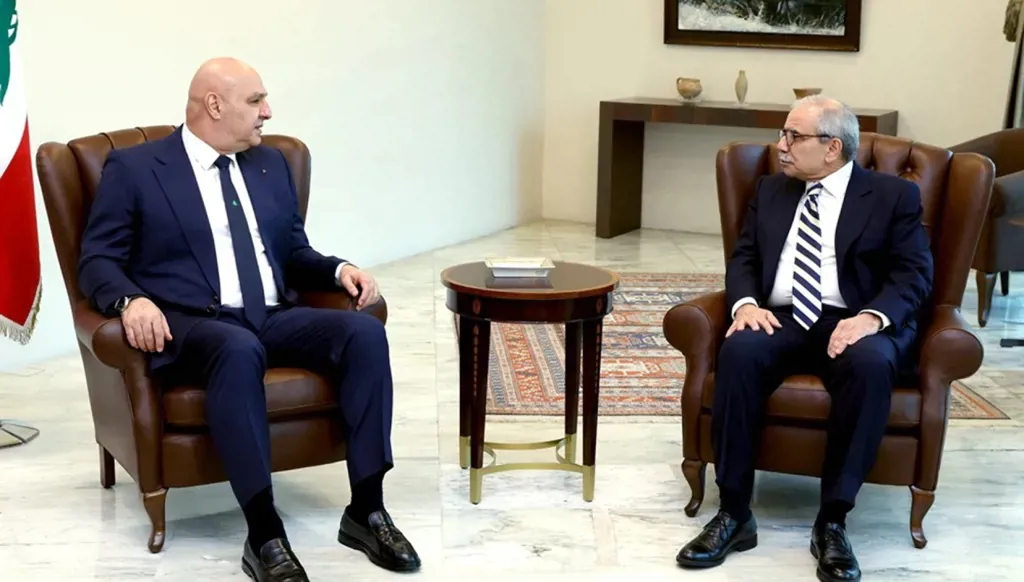


It was not surprising that political and diplomatic circles, both domestically and internationally, viewed the positions that were exceptional in their tone, nature, and bold content, indeed extremely bold, in the two strongest presidential responses issued simultaneously by President of the Republic General Joseph Aoun and Prime Minister Nawaf Salam, to the ongoing Iranian insolence in violating Lebanese reality and exploiting the escalating war on its territory. This in fact created an exceptional event by all national, sovereign, and diplomatic standards.
Although both President Aoun and Prime Minister Salam had previously criticized more than once Iran’s interference in Lebanon’s internal affairs and in matters of Lebanese sovereignty, the unprecedented level that appeared in each of their responses yesterday to the shameless interference of the Iranian Revolutionary Guard in attacking the agreement announced after the fourth round of Washington negotiations appeared as an immediate reassertion of the state’s sovereign position.
This position effectively nullified the impact of Iranian interference, which had led Hezbollah to automatically reject a ceasefire and what followed in terms of disabling the first effects of the Washington statement.
Thus, both President Aoun and Prime Minister Salam did not at all accept the Iranian attempt to overstep the state’s position and responded in a way that placed Tehran in an extremely uncomfortable position, regardless of how it may later justify itself, and also placed its arm Hezbollah in a position of repeated exposure, as it once again prevents its base, the south, and Lebanon as a whole from exiting the cycle of war it has caused.
From this perspective, the two presidential stances yesterday acquired decisive and pivotal significance, granting the state strong external credibility in firmly defending the option of negotiations, especially after this option had begun to achieve a real breakthrough in the latest round of Washington talks.
What also drew attention was the announcement of a visit today by the Commander of the Lebanese Army, General Rodolphe Haykal, to Islamabad in response to an official invitation he received from the Pakistani Army Chief Asim Munir, who plays a key role in his country’s mediation in the file of US Iranian negotiations.
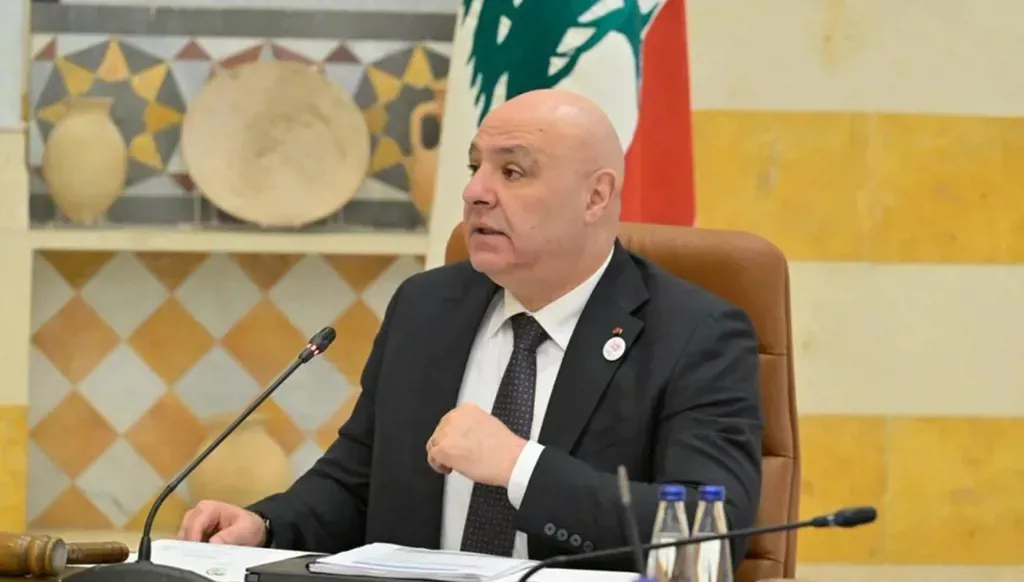
President Aoun interviewed by CNN
In a decisive and firm stance, President Joseph Aoun affirmed that the Lebanese “are fed up” with the war between Israel and Hezbollah, stressing that Lebanon cannot remain a field for settling regional scores or a bargaining chip in international negotiations.
In an interview with CNN, Aoun said that “Iran is not trying to help Lebanon,” considering that “the Lebanese are the ones paying the price for the conflicts taking place in the region.”
He added that “Lebanon’s interests do not align with Iran’s interests, and using Lebanon as a pressure card in negotiations with the United States is unacceptable.”
In a direct message to the Iranian Revolutionary Guard, Aoun said: “Lebanon is not your country,” affirming his rejection of any foreign interference in Lebanese decision making or in matters of war and peace. The President also stressed that the Secretary General of Hezbollah, Sheikh Naim Qassem, “does not represent the Lebanese people.”
Regarding negotiations with Israel, Aoun pointed out that “Lebanon has gone through difficult negotiations,” considering that “the recent agreement could open the door to a just and lasting peace if it is handled in a way that preserves Lebanon’s interests and sovereignty.”
He emphasized that “Hezbollah must understand that there is no option except sitting down and negotiating, and no path except through negotiations and diplomacy.” He declared that “the state of hostility between Israel and Lebanon must end forever.”
PM Salam: Iran must " have mercy on our South"
At the same time, Prime Minister Nawaf Salam addressed a message to all Lebanese, calling on them “to apply reason and to prioritize Lebanon’s interest and the interest of its people above any other interest. Lebanon must not remain a arena for others’ wars, nor should the south and its people pay the price of decisions over which they have no control. Our position is clear: no war may be fought in our name without asking us, and no decision of war or peace may remain outside our state.”
He announced that “thanks to the efforts of the Lebanese state, the efforts of our Arab brothers, and with American understanding, we succeeded in reaching an understanding on a ceasefire in Lebanon. However, the Lebanese were surprised that the Iranian Revolutionary Guard was the first to reject it, before any other party."
"This is further confirmation that this war is not our war, and that it is not being fought for us, but on our land and at the expense of our people. Thus, the south and its people once again pay the price of a decision they did not make and a war that is not theirs.”
Salam continued: “If I were to address Iran with one word, it would be to have mercy on our South and to stop treating it and its people as merely a bargaining chip to improve the terms of its negotiations."
"We are the owners of a homeland that refuses to become a mailbox for others’ messages or an open battlefield for their wars. Lebanon is not a card on anyone’s table, and the south is not a reserve front for anyone.”
It is noted that Salam delivered a speech during the launch of the second urgent humanitarian appeal for Lebanon conference held yesterday at the Grand Serail, aimed at securing additional funding for Lebanon amounting to 331.5 million US dollars, in support of 1.4 million people, bringing the total funding required under the urgent appeal until the end of August this year to 639.9 million US dollars.
Alongside Salam attended the UN Resident Coordinator Imran Riza, ambassadors of donor countries, and representatives of international organizations and UN agencies.
Berri and Jumblatt comment on ongoing negotiagtions
In light of these exceptional presidential positions in terms of content, tone, and significance, a major contrast emerged regarding the position and stance of Speaker of Parliament Nabih Berri, who issued a statement expressing reservations about the Washington statement, while hinting at what might be acceptable to him.
He said: “Instead of this hybrid agreement, we could have read something positive at the beginning of the text if it had referred to a ceasefire unconditionally on land, sea, and air, without demolishing everything that exists. (But it was rigged by adding a total ceasefire by Hezbollah, as well as the evacuation of all its elements from south of the Litani.) It could also have been read positively if it had referred to (withdrawal beyond the occupied borders), but it was rigged (with experimental zones without the entry of any active parties!!!??).
To avoid prolonging the matter, I agree on the following:
1. The ceasefire is understood to be complete and comprehensive without any conditions on land, sea, and air, and without bulldozing or destroying everything that exists.
2. Hezbollah’s withdrawal from south of the Litani in parallel with the Israeli withdrawal from the areas it occupied.
The rest of the text is unjust and not worth mentioning.”
The position of the former leader of the Progressive Socialist Party, Walid Jumblatt, was not far from Berri’s stance. He wrote on his “X” account: “In the vocabulary of negotiation, the ultimate goal of the negotiation process must be clearly defined, and beware of falling into ambiguity and contradiction as stated in the joint US-Lebanese statement, which could take us into a path similar to Oslo, meaning negotiation for the sake of negotiation, while the south, its heritage, history, and people would be lost and forgotten.”
Call between President Aoun and Saudi Crown Prince
In the context of developments related to the negotiations, it is noted that President Joseph Aoun discussed the general situation in Lebanon and the region with Saudi Crown Prince Mohammed bin Salman during a phone call yesterday afternoon, in light of the current developments.
President Aoun thanked the Crown Prince for Saudi Arabia’s support for Lebanon in all fields, particularly for helping to calm tensions and to put an end to the escalation taking place in Lebanon.
Bin Salman reiterated the Kingdom of Saudi Arabia’s support for Lebanon, its commitment to its sovereignty, independence, and territorial integrity, and its continued efforts to alleviate the suffering of the Lebanese people.
Israeli strikes continue on the South
On the field level, the situation remained unchanged and continued to be highly tense, as Israeli evacuation warnings and airstrikes persisted. Strikes and attacks targeted the city of Tyre and the towns of Al-Ghandouriya, Touline, Qalaouiyah, as well as the town of Deir Al-Zahrani in the Nabatieh district in the south.
Israeli artillery shelling at dawn also hit the surroundings of Burj Qalaouiyah, Deir Kifa, Kfar Reman, and Nabatieh Al-Fawqa, as well as the outskirts of Shoukin and Mayfadoun.
Israeli aircraft also carried out raids on Shoukine, Aaba, Nabatieh, and Haboush, targeting a motorcycle. In the morning, Israeli army spokesperson Avichay Adraee issued an urgent warning to residents of the towns of Arnaya (Arnaaba), Anqoun, and Kfar Fila, calling for immediate evacuation.
Later, he issued another urgent warning to residents of Sarafand, Teffahta, Al-Babliyah, Qaaqaiyat Al-Snoubar, Al-Marwaniyeh, and Al-Saksakiyeh, ordering them to evacuate immediately.
An Israeli strike in the vicinity of Jabal Amel Hospital caused extensive damage to the Audi Bank building and resulted in injuries to 12 civilians with moderate and minor wounds, who were transferred by Civil Defense teams to Jabal Amel Hospital.
Civil Defense also announced the deaths of five people, including a paramedic, and one injury following an Israeli airstrike on the town of Zibdin.