

How has the 2023 War reshaped Israel’s identity?
How the longest and most complex conflict since 1948 may be reshaping Israel’s political and ideological future.



 Messenger
 Whatsapp
 Threads
 Email
Email
 Print
Print
 X
X
 Facebook
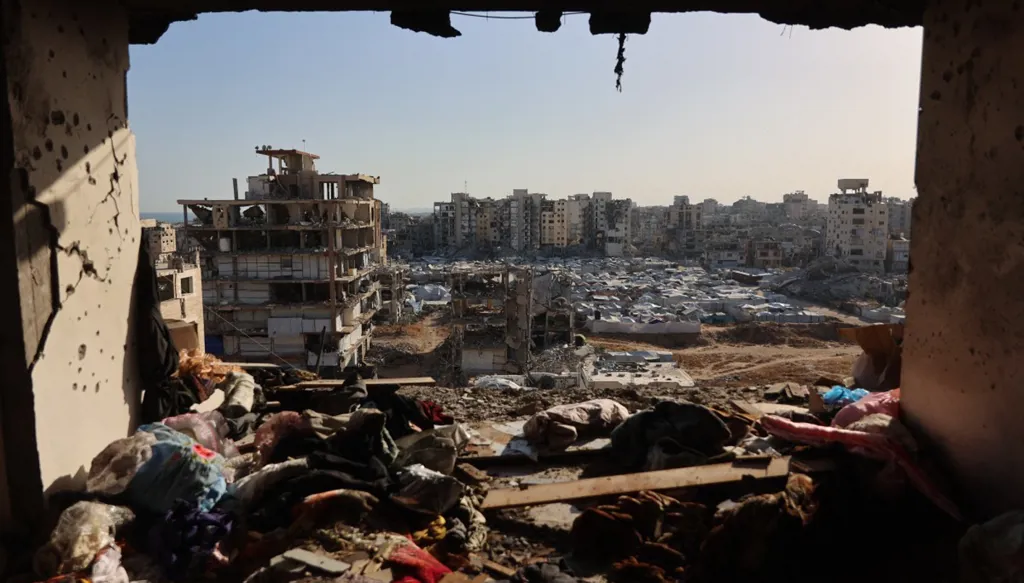


The 2023 war has become the longest Israel has waged since its establishment in 1948, and the most brutal, expansive, and complex, due to the multiplicity of its parties and the intertwining of its forms—between nearby and distant wars, and between regular and irregular warfare. It is also among the most impactful conflicts in the Middle East, perhaps second only to the 1948 war.
In addition to all the above, this war has become the third foundational war in the history of this state in the region, after the first foundational war, which led to the establishment of Israel in 1948 at the expense of the Palestinians, and the second war in 1967, which led to the expansion of this state into Syrian and Egyptian territories, and its domination over the entire Palestinian land from river to sea.
A People Sacrificed at the Altar of Another People’s Catastrophe
The Zionist movement, and later Israel, established or justified the first war as a compensation for Jews who were victims of the Holocaust, even though the Zionist project began before World War II and before the rise of the Nazis in Germany, several decades earlier. However, no crime can authorize or justify another crime, especially against another people, nor can one people’s catastrophe compensate for another’s disaster.
In the June 1967 war, Israel claimed to be a state surrounded by enemies seeking its destruction, asserting its legitimate right to self-defense, including occupying lands from other countries. In general, in all cases, Israel presented itself as a state under attack, as a democratic country and an extension of the West in the region, seeking sympathy and support from Western countries and societies.
What distinguishes the current war, ongoing for more than two and a half years, is that Israel has practically abandoned all its previous claims and no longer adheres to them, revealing itself as a powerful, arrogant state capable of facing multiple foes at once, unashamed of being portrayed as committing brutal genocide, and indifferent to its divergence from the West due to its colonial, racist, and exterminatory policies.
If the first war founded Israel in the image of Ben-Gurion and the Mapai Party (later called Labor), and the 1967 war established the second Israel—paving the way for the rise of Likud and the national and religious right in 1977 after the 1973 war—then the 2023 war may be founding a third Israel, different from its predecessors, or even contrary to them, by transforming into a state of nationalist and religious extremists.
Extremism Against the West Too?
It must also be noted that this extremism is not directed only against Palestinians and Arabs, but also against the West itself, which is now distancing itself from Israel’s policies, viewing it as a security, political, economic, and ethical burden.
Even within Israel, extremists are pushing toward making it a more religious state, over its secular identity, and prioritizing its nature as a Jewish state over being a democratic and liberal one, even for its own Jewish citizens.
The implication of this transformation is that Israel—established as a colonial, racist, religious, aggressive, and external state in the region, and unlike the natural formation of states in the world—is now revealing its deeper nature through its extremists, including toward secular and liberal Israeli Jews.
It is worth recalling that this trajectory had already begun before “Al-Aqsa Flood” in late 2023, through the efforts of the Netanyahu government, Smotrich, and Ben Gvir, in undermining the judiciary in what was described as a constitutional coup, aimed at enabling the government to dominate all authorities and transform Israel into a national and religious state for extremist Jews.
This confirms that extremism against Israelis parallels extremism against Palestinians, and the “flood” operation—regardless of how it is assessed—has merely accelerated these transformations within Israel, exposing them more than at any previous time. The core idea is that extremism and wars have shaped Israel’s history and defined its nature.