




 Messenger
 Whatsapp
 Threads
 Email
Email
 Print
Print
 X
X
 Facebook
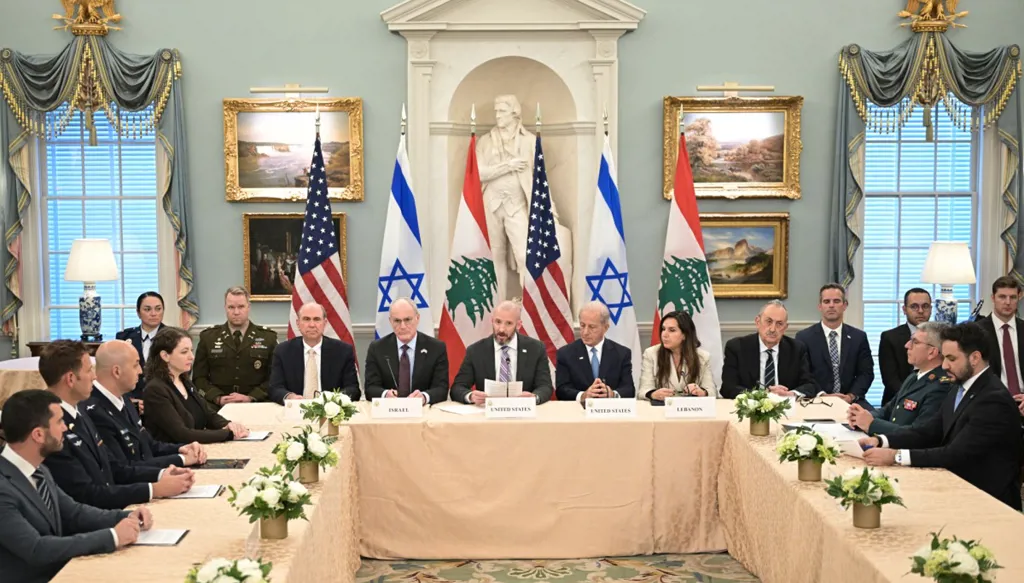


President Joseph Aoun has made a major historic leap forward by decisively choosing to lead the direct negotiations between Lebanon and Israel under US sponsorship.
This step, particularly following the understandings reached during the fourth round of negotiations at the US Department of State, requires considerable moral, personal, and political courage in light of the attacks directed at him by those whose interests are harmed by ending the war, moving Lebanon toward a practical peace, and, naturally, removing all weapons that exist outside Lebanese legitimacy.
This group, represented by Iran's proxy in Lebanon, namely Hezbollah, is prepared to burn Lebanon and everyone in it in pursuit of Iranian interests. The joint US, Lebanese, and Israeli statement issued at the conclusion of the fourth round of talks on Wednesday night in Washington identified Iran at the regional level and Hezbollah at the local level, in the section outlining the US position, which was not challenged by either the Lebanese or Israeli sides, as two parties hostile to Lebanon and the countries of the Middle East.
The mere inclusion of this position, without objection from Lebanon, which had been under Hezbollah's almost complete control for more than two decades, constitutes a historic achievement. It can be said that, regardless of the implementation of the joint trilateral statement, it is a historic document that will remain a foundational document for the next phase, even if Hezbollah, with Iranian support, succeeds in obstructing the implementation of the measures outlined in the statement.
A Clear Implementation of Resolution 1559
It is also extremely important to emphasize the rejection of attempts by any state (Iran) or non-state actor (Hezbollah) to influence Lebanon's future or undermine its sovereignty. The very fact that Lebanon signed a statement bearing Israel's signature at the end of the document, calling for the dismantling of non state armed groups and preventing their reconstitution, constitutes a clear activation of the historic and foundational UN Security Council Resolution 1559, arguably the most significant resolution since the creation of Lebanon in 1920.
Naturally, the affirmation that the Lebanese Army alone must exercise control south of the Litani River means that Hezbollah's disarmament remains the top item on the agenda of the three parties concerned.
Based on the above, it can be said that the step taken in Washington on Wednesday night was a major move toward containing Iran's agenda in Lebanon and stripping additional cards from the hands of its local proxy. It also helps keep the initiative in the hands of the Lebanese state, even if Hezbollah attempts to halt Lebanon's departure from the orbit of the "Resistance Axis," which is spearheaded by Hezbollah, at the expense of Lebanese blood, without distinction.
Hezbollah's position will determine its future
This is why it is essential to protect the achievement secured by President Joseph Aoun, Prime Minister Nawaf Salam, and the government majority that provides legitimacy to the negotiations and their outcomes. In practical terms, the trilateral position issued in the form of a joint statement represents another nail in the coffin of Iran's expansionist and aggressive project in Lebanon.
It also amounts to a declaration of Hezbollah's resounding failure to regain its former position of power and dominance, and points to certain domestic isolation should it continue to rebel against legitimacy and attempt to undermine the state building project and the return of all parties to the rule of law.
For this reason, the course Hezbollah chooses from this point forward will determine its future as a local political force seeking to break away from an external project that has dragged Lebanon, through Lebanese hands, into endless wars.
It is therefore important to carefully consider the information reported by Sky News Arabia at the time of writing, which stated that Hezbollah had informed President Joseph Aoun that it rejects the agreement and insists that any deal must begin with a complete withdrawal of Israeli Defense Forces troops from Lebanon, along with additional conditions.
This position, together with the statements of the Secretary General Naim Qassem, will further complicate the next phase and automatically increase the level of violence in the south, at least for the time being. It will also provide Israel with a new pretext to continue advancing deeper into southern Lebanon, potentially reaching the cities of Nabatieh and Tyre and destroying them completely. Nor should the extensive destruction across dozens of villages and towns be overlooked, as it will undoubtedly create a prolonged displacement crisis with serious repercussions for Lebanon's internal situation.
The Lebanese-Israeli agreement, brokered by the United States and based on removing Lebanon from Iran's regional sphere of influence, represents a golden opportunity.
Missing this opportunity, if it happens, would constitute a multifaceted disaster, most notably through the outbreak of internal conflicts, the continuation of the war with Israel alongside an expansion of the occupation, and the possibility of armed conflict along the eastern border with Syria, which views Hezbollah as a hostile force that threatens its national security.
However, we know Hezbollah well and, unfortunately, expect it to make the same mistake once again.
Disclaimer: The opinions expressed by the writers are their own and do not necessarily represent the views of Annahar.