

Two World Cups, two economic models: Qatar 2022 vs. North America 2026
From mega infrastructure spending to asset reuse, FIFA’s tournaments reveal a shift in how host nations invest in the world’s biggest sporting event.



 Messenger
 Whatsapp
 Threads
 Email
Email
 Print
Print
 X
X
 Facebook
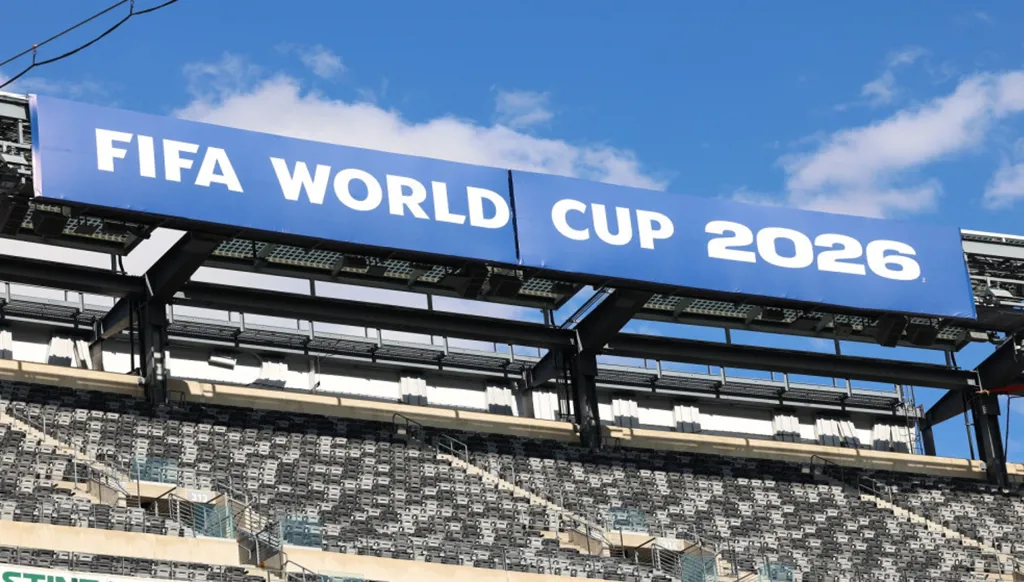


Less than four years ago, attention was focused on Doha, where Qatar hosted the most expensive World Cup in the tournament’s history. Today, as the 2026 World Cup approaches, set to kick off in the United States, Canada, and Mexico on June 11, the question is no longer about who will win the title, but about how much the economics behind hosting the world’s largest sporting event have changed.
The difference between the two editions is not limited to geography. While Qatar built a large share of the infrastructure required to host the tournament, North America is welcoming the World Cup with most of what it already needs in place, including stadiums, airports, hotels, and transport networks. As a result, comparing the two tournaments reveals an important shift in how countries spend on major sporting events.
Qatar: the tournament as a national project
In Qatar, the tournament was not just a football competition but part of a broader vision to reshape the economy and strengthen the country’s position as a global hub for tourism, business, and services. For this reason, the most widely cited estimates of spending range between 200 and 220 billion dollars over twelve years since the hosting rights were awarded in 2010.
However, these figures have sparked debate over what should be counted as the actual cost of the World Cup. The Supreme Committee for Delivery and Legacy stated that the cost of the eight stadiums reached about 6.5 billion dollars, while broader investments extended to projects including the Doha Metro, road networks, airport and port expansions, hotels, and urban development projects linked to Qatar National Vision 2030. From this perspective, Qatari officials argue that a large share of the spending was directed toward development projects that would have been implemented anyway. Nevertheless, the 2022 World Cup remains the most expensive in the tournament’s history by a wide margin compared to any previous edition.
North America: investment in existing assets
On the other hand, the picture for the 2026 World Cup looks very different. For the first time in the tournament’s history, three countries will host the World Cup together. In addition, participation will increase to 48 teams instead of 32, and the number of matches will rise from 64 to 104.
The main reason for the lower hosting costs is simple: North America does not need to build itself for the tournament. In the United States, which is hosting 11 of the 16 cities, no new stadiums will be built specifically for the World Cup. The tournament will rely on large stadiums already in use for American football, such as MetLife Stadium in New Jersey, which will host the final, as well as SoFi Stadium in Los Angeles and AT&T Stadium in Dallas.
This was confirmed by Bobby Goldwater, the academic director of the Executive Master’s Program in Global Sports Operations and Strategy at Georgetown University and the former head of the Sports and Entertainment Commission in Washington, in statements published by the university in May 2026. He said: “No stadiums were built specifically for the tournament, whereas in previous occasions other countries were forced to overspend on building facilities that were barely used after the World Cup, as happened in Brazil.” Goldwater also explained that FIFA’s motivations behind this choice are multiple: “FIFA expects record profits from this selection of host countries in North America, as this primarily benefits it financially, in addition to the fact that the three countries already have well-established infrastructure and world-class stadiums.”
Spending is focused on required FIFA modifications, as well as security, transportation, fan zones, and operational services, without a single unified national spending figure, since responsibility is distributed across different cities and states.
In Canada, the financial picture is clearer. According to a Parliamentary Budget Office report issued in May 2026, total government support amounts to about 1.066 billion Canadian dollars (about 777 million US dollars), of which 473 million Canadian dollars (345 million US dollars) comes from the federal government, while provincial and local governments cover about 593 million Canadian dollars (432 million US dollars). For a country hosting only 13 matches in Toronto and Vancouver, the average government spending is about 82 million Canadian dollars (60 million US dollars) per match.
As for Mexico, it is benefiting from its long experience with the tournament after hosting it in 1970 and 1986, and it relies on three main stadiums: Azteca in Mexico City, BBVA in Monterrey, and Akron in Guadalajara. Estadio Azteca, which will become the first stadium in history to host matches in three different World Cup editions, is undergoing renovation works estimated at around 150 million US dollars. The stadium was reopened on March 28, 2026, with a friendly match between Mexico and Portugal, after being closed for nearly two years for renovation work. Following questions raised about delays in the final stages of construction, officials announced that the stadium is ready to host the opening match on June 11.
Different Economic Models
This contrast in spending patterns reveals a deeper difference between two models of World Cup hosting. In the Qatari case, the tournament was part of a comprehensive national project aimed at accelerating economic and urban development. In North America, however, the World Cup is closer to an operational and investment project built on already existing assets, as the United States, Canada, and Mexico already have extensive networks of international airports, hundreds of thousands of hotel rooms, large-scale sports stadiums, and a highly developed tourism sector.
For this reason, experts expect the economic gains from the upcoming edition to be more closely tied to tourism, consumer spending, and services rather than construction and infrastructure development. A joint study by the World Trade Organization and FIFA, in cooperation with Oxford Economics, suggests that the tournament could add around 40.9 billion dollars to North America’s GDP, while supporting approximately 824,000 jobs.
However, Professor Rob Wilson, Dean of Education at the UK-based sports management institution UCFB and an expert in football economics, warns in statements published on the institution’s website against overstating tourism benefits. He bases this on what he calls the “substitution effect,” where “regular tourists choose not to visit due to congestion and high prices, while local consumers simply redistribute spending they would have made anyway.” He noted that the 2022 World Cup in Qatar attracted more than 1.4 million visitors, but the real question remains “whether these returns exceed the opportunity cost of hosting.”
Estimates of visitor numbers for 2026 vary widely, with Oxford Economics projecting around 742,000 additional international visitors to the United States alone, while broader forecasts for North America suggest more than six million visitors.
Even these figures do not resolve the long-standing debate over the value of hosting major tournaments. In almost every edition, opinions are divided between those who see the event as an opportunity to stimulate investment, tourism, and a country’s global image, and those who question whether such tournaments generate sufficient economic returns to justify public spending. Wilson points to the historical record, noting that “South Africa spent around 3.6 billion dollars hosting the 2010 World Cup, Brazil’s bill exceeded 11 billion dollars in 2014, and Russia surpassed that in 2018—and in most of these cases, the projected economic benefits did not hold up under later review.”
Goldwater adds a social dimension to the equation, noting that residents of host cities often have mixed feelings. While some welcome the attention and economic activity generated by the event, others fear traffic congestion, disruption, and the high costs of tickets and transportation. He cited New Jersey, where FIFA’s decision to remove public parking near MetLife Stadium triggered a wave of criticism.
Still, the comparison between Qatar 2022 and the 2026 World Cup remains particularly meaningful. The first used the World Cup as a tool to accelerate the building of a modern state, while the second tests the ability of an entire continent to leverage what it already has. As Wilson summarizes the equation: “Major events should not be designed to create economic miracles, but to amplify existing economic foundations. Countries with a clear legacy strategy may find in the tournament a transformative lever, while those chasing glamour without planning will find themselves facing an expensive spectacle.” Qatar built a country ready for the World Cup, while North America is adapting an existing infrastructure to accommodate it.
Five Key Facts
- Estimated World Cup related spending in Qatar 2022 reached around 220 billion dollars over 12 years since hosting rights were awarded in 2010, making it the most expensive tournament in history.
- The cost of the eight stadiums in Qatar did not exceed about 6.5 billion dollars according to the Supreme Committee for Delivery and Legacy, while the bulk of spending went to infrastructure and urban development projects.
- No new stadiums will be built specifically for the 2026 World Cup in the United States, as the tournament relies on existing sports facilities.
- Canada estimates its government spending on the tournament at about 1.066 billion Canadian dollars which is about 777 million US dollars to host 13 matches in Toronto and Vancouver, according to the Parliamentary Budget Office.
- A study by Oxford Economics in cooperation with FIFA and the World Trade Organization indicates that the 2026 World Cup could add about 40.9 billion dollars to North America’s GDP and support approximately 824,000 jobs.