

Lebanon–Israel talks signal major shift toward ceasefire framework and regional realignment
Washington negotiations mark a turning point as a draft agreement outlines Hezbollah withdrawal, expanded Lebanese state control, and a potential end to decades of hostility, amid rising regional tensions with Iran.




 Messenger
 Whatsapp
 Threads
 Email
Email
 Print
Print
 X
X
 Facebook
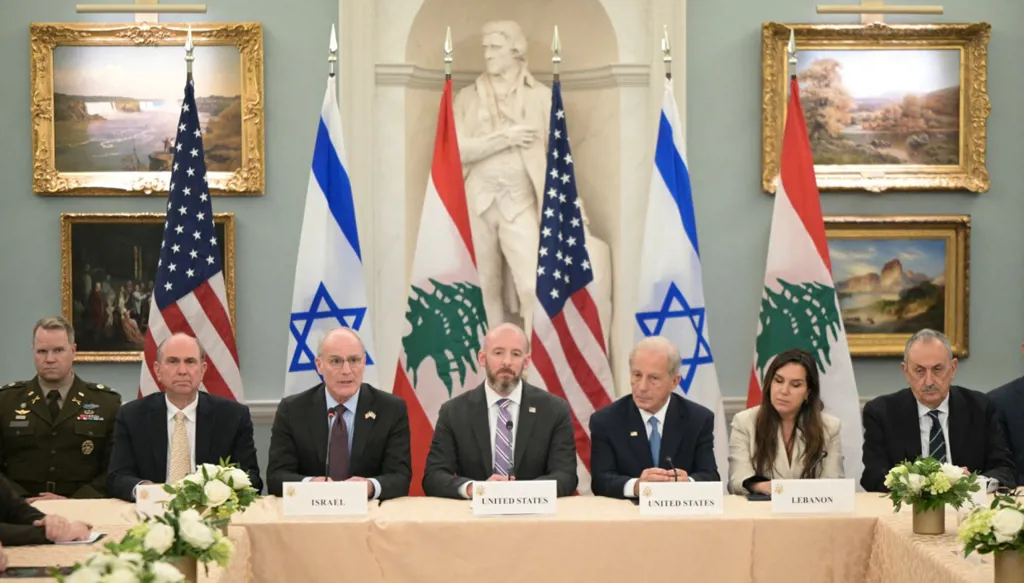


The statement issued by the U.S. Department of State following two days of direct Lebanese-Israeli negotiations in Washington, held as part of the fourth round of talks, carries significant implications that go beyond the mere advancement of a security and diplomatic framework between Lebanon and Israel.
It reflects a combination of converging positions and the emergence of a comprehensive ceasefire understanding, the introduction of pilot zones in which the Lebanese state asserts exclusive authority, and an explicit declaration of the end of a state of “hostility” between the two countries.
The importance of this development is expected to gradually crystallize into a “significant” new reality, not only because the outcomes announced after the fourth round mark an unexpected shift in timing and substance, but also because the statement explicitly confirms, from the Lebanese delegation’s side, the withdrawal of “Hezbollah” from south of the Litani River and the dismantling of its military structure.
This aligns fully with the Lebanese Council of Ministers’ decisions on the exclusive possession of arms by the state and the classification of Hezbollah’s military wing as operating outside the law.
A Fundamental Convergence of Interests
The progress in these negotiations can be seen as a predictable trajectory within the U.S. administration’s effort to achieve a meaningful breakthrough in the Lebanese file, particularly amid the prolonged and exhausting deadlock in the Iranian file.
The strategic significance of the four rounds of talks so far becomes clearer in the underlying convergence of interests among Lebanon, the United States, and Israel, aimed at separating the Lebanon–Israel negotiation track from the Iranian–American one.
The objective is to prevent Tehran from continuing to use the Lebanese arena as a bargaining tool and leverage point in both conflict and diplomacy.
In this context, the U.S. State Department statement on the fourth round, which also condemned what it described as Iranian recklessness in targeting Kuwait and other Gulf countries, adds further weight to the announcement of a framework agreement. It introduces a broader regional dimension that situates Lebanon’s position within its Arab identity and aligns its core interests with those of the Gulf Arab states in opposition to Iranian actions.
Ceasefire linked to Hezbollah's constraint
Despite these developments, it is not possible to overlook the risks that are likely to grow alongside increasing doubts about the implications of the statement and its operational components. These concerns begin with potential negative repercussions on “Hezbollah” and Iran.
The statement includes a strong condemnation of Iran and rejects any attempt to use the Lebanese file for its benefit, linking the comprehensive ceasefire to “Hezbollah’s” commitment as a preliminary step toward its full withdrawal from south of the Litani, thereby paving the way for an Israeli withdrawal and the extension of Lebanese Army authority.
As a result, both Hezbollah and Iran behind it are confronted with a heightened level of challenge and exposure, as they would bear the consequences of any attempt to obstruct the ceasefire or disrupt the post-conflict arrangements designed to fully restore areas in southern Lebanon that remain under Israeli occupation or influence.
A Sharp Blow to Iran
It is likely that neither Hezbollah nor Iran had anticipated that the Lebanese authorities—now described in Hezbollah’s media and press as the “American-Gulf-Israeli tutelage authority”—would reach such an advanced level of positions, leading to what is perceived as a shock to both Hezbollah and its backer.
Accordingly, Iran appears to have received a sharp blow in its strategic trajectory, as it continues to tie its path and interests to its leverage in Lebanon through its ally, its armed wing, and its political partner “Hezbollah,” even as it may attempt to counter or neutralize the impact through immediate escalation on the ground, accompanied by a wave of threats against what it calls a “treacherous” Lebanese state. It is in this context that the resilience and resolve of the state are put to a genuine test.
Disclaimer: The opinions expressed by the writers are their own and do not necessarily represent the views of Annahar.