

Barrack’s appointment and the future of U.S. strategy in Iraq
Washington’s new envoy signals reveal a coordinated push to reshape Iraq’s political and security landscape, curb Iranian influence, and redefine regional balance amid ongoing U.S.–Iran tensions.



 Messenger
 Whatsapp
 Threads
 Email
Email
 Print
Print
 X
X
 Facebook
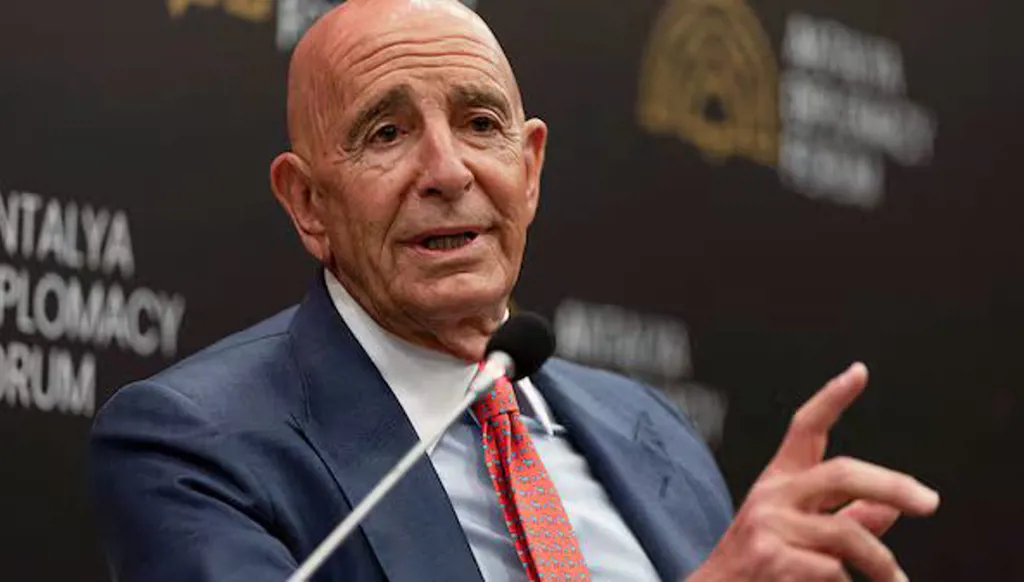


Tom Barrack was not far from Baghdad when most were surprised by U.S. President Donald Trump’s announcement appointing him as a special presidential envoy to Iraq.
After Mark Savaya was removed from the mission, Barrack became involved in Iraqi geopolitics and its extension into Syrian and Lebanese files. He landed in Baghdad, in what was described as a quasi-official assignment, to recalibrate the challenge that the Coordination Framework had posed to the United States when it nominated former Prime Minister Nouri al-Maliki, placing all political forces before a moment of choice between confronting the White House or accepting its vision without obstructing.
His early success, through his sharp approach and influential decisions, reflected in how he handled the formation of the government and moved quickly to resolve it, paved the way for this appointment.
It is meant to continue Trump’s approach, which has not yet been officially announced, focusing on dismantling the network of military, economic, and political factions and directly confronting Iranian influence in order to reclaim Iraq and reshape the balance of power in the Middle East.
Barrack's appointment reflects broader regional vision
Barrack’s appointment was not separate from the nature of the shifts in U.S. strategy toward the region after the war with Iran, with Iraq, Syria, and Turkey intended to become “a single, coherent American point of contact and influence, and the strategic axis on which any lasting stability in the Middle East must rest,” according to Barrack’s remarks about his upcoming mission as special envoy.
This reflects, in part, Trump’s vision for Iraq, and signals that the phase of integrating Iraq into what is known as the new Middle East is now being directly implemented, positioning Iraq as a pillar of stability rather than a platform used to threaten Gulf states or Western interests.
The appointment of Barrack coincides with U.S.–Iran negotiations, in which all cards are being used to secure gains. Therefore, the start of “Tom's” oversight of the Iraqi file is intended to preemptively remove this card from Tehran’s hands, preventing it from being used as leverage in negotiations over the nuclear file or ballistic missiles, especially given that there are no near-term indications of an end to the conflict or a move toward lasting peace between the two sides.
The timing of the appointment also coincides with the granting of confidence to the government of Ali al-Zaydi, giving the impression that it was carefully calculated to provide official backing to a prime minister favored by Trump, and to apply maximum pressure on any actor opposing U.S. directions from the Shiite Coordination Framework forces and Iran-aligned armed factions.
This would prevent them from placing obstacles in front of al-Zaydi and his plan to manage the state and dismantle the parallel state created by Iran’s allies to control state institutions and decision-making.
Confrontation with non-state militias
Barrack’s mission can be described as a “confrontation” with armed factions that refuse to disarm. However, it will also open a broad front over spheres of influence that may appear internal in their military and institutional dimensions.
Yet he will inevitably face a direct conflict with Iran, since the actual disarmament process and the shift from the ideology of weapons to the ideology of the state is not a decision that rests with these entities themselves, but rather with Iran’s Islamic Revolutionary Guard Corps, which created them and rejects any idea of abandoning the so-called resistance project.
For this reason, Barrack will confront a deep and complex Iranian influence that will work to undermine the objectives of his plan. This makes his mission a true test of Washington’s ability to reshape the balance of power within a fragmented Shiite political environment that does not trust it and suffers from dispersed decision-making.
This reality will push him to take firm measures against parties that continue to implement the Iranian agenda. His struggle with them is part of a broader war between Washington and Tehran. Moreover, Trump will accept nothing less than a complete victory in Iraq.
Disclaimer: The opinions expressed by the writers are their own and do not necessarily represent the views of Annahar.