

From revolutionary state to security state: How war is reshaping Iran's future
The conflict exposed the vulnerabilities of Tehran's strategic model while empowering the institutions built to defend it.



 Messenger
 Whatsapp
 Threads
 Email
Email
 Print
Print
 X
X
 Facebook
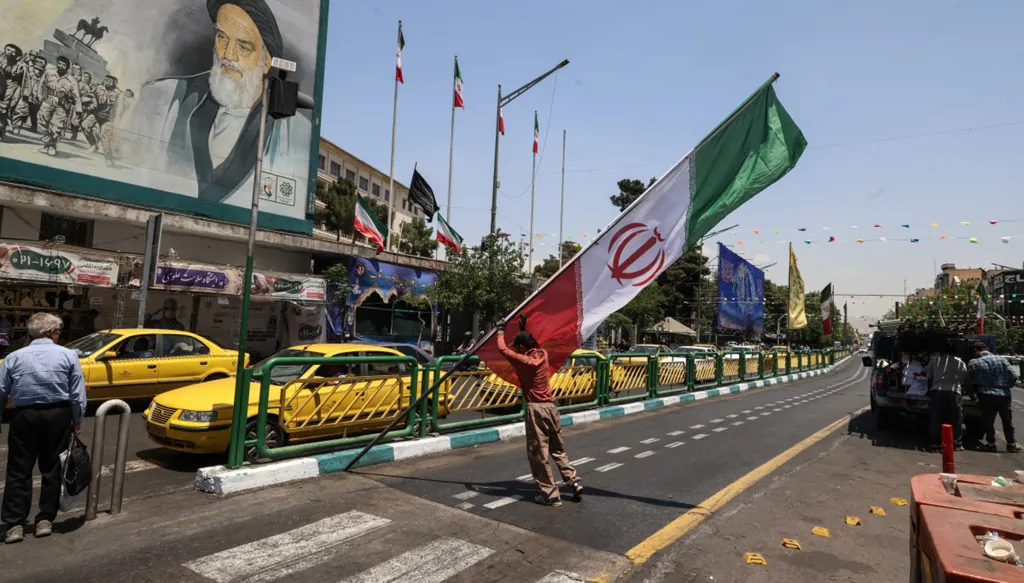


The war with Israel and the United States did not pave a simple path toward the collapse of the regime in Iran. Instead, it produced a far more complex contradiction: a weakened state, eroding legitimacy, and an increasingly hardened security apparatus.
The military strikes inflicted significant damage on Iran’s deterrence narrative, nuclear infrastructure, leadership credibility, and economic resilience. Yet at the same time, they provided the security-military establishment with a renewed opportunity to justify repression, intensify the nuclear challenge, expand economic control, and invoke national mobilization.
The central question today is not whether the Iranian regime has been weakened—it has, and perhaps irreversibly so. The more important question is what kind of transformation this weakness will produce.
The war exposed the fragility of Iran’s strategic model. This time, Mojtaba Khamenei's legitimacy was not established through overt clerical ceremonies suggesting a “divine mandate.” Instead, his appointment was effectively secured through the earthly power of the Revolutionary Guards. In this context, succession is no longer merely an internal transition; it has become a sign of profound change in the very center of power.
Nevertheless, Iran’s trajectory oscillates between two extremes. Beneath the surface, structural political divisions may bear fruit over the medium term. On the surface, however, the regime is reacting as many authoritarian systems do when faced with humiliation: tightening repression, restricting elite competition, redirecting resources toward security institutions, and reframing defeat as evidence of an existential siege.
In this sense, the military nuclear project is no longer a strategic luxury but the regime’s new line of survival.
This dynamic produces three outcomes:
First, the Supreme Leader becomes hostage to the legitimacy of dominance imposed by the Revolutionary Guards, intelligence agencies, the judiciary, and the Basij.
Second, the position of civilian political elites becomes increasingly precarious. Despite ideological rigidity, the civilian political establishment faces immense pressure to mitigate risks and stabilize a deteriorating economy, even as tensions intensify among clerical conservatives, Revolutionary Guard leaders, militant ideological networks, and corrupt economic interests embedded within semi-governmental institutions.
Third, while the facade of the regime remains intact, the internal balance of power shifts dramatically.
Constitutional symbolism, the Supreme Leader, the Assembly of Experts, and revolutionary slogans continue to exist on the surface. Yet these structures gradually become hollow shells as operational authority transfers—perhaps irreversibly—to military and intelligence institutions. Thus, the state weakens while the security apparatus strengthens and consolidates its grip.
Iran’s legitimacy crisis did not begin with the war, but the war has accelerated it. The 2024 Gamaan survey found that only about 20 percent of Iranians support the continuation of the Islamic Republic, while a broad majority favors a different political system.
The current legitimacy crisis operates on three levels:
The first is performance legitimacy: the regime promised security, yet failed to prevent strikes that deeply damaged its strategic national project, all while the economy contracted, inflation persisted, and pressure on resources intensified.
The second is ideological legitimacy. The regime’s identity has long been tied to triumphant resistance against Israel and the United States, making the current crisis not merely one of military capability but of political identity. Revolutionary rhetoric increasingly risks becoming an empty vessel.
The third is national legitimacy. While the American attack weakened the regime’s legitimacy, it simultaneously strengthened militaristic tendencies within society.
A Delicate Paradox and Possible Scenarios
Post-war polling conducted by the University of Maryland and CISSM showed that seven out of ten respondents believe Iran should increase its military capabilities, while only about a quarter concluded that Iran must make significant concessions because it cannot adequately defend itself. These findings reveal a delicate paradox: the regime can borrow national sentiment, but it cannot easily convert it into renewed ideological legitimacy.
With moderate confidence—given the opacity of Iranian elite politics and the volatility of the wartime environment—the interaction of these dynamics places Iran at the intersection of four overlapping scenarios over the next two years.
The first is a scenario of retreat and extremism, with an estimated probability of about 40 percent. In this path, the regime concludes that repression, nuclear latency, rearmament, and the revitalization of proxy networks are the only means of preventing future humiliations.
The second is a scenario of pragmatic security accommodation, resembling the post-1967 Arab model, with an estimated probability of about 30 percent. Here, military-security elites preserve the facade of the Islamic Republic while selectively de-escalating to stabilize the economy and prevent systemic collapse.
The third is a scenario of mass uprising, with a probability of about 20 percent. In this path, collapsing legitimacy, inflation, elite fragmentation, and coordinated protest movements break the regime’s enforced cohesion.
The fourth is a scenario of partial disintegration, with a probability of about 10 percent. Central authority weakens in border regions, creating space for rebellions, secessionist pressures, or forms of regional security autonomy.
In any case, Iran remains trapped in the nuclear snare. This creates a dangerous contradiction for both the region and Iran itself. If the regime seeks to preserve the nuclear option as its ultimate survival strategy, the consequences for the Iranian nation could be severe: additional military action, deeper sanctions, broader isolation, and the diversion of scarce resources away from state institutions, society, and economic recovery toward the singular objective of regime survival.
This trap may protect the regime in the manner that nuclear deterrence protects North Korea, but it exposes the Iranian nation, the state itself, and the broader region to profound risks. The regime may continue to survive by pushing the burden downward—managing subsidies, restricting imports, rationing resources, controlling the currency, suppressing labor unrest, and selectively distributing welfare.
The state retains operational capacity, while society grows poorer and more exhausted, and the civil state becomes increasingly fragmented.
What are the takeaways?
Perhaps the most accurate conclusion is that Iran’s future after this war does not open a direct path to collapse, but rather to an inevitable transformation of the regime’s structure. For ordinary Iranians, the most dangerous scenario is not the regime’s fall, but its survival through their sacrifice on the altar of resilience and resistance.
In this context, Trump risks confusing pressure as a tool with strategic objectives as an end. The priority should be changing the regime’s behavior, ensuring maritime security, and protecting Gulf infrastructure—not pursuing maximalist demands aimed at toppling the regime.
For the Arab Gulf states, Iran remains a reality, with both its weaknesses and strengths. Their interest lies in changing the regime’s behavior, not dismantling the Iranian state. This requires several parallel tracks.
First, any U.S.-Iranian arrangement should include enforceable guarantees concerning the Strait of Hormuz to prevent Iran from evolving into a desperate, fragmented, nuclear-armed state that threatens the Gulf and its economies.
Second, Gulf states should intensify efforts against commercial and financial networks linked to the Revolutionary Guards. This is a matter of national security, not a pathway to ideological escalation.
Third, channels of de-escalation with Tehran should remain open.
Fourth, while pursuing pragmatic de-escalation, Gulf states should continue supporting the stability of the Iranian state through clear, conditional, and well-defined relations.
The question that remains is whether rational and civilian forces in Tehran can seize this moment...