

The new U.S. approach to the Levant: Expanding the Syrian file from Damascus to Baghdad
Washington is reshaping its engagement in Syria into a broader regional framework linking Iraq, Turkey, and security, energy, and influence files, while Damascus seeks to turn this opening into economic gains through sanctions relief and reconstruction.



 Messenger
 Whatsapp
 Threads
 Email
Email
 Print
Print
 X
X
 Facebook
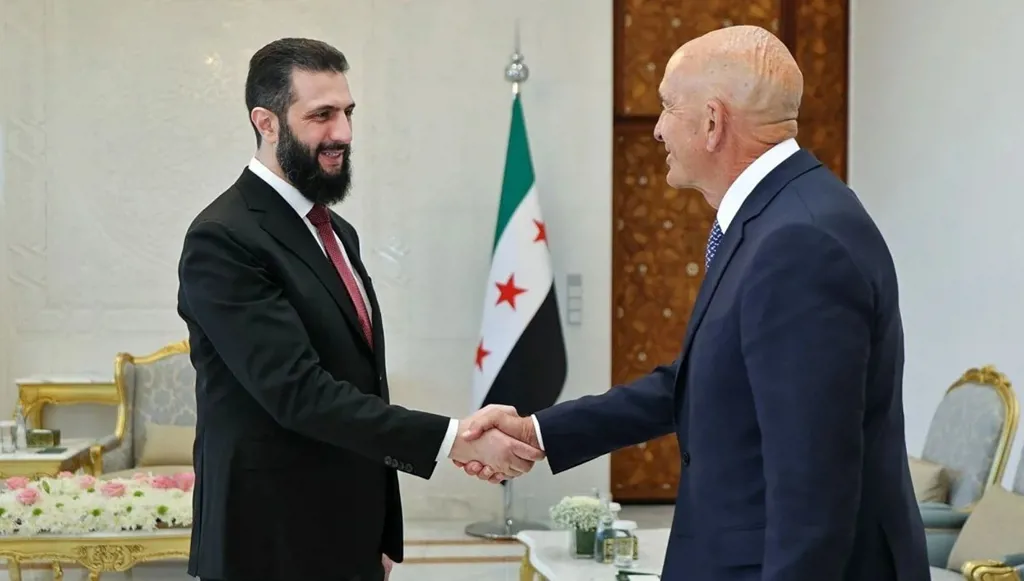


U.S. President Donald Trump has brought Tom Barrack back to the forefront of the Syrian file with expanded powers, in a move that places Syria within a new regional approach extending from Iraq and Turkey to the files of the Syrian Democratic Forces (SDF), ISIS, border security, energy, and Iranian influence.
The expansion of Barrack’s mission came just one day after Secretary of State Marco Rubio announced the end of his previous status as special envoy to Syria, before confirming that he would continue to play a leading role in both the Syrian and Iraqi files.
The swift transition from ending Barrack’s previous mission to appointing him as presidential special envoy to Syria and Iraq, while retaining his position as ambassador to Turkey, reveals the scale of the bet the Trump administration is placing on him to manage a new phase of Levant-related dossiers.
Sharaa push on sanctions
The first Syrian signal of the importance of this shift came through a phone call between President Ahmed al-Sharaa and Trump, placing the lifting of remaining sanctions and support for economic recovery at the top of the discussion.
This timing does not appear to be a mere protocol detail. Damascus interpreted Barrack’s appointment as a direct signal from the White House of continued U.S. engagement in the Syrian file, through a figure who enjoys Trump’s trust and has a margin of maneuver that extends beyond Syria.
In the Syrian statement, bilateral relations and political and security developments in the region were present in the call, but the economic dimension was the most prominent. Sharaa focused on lifting sanctions as a gateway to reviving the economy and attracting investment, in an attempt to define the priorities of the next phase from an economic perspective.
In contrast, Washington was redrawing Syria’s position within a broader security and political map extending from Iraq to Turkey.
Barrack has not presented himself since entering the Syrian file as an envoy managing a temporary crisis. After meeting Syrian Foreign Minister Asaad al-Shaibani in Ankara, he described Syria as an opportunity that must be seized. After his meeting with Sharaa in Damascus on May 16, he described it as a laboratory for a new regional alliance. This is language drawn from a vocabulary of political and economic engineering that Syria is intended to become part of.
From Damascus to Baghdad
The inclusion of Iraq within Barrack’s mandate provides another indication of the nature of this vision. The files of northeastern Syria are no longer separate from Iraq, whether in relation to ISIS, camps and detention centers, border security, or the future of the Syrian Democratic Forces (SDF). Iranian influence is also not measured within the Syrian arena alone, but through the geographical continuum that links Iraq, Syria, and Lebanon.
From this perspective, Sharaa’s call with Trump becomes more than just an economic request. Damascus understands that the U.S. administration is seeking to integrate it into a broader regional security framework, while it is trying to assert a different priority based on lifting sanctions, launching investments, and linking stability to economic growth.
However, the economy will not be separated from security in U.S. calculations. Opening the door to investment will remain tied to preventing the return of ISIS, integrating the SDF into Syrian state institutions, and reducing Iranian influence.
Iran also enters the picture from another angle. Washington, following the recent military confrontation with Tehran and the negotiations that followed, is seeking to limit Iran’s ability to reestablish its network of influence stretching from Iraq to Syria and Lebanon. In contrast, Turkey does not appear enthusiastic about Iran’s reduced influence becoming an opportunity for uncontrolled Israeli expansion in the region.
The new engineering of the Levant
Damascus finds itself facing a complex equation. It wants to benefit from U.S. openness and the lifting of sanctions, but at the same time it will face questions and pressures linked to security files over which it does not fully hold the keys. Turkey, given Barrack’s position in Ankara, will also remain central to the equation, whether in relation to border security, the SDF file, or broader regional balances.
Barrack’s rise cannot be separated from internal shifts within the Trump administration itself. The way his previous role was terminated and then reinstated in a presidential format reveals a clear overlap between the White House and the State Department, and between traditional diplomacy and the president’s personal channels.
The promotion of Michael Needham, Rubio’s former aide, to deputy national security adviser also gives the Secretary of State and his team additional influence within the decision-making process.
Thus, Barrack does not appear as an independent figure from institutions, nor as a traditional bureaucratic official within them, but rather as a bridge between the presidency, the State Department, Ankara, Damascus, and Baghdad, and as one of the architects of Trump’s new approach to the Levant.
In contrast, Damascus holds a different vision of priorities. It does not want to enter the White House only through the files of the SDF and ISIS, but through the gateway of the economy, reconstruction, and investment. In this context, the Syrian leadership views the lifting of sanctions as a starting point rather than a final reward, based on the belief that the stability demanded by Washington cannot be sustained without real economic recovery.
In conclusion, Barrack’s appointment does not appear to be a mere diplomatic reshuffle, just as Sharaa’s call with Trump goes beyond political courtesy. Washington is working to expand the geopolitical map of the Syrian file, while Damascus is trying to translate this opening into direct economic gains.
Between these two approaches, the features of the next phase will be defined, and whether Syria will become a gateway to a new regional order or a new arena for overlapping regional and international power projects.