

Lebanon’s crisis and the Arab state question: When slogans replace sovereignty
The Lebanese moment exposes a deeper regional struggle over the balance between ideology, institutions, and the authority of the state.



 Messenger
 Whatsapp
 Threads
 Email
Email
 Print
Print
 X
X
 Facebook
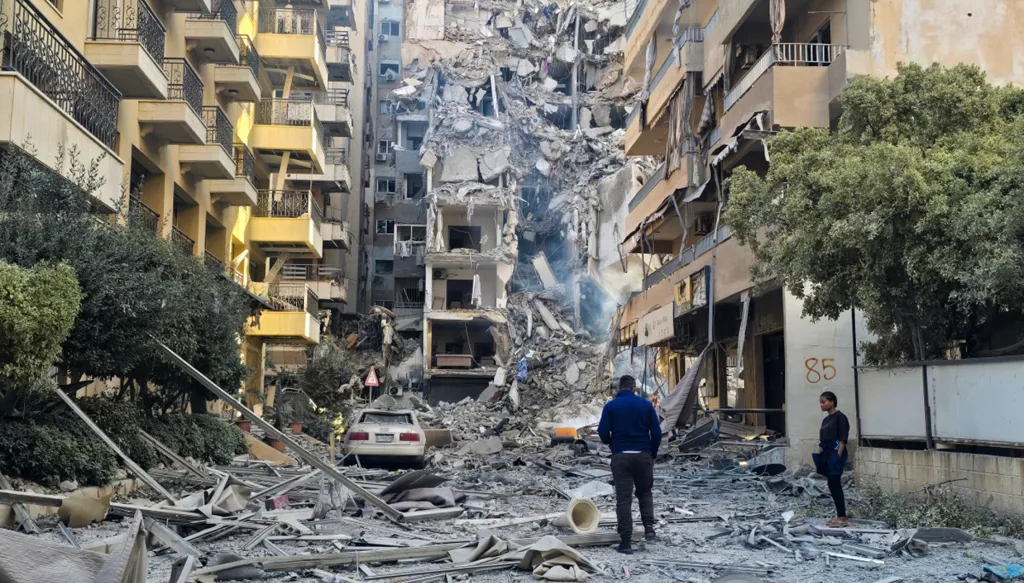


What Lebanon is undergoing is not merely a military, security, or political development concerning an Arab state facing accumulated challenges, but also a revealing moment of one of the greatest intellectual failures that has marked a significant aspect of Arab political consciousness in recent decades.
What is happening today in Lebanon goes beyond the limits of Israeli aggression, military conflict, or regional balances. It raises a question that many sectors of Arab elites have long evaded: what happens when ideology prevails over the state, when organization becomes stronger than institutions, and when slogans outweigh sovereignty?
The exceptional importance of the Lebanese case does not lie only in a state crisis, but also in its role as a practical test of a comprehensive political theory that has dominated the Arab public sphere for decades.
This theory was based on the assumption that major causes can compensate for state weakness, that the legitimacy of resistance can surpass the legitimacy of institutions, and that the multiplicity of centers of power does not necessarily constitute an existential threat to the national state.
It can be said that Egypt was among the first countries to recognize early on the dangers of this perception. Its confrontation with transnational organizations or groups competing with state institutions, most notably the terrorist organization “Muslim Brotherhood,” was not merely a security battle, but fundamentally a defense of the concept of the state itself.
For the national state, despite its crises or shortcomings, remains the only framework capable of preserving societal unity, sustaining institutions, and safeguarding national interests. By contrast, ideological and organizational alternatives, as experience has shown, may be capable of mobilization and rallying, but are incapable of building the state or ensuring its stability.
However, a wide sector of Arab elites chose a different path, whereby the political scene for decades was reduced to almost a single criterion: the stance toward Israel. This criterion gradually became a tool that grants political and moral legitimacy almost automatically, regardless of the nature of the actor or its impact on the state and society.
Within this approach, fundamental questions receded to the margins: who monopolizes weapons? Who holds the sovereign decision? Who bears responsibility for war and peace? And who protects state institutions when they are shaken?
Indeed, merely raising these questions was sometimes met with ready-made accusations, as if defending the state had become a position requiring justification, while questioning it became a form of political virtue.
Here lies the truth that some elites have long sought to ignore: the state is not a mere administrative detail that can be bypassed, nor just a bureaucratic structure that can be replaced at will. It is the vessel that protects the entire society. When the state weakens, everyone becomes more fragile, no matter how powerful organizations are or how elevated slogans may be.
The most telling paradox is that many voices that have offered unconditional political and moral support to various groups and organizations over the past two decades have not yet conducted a genuine reassessment of their past positions. We have not witnessed self-criticism proportional to the major changes the region has experienced, nor have we read a serious evaluation of the mistakes that contributed to producing this reality.
Instead, some of these elites have simply moved from one failed bet to another, from one collapsed narrative to a new one, without pausing to consider questions of intellectual or political responsibility.
More dangerously, some of these voices still attempt to reproduce old Arab divisions at a moment when the region requires the highest degree of strategic cohesion. Instead of focusing on strengthening Arab states against the repercussions of regional conflicts, some remain preoccupied with reviving the same polarizations that have exhausted the region over an entire decade. Here, the problem goes beyond political error to become a crisis of methodology in thinking.
The lesson Lebanon offers today is not about Lebanon alone, but about the future of the Arab national state itself. The experience has shown that slogans do not build institutions, that the justice of a cause does not compensate for state weakness, and that major conflicts are not managed through emotion and rhetoric, but through the capabilities of states, their institutions, and their strategic calculations.
The past years have proven that the strength of the state is not opposed to major causes, as some have claimed; rather, it is a condition for defending them. Sovereignty is not a political luxury, but the foundation of national survival.