

Lebanon war diplomacy deepens as Arab and global power struggle shapes negotiation tracks
Saudi-led contacts, competing US-backed channels, and regional exclusions signal a shifting and increasingly fragile diplomatic landscape amid escalating conflict.



 Messenger
 Whatsapp
 Threads
 Email
Email
 Print
Print
 X
X
 Facebook


Amid internal and external efforts to halt the fighting in Lebanon, a Saudi diplomatic movement has emerged on the communication front—one that is not new, as it began with the outbreak of the war and intensified alongside campaigns targeting Prime Minister Nawaf Salam. The Kingdom moved out of concern that these campaigns could evolve into internal unrest threatening civil peace or even target the premiership itself.
This engagement continued through periodic communications conducted by Prince Yazeed bin Farhan with President Joseph Aoun, Speaker Nabih Berri, and Prime Minister Nawaf Salam. Notably, no recent contacts have been recorded within presidential circles outside the general context or Eid greetings, according to political sources.
This move comes within a broader Arab landscape that includes Egypt, working toward halting the war, amid a growing conviction marked by frustration over what is seen as an Israeli monopoly over the Lebanese file, supported by the United States.
This discontent, particularly from the Saudi perspective according to political sources, stems from concern over Israeli Prime Minister Benjamin Netanyahu’s ability to achieve a victory in Lebanon at the expense of the country’s unity and sovereignty, while neighboring Arab states are either unable or even prevented from engaging in any peace process.
This extends to France and other European countries, which are also excluded from mediation or initiatives, amid Israeli pressure on Washington to limit direct negotiations to a bilateral track between Lebanon and Israel under American auspices alone.
Two Lines of Negotiation
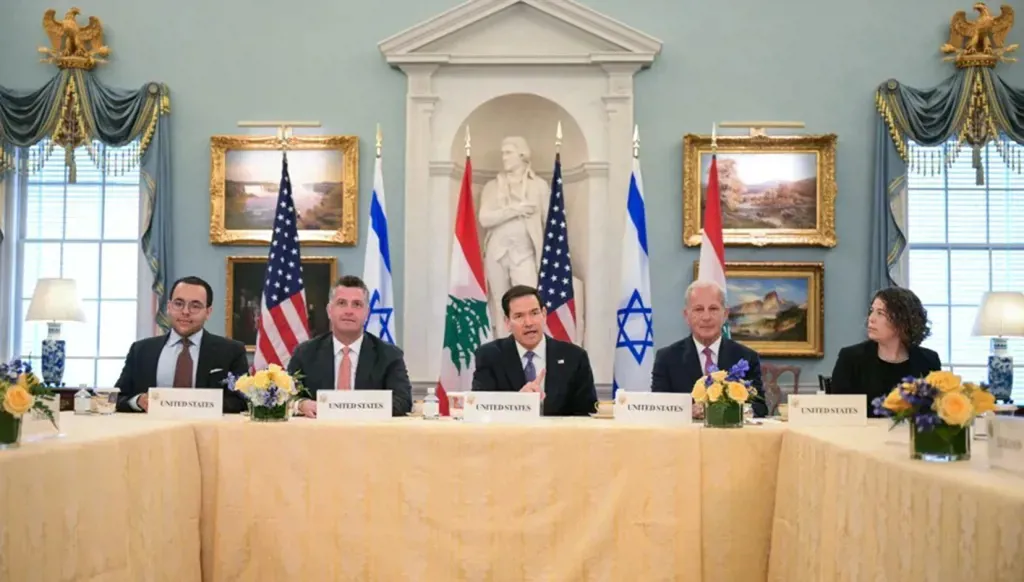
To reinforce this approach, two parallel negotiation tracks have emerged: one taking place in Islamabad between Washington and Tehran under Pakistani sponsorship, and another in Washington between Israel and Lebanon under American auspices.
In this context, Lebanon has lost both European and Arab backing that could strengthen its position in negotiations and provide it with leverage, as it cannot move toward a peace agreement with Israel without Arab sponsorship.
This situation, combined with the firm stance of the Speaker, who imposed a party veto on the Washington negotiations and insisted on no commitment to any ceasefire unless Israel commits first, coinciding with Israel expanding its targets to include Beirut’s southern suburbs, signals a highly dangerous phase.
It leaves no room for diplomacy and instead shifts the decisive factor to the battlefield, where confrontations have escalated from military clashes to a ground invasion that political efforts alone cannot halt.
Disclaimer: The opinions expressed by the writers are their own and do not necessarily represent the views of Annahar.