

The wrong president for the right war
The debate over a military confrontation with Iran highlights strategic gaps, disputed assumptions, and constrained political options in Washington, raising doubts that any available US leadership would pursue, or successfully sustain, such a war.




 Messenger
 Whatsapp
 Threads
 Email
Email
 Print
Print
 X
X
 Facebook
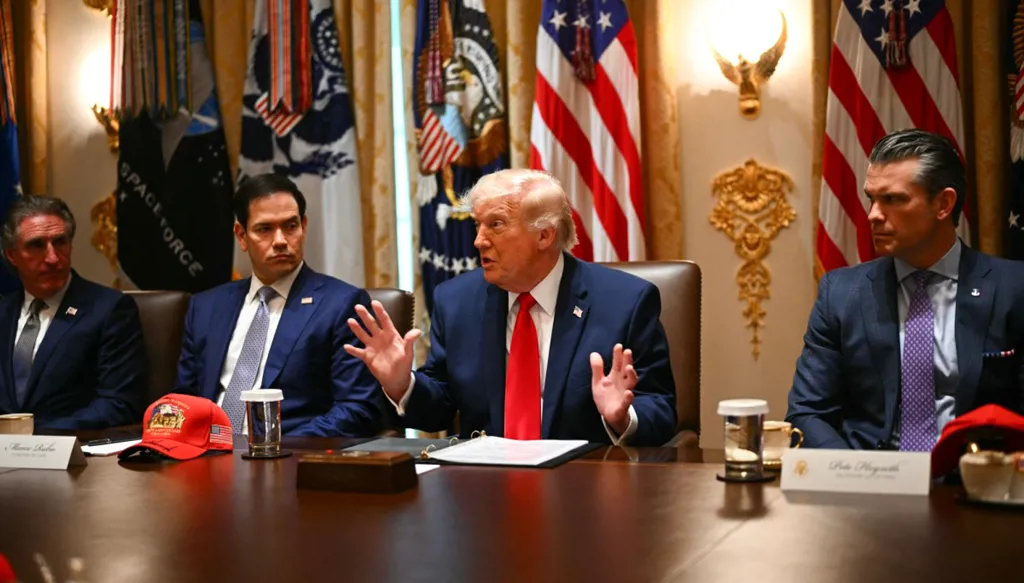


“The right war with the wrong president.” This is an expression used by writer Jake Wallis Simons in the British newspaper The Daily Telegraph. Simons began his article by expressing his support for President Donald Trump’s war on Iran, before later faltering.
According to his view, the regime is now confident of a strategic victory, the nuclear issue remains unresolved, and Washington is considering releasing funds in Iran’s favor.
According to Simons, there were two clear mistakes: the massive failure to design a plan that would counter the closure of the Strait of Hormuz, and Trump’s retreat from the Israeli idea of creating a corridor from Iraq for tens of thousands of Kurdish fighters to enter Iran and help ignite an uprising aimed at toppling the regime.
Trump and the two mistakes: between reality and analysis
The idea of supporting a land corridor did not have strong chances of success. According to what CNN reported from a US intelligence assessment, Kurds in Iran lacked the influence or resources to support an uprising against the government, while Iraqi Kurds were already hesitant to proceed with this plan, not to mention the Iranian opposition itself. It is not that Trump did not try to arm Iraqi Kurds. However, according to a previous statement he made, they seized the weapons and did not move. In any case, preparing such a plan would require a time frame measured in years rather than months.
Regarding the lack of preparedness for closing the Strait, the issue becomes more serious. One can first ask whether the administration did not expect that Iran would have the intention to take such a step, or the capability to carry it out. Most likely, the White House believed that the regime would not have enough time to close the Strait, because it would quickly collapse after a “decapitation” strike in the first hours of the war. This operation succeeded in assassinating Iranian Supreme Leader Ali Khamenei along with about 50 senior security officials. But this does not spare the United States from the question of whether it had anticipated the possibility that the assassination plan might fail, or even that the regime might not fall despite the assassination.
What is certain regarding preparations, or the lack thereof, is Trump’s announcement in mid-March that he was surprised by Iran’s targeting of Arab Gulf states. This happened despite the fact that one security official told Reuters that this targeting had always been present as a possible scenario within intelligence assessments.
Trump becomes realistic?
Many of Trump’s “fluctuating” positions stem from his unwillingness for the war to resume. This lack of desire will significantly constrain him. On the one hand, there is fear of a shortage of ammunition needed to continue the war. On the other hand, Trump has come to the conclusion that the United States has already used most of its military power against Iran, and that what remains may not change much in the near term. In a recent press briefing, a senior US administration official said that it is always possible to obtain more by escalating military steps, but the question is whether this is worth the cost. So far, in Trump’s view, it is not worth the cost, according to the same official briefing.
However, a major question remains about how the administration has reached a point where the remaining military options seem either weak in impact or fraught with risk. Could another president have avoided this predicament? Perhaps. But the answer will not please Simons and supporters of continuing the war. A “right president,” meaning one who carefully weighs options, might not even launch a war in the first place if he prefers to avoid risk. Cautious leaders would most likely avoid taking such a gamble.
Even under another traditional Republican president, war would be unlikely. Assuming the accuracy of a New York Times report last month, Secretary of State Marco Rubio, a Republican who is traditionally considered a “hawk” in foreign policy, appeared hesitant about the war. He preferred a campaign of maximum pressure instead of military action, and if war were inevitable, then destroying Iran’s military capabilities would be possible, unlike regime change, according to Rubio’s presumed belief.
“The right war with the right president”
In short, the option of “the right war with the right president” is closer to wishful thinking than to reality. The group of American figures who could reach the presidency do not support such a war, whether Rubio or former Democratic candidate Kamala Harris, as well as Vice President JD Vance. Former Vice President Mike Pence and former Republican candidate Nikki Haley might be firmer than Trump toward Iran, but the last election showed the limited chances of either of them reaching the White House.
For supporters of the war, Trump, with all his strengths and weaknesses, remains the best available option.