Lebanon draws red lines ahead of high-stakes U.S.-Israel military talks

Opinion 26-05-2026 | 08:57

Lebanon draws red lines ahead of high-stakes U.S.-Israel military talks

Beirut’s military leadership says no future arrangement is possible without a full Israeli withdrawal and a genuine ceasefire.


Lebanon draws red lines ahead of high-stakes U.S.-Israel military talks
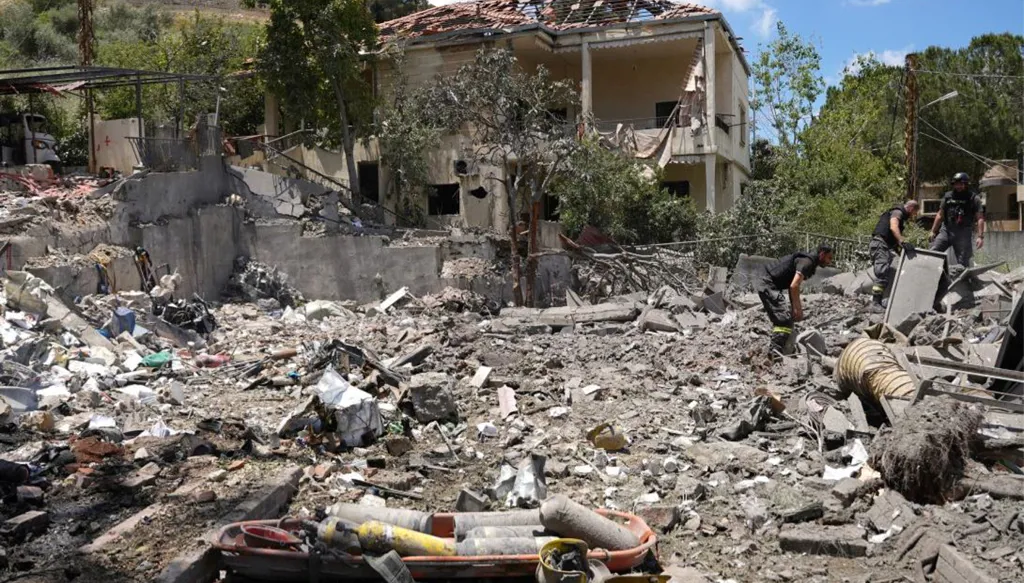
Destruction resulting from the targeting of a civil defense center in Nabatiyeh, southern Lebanon, on May 24, 2026. (AFP)
Smaller Bigger


The military meeting organized by the U.S. Department of Defense for delegations from the Lebanese and Israeli armies, according to the principles document prepared by the Lebanese army leadership, will merely continue the discussions previously held during the “mechanism” meetings in Naqoura. The Lebanese military institution sees no room for any future arrangements without a genuine ceasefire as a first step and a complete Israeli withdrawal from Lebanon.


Early on, Lebanese Army Commander General Rodolphe Haykal rejected, both in form and substance, a proposal publicly put forward by U.S. Secretary of State Marco Rubio calling for the creation of a Lebanese military force tasked with disarming “Hezbollah.” The proposal contradicts the unity of the Lebanese military institution, which cannot accept the existence of different types of brigades assigned according to specific missions.


General Haykal informed the preparatory committee for the Pentagon meeting that the Lebanese army considers it impossible to accept an American-Israeli proposal involving direct coordination between Lebanese military forces on the ground and Israeli military units to address issues that may arise.


General Haykal insists that any coordination must take place through the mechanism traditionally followed by the “mechanism” committee established under the 2024 cessation of hostilities agreement. At a minimum, he is open to communication with the Israeli army through the American mediator.


Disagreement on Concepts and Coordination Mechanisms


The deliberations that the military delegations will conduct at the U.S. Department of Defense are an integral part of the core negotiations taking place at the U.S. Department of State. They cannot, in any way, be considered parallel negotiations, as the military track is intended to clarify matters for the political and diplomatic level and provide definitions that would make ceasefire agreements solid and sustainable. Manipulating meanings is what leads each side to accuse the other of violating ceasefire agreements.


A military source involved in these negotiations cites examples highlighting the importance of agreeing on terminology, stressing the need to clearly define what constitutes an “imminent threat.”


From Lebanon’s perspective, such a threat would mean that the Israeli army detected, for example, a rocket launcher on Lebanese territory and found that the Lebanese army either refused or failed to confiscate it. If the launcher were being loaded with rockets, an attack could then be justified.


According to the source, this has not occurred in the past, as Israel has typically targeted what it considers priorities on its list without taking the surrounding circumstances into account and often without regard for the destruction caused to buildings or the resulting casualties.


The Lebanese army believes that this Israeli approach exploits ambiguity in terminology, potentially rendering every ceasefire agreement fragile.


The Lebanese army leadership believes that Israel’s underlying intentions can quickly undermine ceasefire agreements, while better intentions could help prevent potential disasters. A senior military source cites the example of Hezbollah launching six rockets at Israel on the morning of March 2.


According to the source, had Israel allowed the Lebanese army to pursue the launch sites and arrest those responsible, both Lebanon and Israel could have avoided the subsequent war. Following the launch of the six rockets from Lebanon toward Israel, the Lebanese army offered the “mechanism” committee the opportunity to act swiftly, but Israel ignored the Lebanese proposal and chose instead to launch a major military campaign.


According to accounts attributed to Lebanese Army Commander General Rudolf Haikal, it is impossible for Washington to accept this type of Israeli conduct. Lebanon, he argues, cannot be treated as “two Lebanons” — one represented by the state with which negotiations are held, and the other by “Hezbollah,” with which confrontation is pursued. Either the state bears responsibility, or there is no value in negotiations or in considering any form of coordination.


These positions may not satisfy the American and Israeli sides, but they represent the minimum that the army leadership considers necessary to achieve productive and positive outcomes.


Based on this, achieving positive results from the upcoming May 29 meeting may prove extremely difficult, but the talks could help clarify the line between what is possible and what remains unattainable.


Disclaimer: The opinions expressed by the writers are their own and do not necessarily represent the views of Annahar.