The battle over Lebanon’s south: Ceasefire talks and competing regional visions

Opinion 24-05-2026 | 16:58

The battle over Lebanon’s south: Ceasefire talks and competing regional visions

As Washington pushes for calm, diverging Israeli and Hezbollah strategies complicate Lebanon’s path toward stability.


The battle over Lebanon’s south: Ceasefire talks and competing regional visions
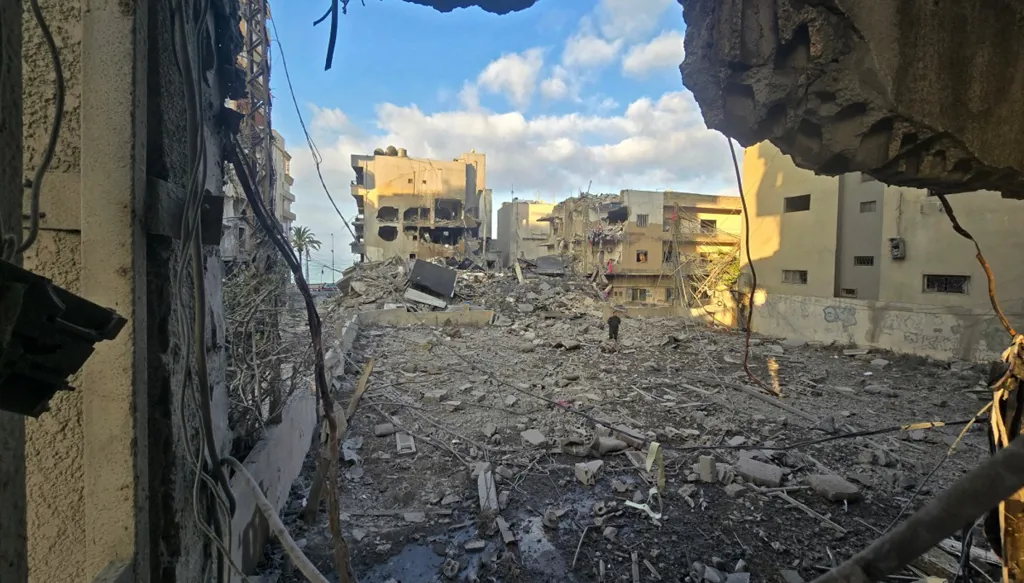
A man searches for his belongings amid the rubble of a building destroyed in an Israeli airstrike on the coastal city of Tyre in southern Lebanon (AFP)
Smaller Bigger


The United States sought, in the latest round of negotiations between Lebanon and Israel in Washington, to establish a ceasefire between Israel and Hezbollah, despite knowing that both parties continue to act as if the war between them is still ongoing and likely to persist.


For this reason, “the party” urges residents of the south who have taken refuge in Beirut, the “mountain,” and other areas to remain where they have sought asylum and not attempt to return to their towns and villages until their region is completely safe, which it is not today. It is perplexing that both the Israeli and Lebanese sides hold contradictory strategic readings of the situation in the area and are pursuing strategies with opposing objectives. It should be noted that their actions converge in undermining the Lebanese state and its efforts to resolve the conflict, disarm Hezbollah, and preserve the integrity and sovereignty of its territory.


The aforementioned convergence is not by chance. It reflects the “trap” in which the Lebanese state finds itself today, positioned between an enemy, Israel, which denies its sovereignty over its territory, and a “local” non-entity in name only, Hezbollah, which operates in a powerful and effective manner that renders the sovereignty of the Lebanese state incomplete. For Israel, its campaign has two main objectives. The first is to “cleanse” the towns and villages within what is referred to as the security zone in southern Lebanon of their predominantly Shiite population, causing their destruction and preventing residents from returning. In this way, Israel seeks to avoid negotiating with Lebanon over the future of the areas within the security belt or zone. Instead, the Lebanese and Israeli sides would focus on extending the ceasefire and facilitating the return of displaced people from areas adjacent to the border strip, and eventually initiating the reconstruction process.


There was considerable ambiguity last year when the U.S. envoy Tom Barrack proposed an economic zone plan in the border area. He attempted to present the proposal as a means of providing prosperity for residents of the border villages, rather than leaving them dependent on “Hezbollah.” It was reported that the formulation of this proposal took place between Barrack and Ron Dermer, a trusted advisor to Prime Minister Benjamin Netanyahu.


From the Israeli perspective, the strategy for the adjacent buffer zone in Gaza has included proposals to create areas to which residents deemed hostile to Israel may be prevented from returning. In this context, Barrack’s proposal serves two purposes: it acts as an incentive for local residents to make peace with Israel, while also potentially becoming a mechanism through which Israel could “filter” Lebanese citizens eligible to live in an area that would ultimately fall under its sovereignty.


Of course, extreme Israeli proposals are not surprising under Netanyahu’s leadership. One of his ministers has called for Israel to expand its borders northward to annex Lebanese land up to the Litani River. In any case, such statements can only undermine the diplomatic process in which Lebanon is fully engaged today, as long as Hezbollah remains armed and active, leaving Lebanon’s sovereignty incomplete.


From an Israeli perspective, the current campaign has two main goals. The first is ethnic cleansing in the cities and villages within what is called the security belt in southern Lebanon of their majority Shiite inhabitants. This will lead to their destruction. In this way, Israel tries to avoid negotiating with Lebanon over the future of areas within the security belt. Instead, the parties might discuss extending the ceasefire in areas outside the “strip,” the return of residents outside it, and finally reconstruction.


According to an Arab researcher at an American think tank, the extreme Israeli stances are not exceptional in a government led by Netanyahu. One of his ministers has proposed annexing Lebanese land between the Israeli border and the Litani River. However, such statements undermine the diplomatic process that the Lebanese government is fully engaged in today.

From Hezbollah’s perspective, Israel will not bring benefits to Lebanon, as it seeks to secure its disarmament and could potentially end up annexing the area in question. The second Israeli objective is to create conditions for a strong Lebanese movement against Hezbollah, whether through the government or at the popular level. Airstrikes targeting predominantly Shiite areas, as well as mixed communities, are seen as an attempt to incite tensions among different Lebanese sects against Shiites. It is also noted that a rapid disarmament of Hezbollah under Israeli pressure could endanger the Lebanese government and make the process of disarming the group extremely difficult.


On the other hand, the “party’s” strategy is to link the southern Lebanese front to the broader American-Israeli conflict with Iran, in line with Iranian national security thinking. It is said that Iran set this as a condition for a ceasefire in the Gulf and its war with the United States. Whether this is accurate or not, Hezbollah is hoping for two things. The first is an agreement similar to the April 1996 Understanding, limiting the fighting between Hezbollah and Israel to Lebanese areas occupied by Israel. The second is to allocate any funds Iran may decide to provide to Lebanon after the war ends toward the reconstruction of destroyed Shiite areas. Negotiations could also lead to an understanding among Saudi Arabia, Turkey, Pakistan, and Egypt, and the formation of a front against Iran by these countries.


They are concerned about Israel’s regional dominance, backed by the United States. This could provide significant relief to Hezbollah while undermining the authority of the Lebanese state. In short, the Lebanese government must avoid making unilateral concessions to Israel, as this could help Hezbollah reorganize its position within Lebanon. At the same time, prolonged Israeli occupation of southern Lebanon or parts of it would give Hezbollah a renewed role and allow it to restructure its conditions and influence in the country. Lebanon must define its own negotiation terms with Israel and keep the process independent from any regional bloc opposed to Israel.


Disclaimer: The opinions expressed by the writers are their own and do not necessarily represent the views of Annahar.