Cuba at the center of escalating U.S. pressure, sanctions, and regional rivalries

Opinion 24-05-2026 | 09:33

Cuba at the center of escalating U.S. pressure, sanctions, and regional rivalries

Tensions between the United States and Cuba are escalating as sanctions tighten, deepening the island’s economic and humanitarian crisis amid growing regional concern.


Cuba at the center of escalating U.S. pressure, sanctions, and regional rivalries
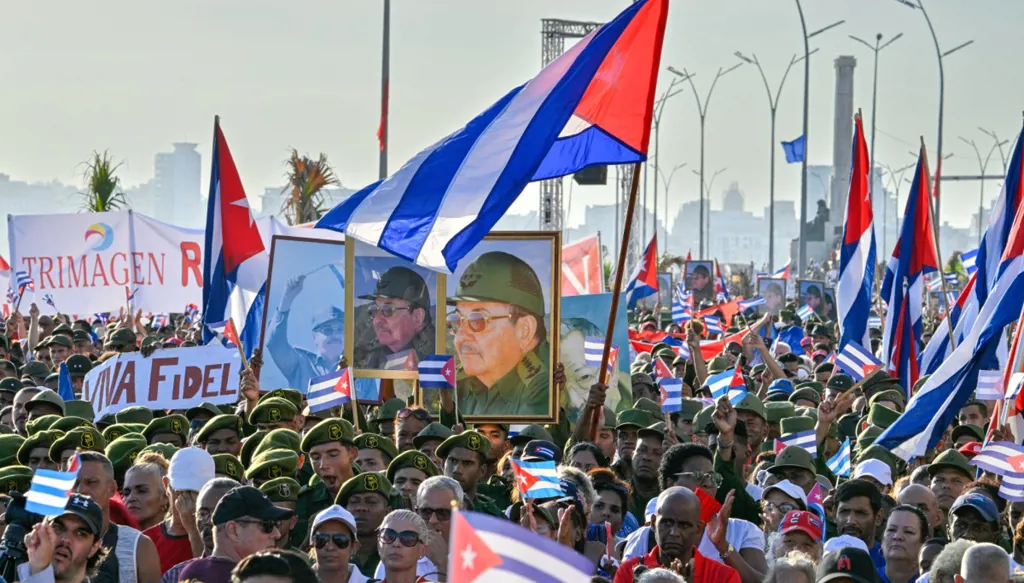
A rally supporting former Cuban President Raúl Castro in front of the U.S. embassy in Havana on May 22, 2026 (AFP)
Smaller Bigger


The American campaign against Cuba is escalating; the oil embargo imposed on the island, which is 145 kilometers from the coast of the American state of Florida, has plunged Cuba into a severe humanitarian crisis, causing frequent power outages across the country, leading to rare protests, school and university closures, and hospitals struggling to treat patients.


Meanwhile, as the U.S. aircraft carrier “Nimitz” and its strike force entered the Caribbean amid tensions with Cuba, federal prosecutors indicted former president Raúl Castro (aged 94), brother of Cuba’s historic leader Fidel Castro, on charges of murder. Cuban President Miguel Díaz-Canel stated that the American decision aims to “add more to the fabricated file to justify the folly of military aggression against Cuba,” while Russia and China condemned this action.


Is Cuba next?


It is known that after U.S. special forces allegedly kidnapped Venezuelan President Nicolás Maduro during “Operation Absolute Resolve” on January 3 last year, U.S. President Donald Trump boasted that “Cuba is next.”


U.S. Secretary of State Marco Rubio, of Cuban descent, is leading a campaign for regime change in Havana. He considers the relinquishment of power by President Miguel Díaz-Canel a prerequisite for lifting the oil embargo and providing much-needed basic assistance to the country.


Rubio is considered one of the strongest opponents of Chinese influence in South America, which the United States regards as its “backyard,” arguing that Washington should be the sole power of influence in the Western Hemisphere, in line with the “Monroe Doctrine” dating back to 1823, named after then U.S. President James Monroe, who called for the removal of European influence from the region and placing it under American dominance.


Today, there is no European influence in Latin America that competes with the United States. Instead, there is Chinese influence through billions of dollars in Chinese investments in several countries in the region, including Venezuela, Cuba, Bolivia, Panama, and Guatemala, among others.


After the “Operation Steadfast Resolve” in Venezuela and the assumption of power by Nicolás Maduro’s deputy, Delcy Rodríguez, who expressed a willingness to cooperate with American demands and redirect the country’s oil sector toward American companies, U.S. President Donald Trump pressured Colombian President Gustavo Petro to reverse his anti-U.S. stance and, after initial reluctance, agree to accept undocumented migrants detained by U.S. immigration authorities and deported from the country.


However, Cuba’s story does not begin with Trump. Its opposition to the United States dates back to 1962, when the U.S. imposed comprehensive sanctions on the island following the Cuban Missile Crisis, which brought the two superpowers of the time to the brink of a direct nuclear confrontation. The crisis erupted after CIA-backed Cuban exiles attempted to invade southern Cuba in an effort to overthrow Fidel Castro’s communist government, an event known as the Bay of Pigs Invasion.


Simmering hostility


Fidel Castro, alongside Argentine Che Guevara, led a revolution in Cuba that overthrew the U.S.-backed dictator Fulgencio Batista in 1959. Since then, hostility between Cuba and the United States has intensified.


Former U.S. President Barack Obama, however, sought to open a new chapter in relations with Havana, making a historic visit to Cuba in March 2016 and laying the foundation for normalizing relations between the two countries after half a century of hostility. When Donald Trump succeeded Obama in 2017, he dismantled all bridges of rapprochement with Havana and reimposed the sanctions Obama had eased. President Joe Biden, during his term from 2021 to 2025, did nothing to reconnect with the island.


However, Trump seeks to complete what he started in his first term, aiming to change the regime in Cuba “the Venezuelan way,” meaning without extensive military involvement, especially after faltering in the Iran war.


Trump resorts to tightening the embargo and sanctions on Cuba, considering it an “exceptional threat” to U.S. national security. Cubans live with the constant fear of an American invasion of the island at any moment, while the Cuban government expresses its readiness for dialogue, while also asserting its determination to defend the island.