

US sanctions and Lebanon–Israel talks advance in parallel escalation
As Washington tightens sanctions on Lebanese political and security figures linked to Hezbollah and its allies, diplomatic and military coordination tracks with Israel move forward amid mounting pressure to reshape Lebanon’s security landscape.



 Messenger
 Whatsapp
 Threads
 Email
Email
 Print
Print
 X
X
 Facebook


“This is only the beginning. And anyone who still protects this terrorist organization, cooperates with it, or in any way undermines Lebanon’s sovereignty must realize that they will be held accountable. A stable, secure, and independent Lebanon requires the full disarmament of Hezbollah and the restoration of the Lebanese government’s exclusive authority over security affairs throughout the entire country. The United States affirms its readiness to assist the Lebanese people and the Lebanese government in charting a path toward a better future, one that is more peaceful and prosperous.”
This is how the US Department of State, which is hosting the direct Lebanese–Israeli negotiations, commented on the sanctions imposed by the Office of Foreign Assets Control (OFAC) of the US Treasury Department on nine figures from the army, the General Security, the Iranian embassy, and the Amal Movement and Hezbollah. The individuals are: Mohammad Abdel Muttalib Fanoush, Hassan Fadlallah, Ibrahim al-Moussawi, Hussein al-Hajj Hassan, Mohammad Reza Sheibani, Ahmad Asaad Balbaki, Ali Ahmad Safawi, Brigadier General Khodr Nassereddine, and Colonel Samir Hamadeh.
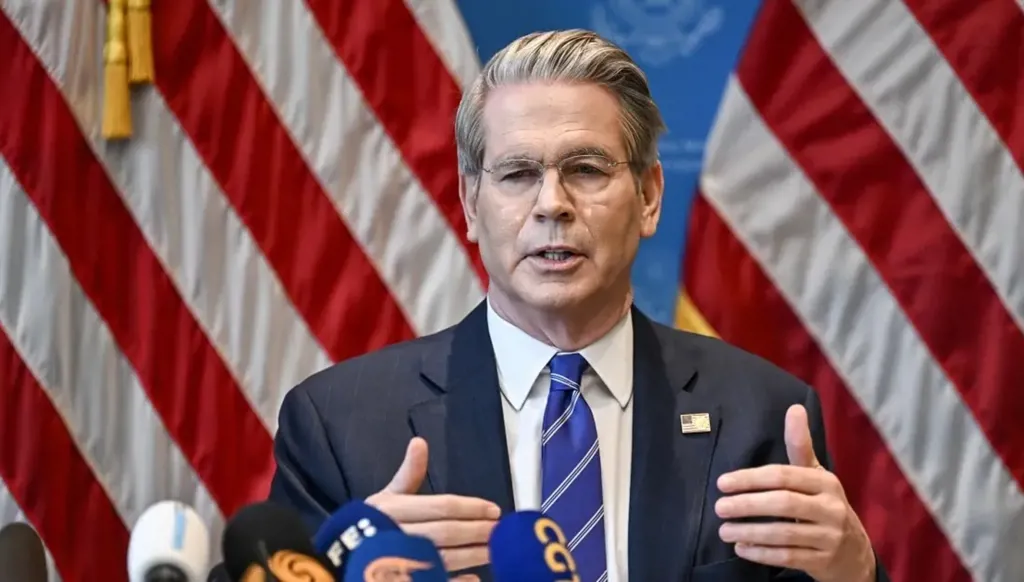
US Treasury Secretary Scott Bessent said that his department will continue taking measures against officials who have “infiltrated the Lebanese government and facilitate Hezbollah’s violent campaign against the Lebanese people and obstruct lasting peace.”
There is no ambiguity, and therefore no need for interpretation or debate about background context: the US administration is implementing all measures aimed at stripping Hezbollah of the means that enable it to defend its weapons, and removing protection from its allies who not only serve it but also complicate the task of reaching Lebanese–Israeli peace.
And “this is only the beginning.” In the field of sanctions, beginnings are by nature warning and directive in character. The more difficult steps always come later.
For Hezbollah, this represents a dangerous development on two levels: at the level of its political wing, and at the level of the fear that may affect anyone who relies on its services or covers its role.
As for the Amal Movement, this constitutes a removal, at a critical moment, of the immunity surrounding the position of Speaker Nabih Berri, as it comes as a simple executive step aligned with what Israel had discussed months earlier regarding the need to politically target Berri.
As for the Lebanese army and the General Directorate of General Security, these sanctions, which targeted an officer here and an officer there, appear consequential, because they carry a clearly defined message to the leadership demanding the severing of all ties between the army and Hezbollah, even in the form of coordination and exchange of information. Senior officers are well aware of the background, motives, and narratives behind this US punitive decision.
Sanctions and negotiations… two tracks advancing in parallel
This decision coincides with the Lebanese Army command’s completion of naming six Lebanese officers, one of whom belongs to the Shiite sect, to participate in the coordination meeting at the Israeli Ministry of Defense on 29 May, alongside six other officers from the Israeli army. The meeting will discuss the military demands of both sides, which could provide momentum toward the required agreement on the diplomatic track.
In this context, the Lebanese and Israeli delegations will return to meet on 2 and 3 June at the US Department of State, where work is underway to issue a “letter of intent” that remains stalled to date due to conflicting mechanisms requested by Lebanon on one side and Israel on the other.
These sanctions reflect the United States’ aspiration for a day when the Lebanese Army’s movements are shielded from information, interference, and influence from Hezbollah.
Returning to the sanctions targeting Hezbollah MPs and officials in its political wing, this development would remove the security immunity that was previously granted to the party’s politicians, as Israel had been sparing them due to US pressure. Today, however, that pressure has effectively collapsed with the imposition of sanctions on them, especially since Israeli assassination policy focuses on targeting all those previously placed on US sanctions lists.
As for the Amal Movement, the cost of maintaining the “duo” framework has become extremely high, and it is expected to become increasingly costly over time, given that “this is only the beginning,” as the US Department of State stated.
In any case, these sanctions, with all their serious dimensions, send a direct message to the Lebanese authorities to remain focused on the two objectives they previously declared, on the basis of which the White House activated and personally sponsored the direct negotiation mechanism under President Donald Trump: stripping Hezbollah’s weapons and military activity of any legitimacy, in line with the requirements of the March 2 resolution, and committing to a sustainable resolution of the military conflict with Israel as a prelude to reaching a peace agreement, while not yielding to pressure from any side.
Disclaimer: The opinions expressed by the writers are their own and do not necessarily represent the views of Annahar