

Is Afrocentrism only Egypt’s problem?
It may only be a matter of time before some people, driven by compounded ignorance, illusion, and a sharp sense of inferiority, stand in front of the burial sites of the Dilmun civilization in Bahrain or the palace of Petra in Jordan and declare that these are ours as well.



 Messenger
 Whatsapp
 Threads
 Email
Email
 Print
Print
 X
X
 Facebook
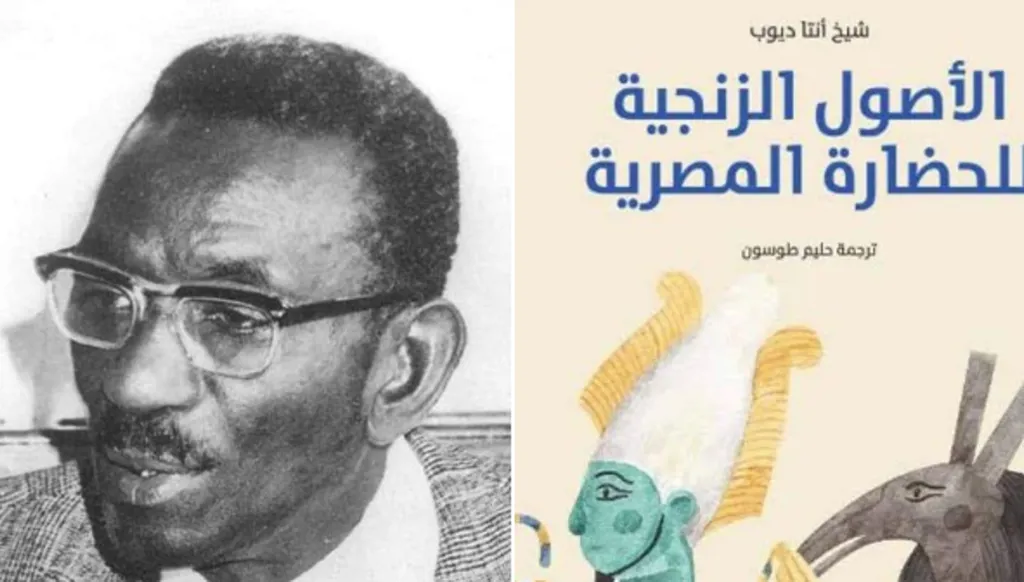


To answer the title of this article, I went back to the Senegalese scholar Cheikh Anta Diop, who is presented as one of the greatest contemporary African historians and anthropologists. I read his book translated into Arabic under the title “The African Origin of Civilization: Myth or Reality”, which is considered a reference among supporters of the African centered theory, or Afrocentrism, since its publication in 1954.
Diop cites the Bible, where the prophet Noah supposedly “cursed” his son Ham, and his descendants were afflicted with the “curse” of black skin. The sons of Ham are Mizraim who settled in Egypt, Cush who settled in Ethiopia, and Canaan who settled in the Levant and Phoenicia.
All of these, Diop claims, were black, and they established civilizations that lasted for thousands of years in what he describes as “black countries”. The historian also “asserts” that the Sabaeans, the people of ʿĀd, and the rest of the peoples who inhabited the Arabian Peninsula were originally branches of Cush. According to him, there are no extinct Arabs, no pure Arabs, and no Arabized Arabs. We are all black people. In Diop’s view, present day Arabs are only the result of the intermarriage of black people with “white occupiers” in the second millennium before Christ.
As for the Hebrew cousins, they were the result of intermarriage between the black Canaanites, or what he calls “civilized black people”, and “uncultured whites”. Since Phoenician Canaan was black, Diop naturally refers to the Phoenician community that migrated to Carthage as “black”.
The author does not leave anything out, as he notes that the earliest kings of the Elamite civilization, which was within the region of Arabistan currently occupied by Iran, were black. The Chaldeans in Iraq were likewise “merely a group of priestly astronomers from Egypt, meaning black people”.
The description of “whites” as “uncultured” and blacks as “civilized” in the previous paragraph was not accidental, as Diop effectively restricts civilization, science, advancement, and development to black people. Wherever achievements and prosperity are found, he sees only the supposed blackness of skin. In the case of Egypt, for example, he completely denies that any of the “white” peoples who arrived there, such as the Persians, Assyrians, Libyans, or Hyksos, developed anything in mathematics, philosophy, physics, or astronomy.
The book contains even more extreme claims for anyone looking for amusement, such as Diop’s agreement with the Nazis that the French, Italians, and Greeks are of black origin. As for Spaniards being “the darkest of Europeans”, this is not due to their recent contact with Arabs, but rather due to Phoenician settlement in Spain, and the Phoenicians, have you got that by now, were black.
Where is the danger?
Diop’s theories have been refuted many times over the past 72 years. But as long as believers in Afrocentrism are still able to be convinced by a book with this level of bias and, in the author’s view, absurdity, and as long as they continue to circulate its content and promote it, Afrocentrism may not remain a problem faced by Egyptians alone in films, podcasts, books, and songs, and eventually through tour guides who sell these lies to tourists.
It may only be a matter of time before some people, driven by compounded ignorance, illusion, and a sharp sense of inferiority, stand in front of the burial sites of the Dilmun civilization in Bahrain or the palace of Petra in Jordan and declare that these are ours as well.
Disclaimer: The opinions expressed by the writers are their own and do not necessarily represent the views of Annahar