

"The Green Book" and the age of ideological power: How Gaddafi’s vision compared to Mao and Hitler
From Andreotti’s failed diplomatic overture to Heikal’s warning, Libya’s Green Book was meant to reshape politics, but its legacy unfolded very differently from the revolutionary texts it is often compared to.



 Messenger
 Whatsapp
 Threads
 Email
Email
 Print
Print
 X
X
 Facebook
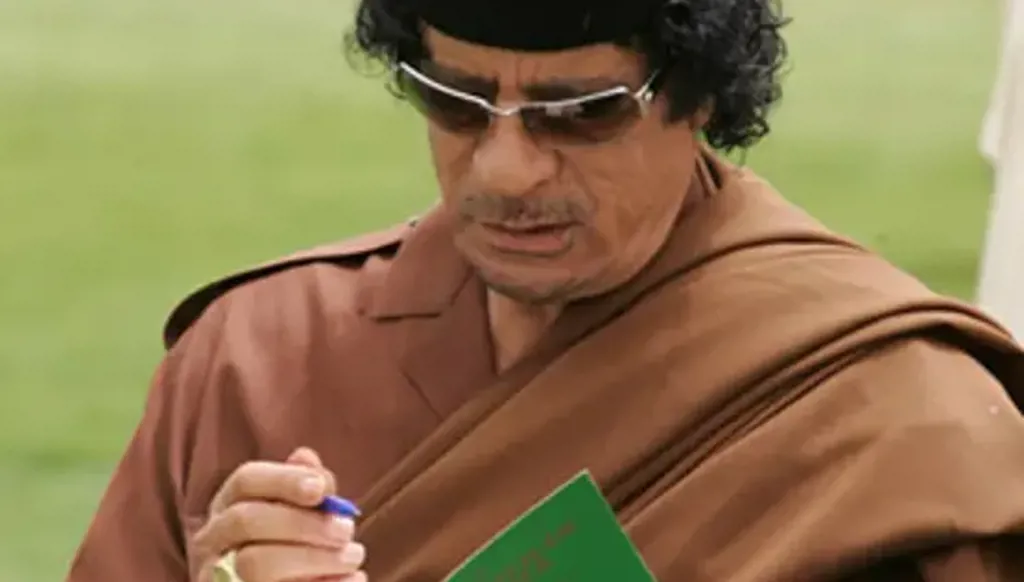


The famous Italian politician Giulio Andreotti, who led six Italian governments, is said to have attempted to bridge the gap between U.S. President Ronald Reagan and Libyan leader Colonel Muammar Gaddafi, but his efforts did not succeed. The U.S. raid on Libya took place at dawn on April 15, 1986, during a military operation called “Operation El Dorado Canyon.”
According to former Libyan Foreign Minister Abdul Rahman Shalgham, who shared the story during his time as ambassador to Rome, Andreotti tried to present U.S. President Ronald Reagan with the English version of Colonel Muammar Gaddafi’s “Green Book,” but Reagan refused to accept it. Andreotti reportedly told him, “This is a book without explosives,” to which Reagan replied, “Even Hitler wrote a book called ‘Mein Kampf,’ and he burned people and waged war on the world, while Mao Tse-tung wrote The "Little Red Book" (Quotations from Chairman Mao Tse-tung), which he destroyed China."
Since taking power in Libya following the 1969 Libyan revolution or Fateh Revolution of September,” Muammar Gaddafi was keen to establish an intellectual framework for the new system through what was called the “Third Universal Theory,” encapsulated in The Green Book, in an attempt to grant his regime ideological legitimacy independent of the prevailing traditional currents, offering an alternative to both capitalism and Soviet communism, and based on the belief that the world needed a new political, economic, and social model.
Gaddafi was initially influenced by Arab nationalism and the ideas of President Gamal Abdel Nasser, but after Nasser’s death and the decline of the Arab unification project, he shifted toward establishing his own distinct political philosophy.
The Green Book was published in three phases between 1975 and 1979. The first part appeared in 1975 under the title "The Solution of the Problem of Democracy (The Authority of the People). In it, Gaddafi criticized representative democracy, political parties, and parliaments, considering them “disguised tools of dictatorship,” and raised slogans such as “He who forms a party betrays” and “Representation is domestication.”
The second part came out in 1977 under the title "The Solution of the Economic Problem (Socialism)". It put forward slogans such as “Partners, not employees,” “The house belongs to its occupant,” and “Land belongs to no one,” calling for the abolition of large private ownership and state control of resources, while emphasizing social justice.
The third part was published in 1979 under the title “The Social Basis of the Third Universal Theory,” where it addressed issues of family, tribe, women, education, and culture from a perspective that blended social conservatism with some revolutionary ideas.
Unofficial constitution
The Green Book became an unofficial constitution for Libya, and “popular congresses” and “revolutionary committees” emerged. The establishment of the “Great Socialist People’s Libyan Arab Jamahiriya” was announced in 1977.
Colonel Gaddafi instructed that the book be made a compulsory subject in Libyan schools and universities, and its quotations spread everywhere across the country, from airports to hotels, from state institutions to shops and cafés. Even public spaces were not spared, as they became saturated with its slogans in a way likened to flowers, trees, dust, and oxygen. The book’s themes also became the permanent headline of the country’s newspapers.
There is similarity, but…
Can the Green Book be considered part of the same category as Mao Zedong’s Little Red Book or Adolf Hitler’s Mein Kampf?
There are indeed similarities between The Green Book and these works, as it served as a foundational text for a political ideology and was directly linked to the leader’s personality, and was used as a tool for ideological legitimacy and mobilization within the state’s machinery, carrying a “quasi-sacred” feature among its supporters. However, the differences are profound and significant.
Mein Kampf, for example, is a book with an explicit nationalist and racist orientation, associated with Nazi ideology, the arrogance of military power, and expansionism. The Little Red Book, on the other hand, is a compilation of short sayings and quotations by Mao Zedong. The Green Book is closer to a political and social manifesto attempting to present an alternative model of governance.
While Hitler’s book had an enormous and destructive impact on European and world history, the Little Red Book played a central role in China’s Cultural Revolution. The Green Book, by contrast, remained limited in its influence to Libya and some African and Arab circles, compared to the major ideologies of the twentieth century.
In his memoir “My Years,” Minister Shalgham recounts that when the Egyptian journalist Mohamed Hassanein Heikal heard that Gaddafi was working on writing a comprehensive intellectual theory, he sent him a message through Mohamed Abu al-Qasim al-Zwai, the colonel’s colleague and companion in the first civilian cell of the Fatah Revolution. The message suggested that the colonel would be the first to oppose and regret what he would write and publish. It pointed out that Gamal Abdel Nasser, after issuing the June 30, 1968 statement, quickly realized that he had created a rope that bound his own mind and movement, and he cursed the day he thought of issuing it, discovering that internal and external events are what draw the lines of action and set the signals that guide it. It is worth noting that Heikal himself drafted that statement after Nasser gave him his general lines of thought.
Disclaimer: The opinions expressed by the writers are their own and do not necessarily represent the views of Annahar.