

The Lebanese constitution: Between founding principles and ongoing transition
A century after its drafting, Lebanon’s Constitution remains a living framework shaped by sectarian compromise, political evolution, and an unfinished journey toward a fully unified state.



 Messenger
 Whatsapp
 Threads
 Email
Email
 Print
Print
 X
X
 Facebook


Attorney Judith El Tini
Doctor of Law
Since the proclamation of the State of Greater Lebanon in 1920, it was clear that the emerging entity needed a constitution to regulate it. In 1926, the French High Commissioner announced his intention to draft this constitution. The representative council met and elected a committee of deputies to prepare it. On 23 May of that year, the Lebanese Constitution was proclaimed.
The Lebanese Constitution did not emerge from a vacuum. It drew its principles from the Constitution of the French Third Republic of 1875 and was also influenced by the structure of the Belgian Constitution of 1831. This led to the adoption of a parliamentary republican system, the organization of relations between the legislative and executive authorities, and even the method of electing the President of the Republic and defining his powers, following the French model of that period.
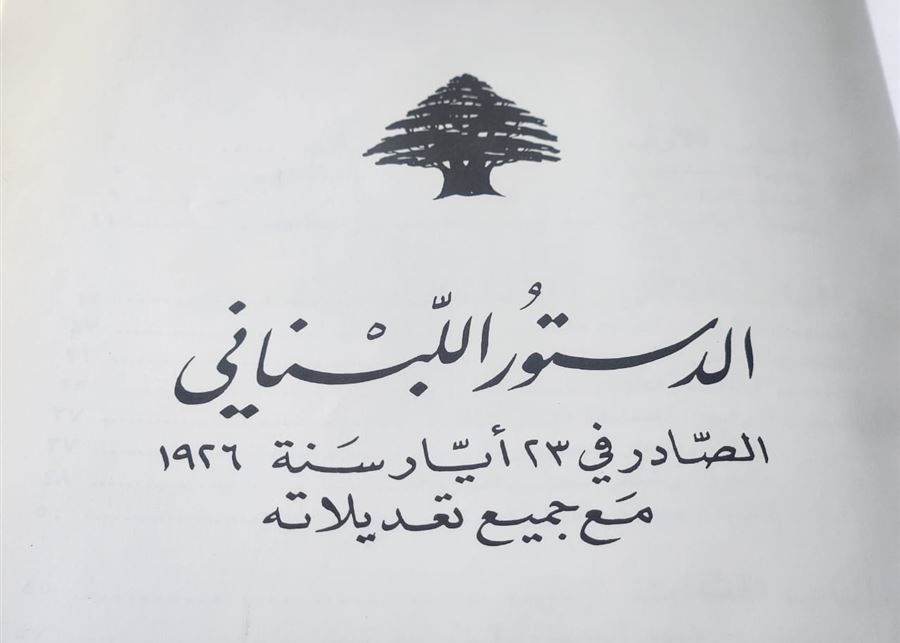
However, Lebanon’s particular character asserted itself from the very beginning. The Constitution of 1926, which established the model of the modern state, also entrenched the reality of a sectarian society. Article 95 in its original wording stipulated fair representation of religious communities in public posts and the formation of the government "temporarily and in pursuit of justice and harmony". Yet the Lebanese notion of "temporary" appeared as if it had become a permanent part of the system’s structure.
In his justification of this article, the rapporteur of the constitutional committee Shibl Dammous presented reasons, as recorded in the book of Pierre Rondot, stating that Lebanese society had not yet reached the stage of complete national integration, and that the Lebanese people were not yet accustomed to prioritizing national solidarity over sectarian solidarity.
After several amendments, the Taif Agreement of 1989 opened the door to a more advanced approach. The constitutional amendments adopted in 1990 did not only redistribute powers among the presidencies, but also outlined a theoretical path toward the abolition of political sectarianism. The amended preamble of the Constitution clearly stated that “the abolition of political sectarianism is a fundamental national goal”, while Article 95, as amended, mandated the gradual abolition of political sectarianism in order to shift the system from one governed by sectarian balance to one based on the balance of powers.
Article 95 established a transitional phase until political sectarianism is abolished. However, after more than three decades, Lebanon remains in this “transitional phase”. This temporary sectarian representation during the transition aligns with the principle of positive discrimination that prevents permanent exclusion. Yet clientelist thinking, political mobilization, and the absence of a genuine understanding of the state within institutional perception have led to a misuse of this article.
What is needed today is not a change of the system or the Constitution, which enshrines constants consistent with the nature of a pluralistic parliamentary system. However, this does not preclude the need to clarify certain provisions. Prime Minister Nawaf Salam addressed ten key points requiring clarification in his book “Lebanon Between Yesterday and Tomorrow,” which concern the legislative and executive branches and the relationship between them. For example, Prime Minister Salam raised the hypothetical case of disagreement between the President of the Republic and the Prime Minister when concluding an international treaty. What happens in such a case? Is the matter referred to the Council of Ministers for a decision? From this, he considered that Article 52 of the Constitution requires clarification. It should be noted that this issue is not currently raised in relation to negotiations with Israel, as the two presidents are in agreement.
Today, after one hundred years, the Lebanese Constitution appears much like Lebanon’s own biography: an ambitious text, rich in principles, yet burdened with interpretations and conflicts. Nevertheless, it remains the primary framework that brings Lebanese people together under the idea of the state, even if that idea is still under continuous negotiation.