

Syria’s constitutional cycle: How power shapes the text, not the other way around
From the 1950 constitution to the post-2011 order, Syria’s constitutional history reflects a recurring pattern: political power shifts first, and constitutions follow, often reinforcing the very dominance they appear to regulate.



 Messenger
 Whatsapp
 Threads
 Email
Email
 Print
Print
 X
X
 Facebook
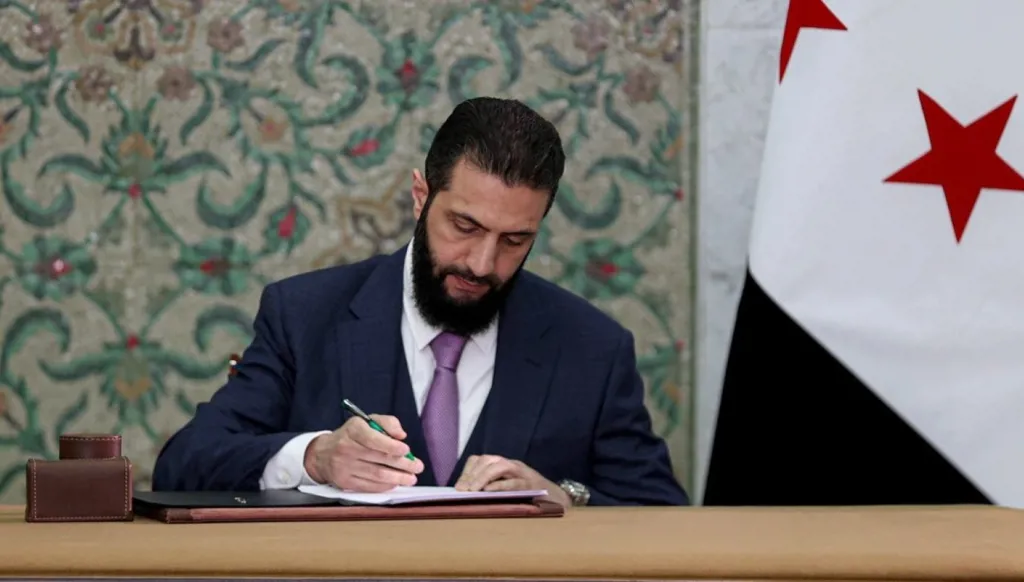


In most of its phases, the Syrian constitution was not born as a political contract that precedes and limits authority, but rather as a delayed mirror reflecting the dominant center of power within the state. Power would first shift, and only then would the text follow, giving it a legal form: the army after the parliament, the leader after the army, the party after pluralism, and the presidency after the party. Therefore, constitutions cannot be read only through their articles, but must also be understood through the social, military, and economic structures they impose, as well as the forces that can protect or consume them. In the Syrian experience, the constitution was often not a tool for distributing power, but a mechanism for reproducing dominance.
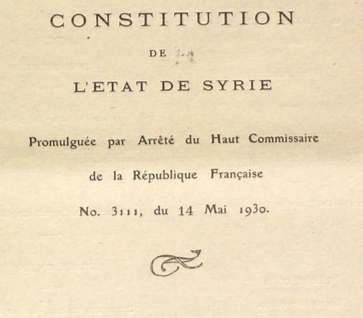
This tension was already embodied in the 1950 Constitution. It was advanced in its structure: a parliament with broad powers, a restricted presidency, and an active judiciary. Yet it emerged at a moment when politics was shifting from the corridors of urban elites to the barracks. After the 1949 coups, Damascus, Aleppo, Homs, and Hama, with their parties, merchants, and landowners, no longer held the state’s keys alone. The army was rising, along with sons of the countryside, the middle, and lower classes, who found in military and party institutions a faster path to power than the old parliament. As a result, the strong text failed to protect itself, not because it lacked constitutional value, but because it did not find a social and institutional base capable of sustaining it.
Adib al-Shishakli came to clearly reveal this transition. His coup was not just a seizure of power, but an early attempt to organize the political field from above through the army, security, party, and referendum, inaugurating the features of a security and propaganda state. With Abdul Hamid al-Sarraj, in the pre-unity years and during it, tools of security control advanced over politics, before unification with Egypt shifted Syrian decision-making into a central presidency that absorbed parties and pluralism in the name of the nation and unity.
With the Ba’ath, the transformation took its deepest shape. The 1963 coup was not only a victory for a partisan idea, but also the rise of a new social bloc: rural officers, sons of minorities and peripheries, and rising classes who found in the ideological party a gateway to the state. Then came Hafez al-Assad, who turned this rise into a closed center. The 1973 Constitution was weak in terms of freedom and separation of powers, but strong in authoritarian terms because it matched the center of power: a military-security presidency controlling the party, army, judiciary, and economy. When the 2012 Constitution came, it removed the façade of the leading party but kept the presidency as the center of the system and its balance.
The year 2011 did not erupt against a specific constitution, but against the structure that had turned the constitution into a façade for a closed center of security, wealth, and loyalty. The explosion was the result of the same accumulated power dynamics: center and peripheries, rural and urban areas, a client economy, poverty and marginalization, conservative societies, incapacitated elites, and a state absorbed by networks of loyalty and fear. Thus, the war was not only a struggle over rule; it was a violent redistribution of centers of power, both internally and externally. However, it did not produce an alternative stable center, but instead overlapping maps of de facto powers, anxious communities, and areas accustomed to managing their affairs outside Damascus.
Hence, the constitutional announcement does not merely outline a strong presidency, but reveals an attempt to build a single political and administrative center that effectively performs some of the functions of a single party without bearing its name. Political administration, trusted figures, mechanisms for selecting the People’s Council, and bodies linked to the presidency all point to an authority that is not content with administering the state, but seeks to organize the political field from above: who represents, who is absorbed, who is excluded, and who is recycled within the new system. Here, representation does not rise from society to authority, but descends from authority to society.
Here, the question of decentralization becomes the other face of the question of the presidency. Alongside an exhausted society, there are de facto powers, demands for guarantees, and components emerging from the war, burdened with fear, while foreign calculations make recognition, lifting sanctions, and reconstruction part of the engineering of the text itself, not just later details. The fundamental question is not only about the extent of the president’s powers, but about who holds the right to distribute power: does the constitution distribute it on a general basis, or does the center manage it through localized understandings with forces it cannot ignore?
What does not begin with the distribution of power rarely ends with its exchange. If the history of Syrian constitutions teaches anything, it is that a text born after the dominance of one center often becomes the language of that dominance rather than a constraint on it. Therefore, the constitutional announcement does not appear as a full departure from the legacy of single authority, but rather a reworking of it: with a different bloc, a different discourse, in a country where the safeguards capable of limiting the expansion of the center have weakened.