

Lebanon caught between Washington and Tehran as Hezbollah ceasefire talks deepen
As U.S.-Iran negotiations intensify, Lebanon faces mounting pressure over Hezbollah’s future, Israel’s security demands, and a fragile regional balance that could redefine power across the Middle East.



 Messenger
 Whatsapp
 Threads
 Email
Email
 Print
Print
 X
X
 Facebook


This ambiguity could ultimately benefit Iran itself as part of an effort to preserve face, potentially encouraging it to make concessions in the anticipated agreement with the United States, though with added complications in Lebanon, given the party’s belief that Iran backs and strengthens it against the Lebanese state in order to preserve its leverage. Lebanon therefore needs clarity from both the U.S. and Israel in this context, to eliminate any ambiguity or uncertainty throughout the expected Lebanese-Israeli negotiations, particularly if they run parallel to U.S.-Iran talks.
Compounding the issue is the presence of both old and new obstructive factors. In particular, the continued refusal of Hamas to disarm in Gaza despite its prior commitment under the ceasefire agreement, alongside Iran’s use of its loyal factions in Iraq to target Gulf states, points to a broader pattern of Iranian maneuvering aimed at demonstrating that it still retains influence and sources of power unrelated to the nuclear file or uranium enrichment. These factors underscore the complexity of the situation in Lebanon within the framework of the “united fronts” theory, albeit with differing dynamics for each front.
Moreover, there is a different approach to the issue of disarming the party, particularly in light of its shift toward drones as a means of confronting Israel, a development that could make the challenge far greater and more difficult for both Israel and Lebanon, given the ease of obtaining simple, low-cost weapons that have proven more effective than direct battlefield confrontations involving heavy arms.
According to diplomatic sources, this major shift in realities requires close monitoring of a broader regional agreement that Iran may seek to barter and negotiate not only with the United States, but also with regional countries, based on Tehran’s post-war endgame, while simultaneously concealing its internal realities by activating — or reactivating — its remaining centers of influence across the region.
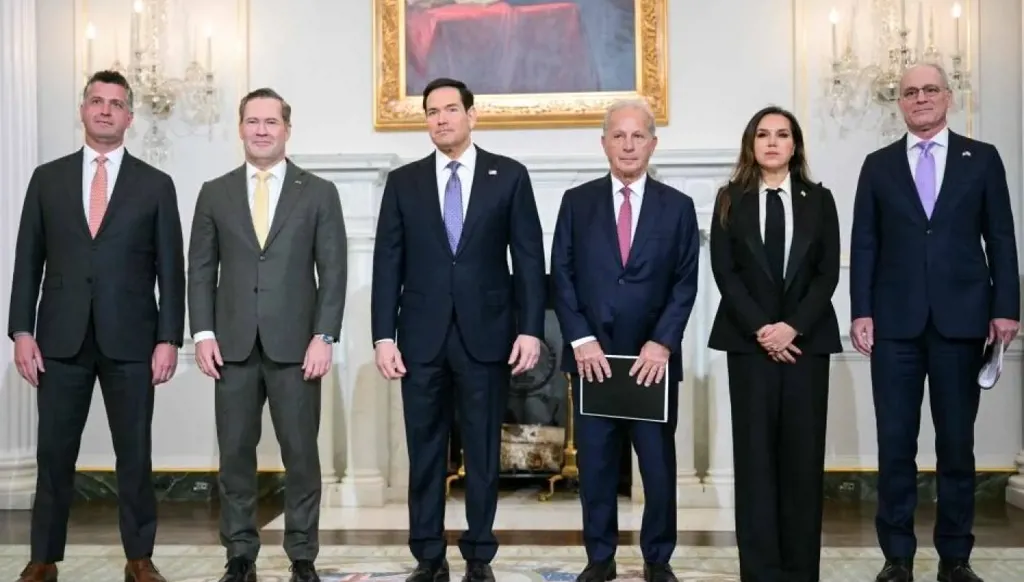
Throughout the three rounds of meetings sponsored by the United States between Lebanon and Israel in Washington, Washington has shown nothing but determination to dismantle Hezbollah as a primary objective, within the framework of guaranteeing Israel’s security, while displaying no flexibility on this issue and prioritizing the separation of Lebanon’s file from the Iranian nuclear file.
However, the matter depends on many factors during a phase in which the United States is seeking to leverage its ability to establish a long-term agreement between Lebanon and Israel, one that could open the door to new and realistic military and political arrangements capable of ending the state of war and laying the foundations for an initial phase of peace, thereby stripping Iran of many of its leverage cards to a large extent.
At the same time, the political power-sharing surrounding the general amnesty law has exposed the vulnerability of the “Shiite duo,” which remains mobilized against the state and rejects its decisions on the grounds that it represents an “occupation authority,” according to its media discourse. Yet despite this rhetoric, it still insists on remaining under the state’s umbrella, in contrast to the defiance shown by Hezbollah in rejecting the negotiations being conducted by the state to secure an end to the war.
Disclaimer: The opinions expressed by the writers are their own and do not necessarily represent the views of Annahar.