

Lebanon poll shows growing openness to peace talks with Israel amid sharp public opinion shift
New survey data reveals rising support for negotiations and normalization, alongside deep generational and sectarian divisions over responsibility and potential peace agreements.



 Messenger
 Whatsapp
 Threads
 Email
Email
 Print
Print
 X
X
 Facebook
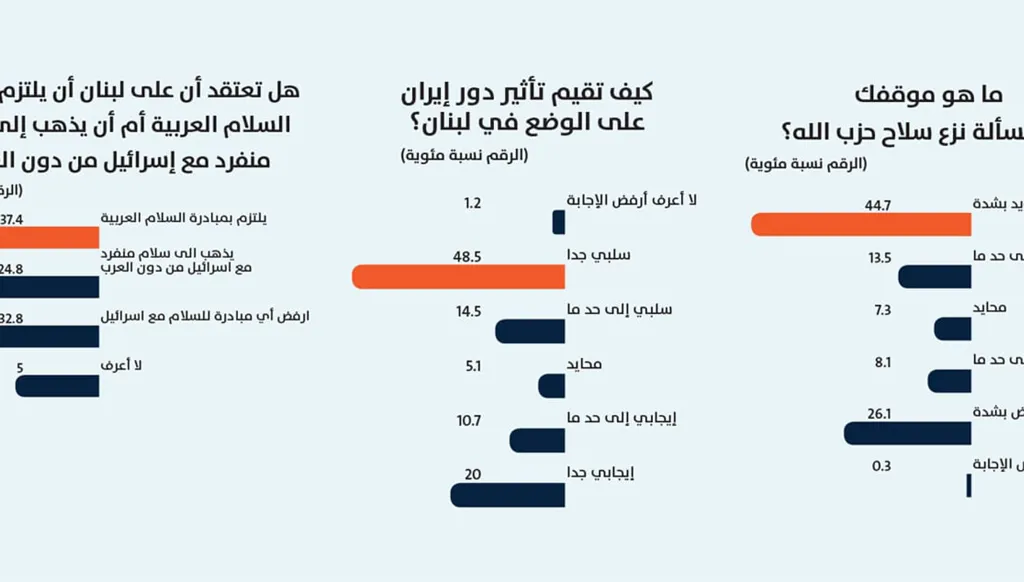


The Lebanese public opinion is witnessing a radical shift in its perception of matters, especially after suffering from successive wars into which Hezbollah dragged Lebanon, from the Gaza support war in 2023 to support for Iran in 2025, and the resulting consequences of these mistaken bets, including killing, displacement, destruction, and the leveling of villages. This has led many Lebanese to support negotiating with Israel, reaching toward a desired peace.
In a reading of a poll conducted by International Information, and according to the interpretation of the company’s president Jawad Adra, it was found that the most significant point is that today’s results clearly differ from the results of the August 2025 poll. In less than a year, the percentage of those supporting a peace agreement with Israel rose from 25 percent to about 49 percent, while the percentage of those supporting normalization increased from 13.2 percent to more than 30 percent. These rapid shifts raise a fundamental question: do political convictions truly change, or do exhausted societies become more willing to adopt choices they previously rejected?
Adra considers that “it is useful to read the results from the perspective of generations rather than sects alone. Younger age groups showed higher levels of opposition to negotiations, normalization, and the opening of an Israeli embassy, while support gradually increased with age, peaking among those over seventy years old. This raises a highly important question: does the memory of wars push older generations toward pragmatism and compromises, while pushing younger generations toward more rigid or principled positions? Or are young people, given their sense of an already lost future, less willing to make concessions they view as moral or related to sovereignty?”
- In response to the question, “In your opinion, who bears the greatest responsibility for the current escalation in Lebanon?” Israel and Hezbollah together topped the list of parties held responsible for the current escalation in Lebanon, with very close percentages of 32.9% and 32.8% respectively. Other options declined significantly, such as “everyone is responsible” at 12.1%, Iran at 8.8%, and the United States at 8.1%.
According to sect, Christian and Druze respondents primarily held Hezbollah responsible, with percentages ranging between 50% and 61%. Shiite respondents held Israel responsible at 57.7%, while none of them attributed responsibility to Hezbollah at 0%. In contrast, Sunni respondents were divided between holding Hezbollah responsible at 39.1% and Israel at 33%.
- Regarding the question “What is your position on direct negotiations between Lebanon and Israel?”, a clear division in public opinion emerges. 21.9% of respondents expressed strong support for this option, while 27.1% expressed partial support, meaning that around 49% lean toward supporting it to varying degrees.
According to sect, Maronite and Orthodox Christians recorded high levels of support for direct negotiations. 78% of Maronites supported it (36.2% strongly and 41.8% somewhat), and 73.6% of Orthodox Christians supported it (37.5% strongly and 36.1% somewhat). The Druze also supported direct negotiations at a rate of 72% (50.9% strongly and 21.1% somewhat). Here, observers note the significant shift within the Orthodox community, which has traditionally prided itself on supporting the Palestinian cause and broader Arab causes.
- Regarding the question “What would your reaction be if the President and the government signed a peace agreement with Israel?”, about half of respondents (48.9%) tend to accept the idea of the President and government signing a peace agreement with Israel at varying levels, with 23% expressing strong support and 25.9% expressing partial support. In contrast, 46% opposed this idea, including 34.4% who strongly opposed it and 11.6% who somewhat opposed it. The neutral group accounted for 4.5%, while those who refused to answer did not exceed 0.6%.