

A war of erasure: The present and the future under attack
In southern Lebanon, villages are being destroyed and lives displaced as residents describe a conflict that goes beyond conventional war, one that targets existence itself and reshapes an entire future.



 Messenger
 Whatsapp
 Threads
 Email
Email
 Print
Print
 X
X
 Facebook
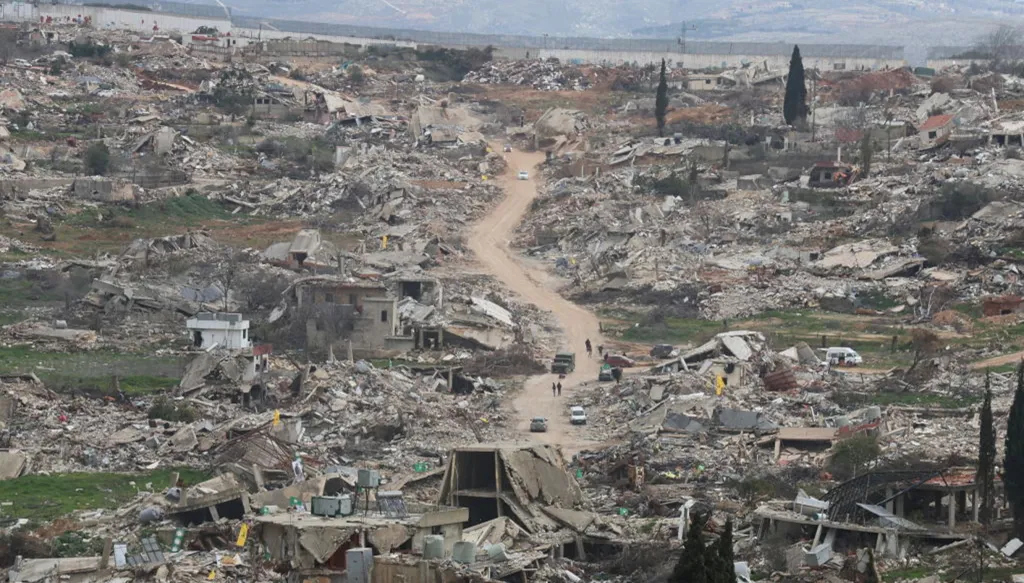


The Israeli war on southern Lebanon is more than just a response to Hezbollah launching a few rockets, which Tel Aviv’s rulers considered a pretext to launch their renewed and ongoing war on the party and its social base since early March of last year. It is a real war of extermination against life as such, against people, stone, trees, tobacco, graves, memories, and the future.
Away from the question of who is responsible for this war, whether Hezbollah was mistaken in its support for Gaza and then Iran, what the point of negotiations is, and whether they can lead to a peace over which Lebanese people differ sharply, dividing deeply and exchanging accusations and insults and rejecting living together, away from all of that and from what is being plotted in Washington, Tel Aviv, Tehran, Islamabad, Paris, and other capitals, southern Lebanon and the areas that form Hezbollah’s Shiite social base are living through a real tragedy whose wound is still fresh, and whose greater pain will come with the passing days as the full scale of the catastrophe is revealed above and below the ground.
Homes are souls
Homes are not just stones and furniture. Homes are souls that are killed with cruelty, then mutilated and dragged by tanks and bulldozers that crush their gravel, sand, and cement, and tear apart their iron. Beneath this vast destruction, previous lives of grandparents, grandmothers, fathers, and mothers disappear. Stories are burned, along with schoolbooks. Coffee cups and tea glasses are crushed, along with olive jars, bags of thyme, and bridal trousseau boxes. Photo albums are torn apart, along with stories of love, illness, and recovery. Children’s dreams, drawn in school notebooks, are lost, and those notebooks themselves become as if they had never existed.
Trees used to die standing, like the staff of Solomon, refusing to fall until drought consumed them. But now they are killed while still green and buried alive. They wither under the rubble, along roadsides, and in razed fields. It will take a long time before the olive trees of Kfar Kila, Meiss al Jabal, Al Adaysseh, Markaba, Houla, and Blida, as well as the carob, orange, mallow, and tobacco, return, in villages and towns whose people have been forced away by fire and bullets and by the unending threat of flight or death.
Massive iron machines carefully tear into the land that survived the horror of toxic missiles, ensuring it can no longer be cultivated. They kill life for generations. Even the soil is not spared; it is treated with hatred, and the seeds of life within it are destroyed, while fertility is stolen from the plains and transferred to the settlements. Even the rubble of homes is transported by trucks to settlements and barren lands, in order to erase memory from everything, following a widespread campaign of looting and stripping.
There will be no ruins left for the displaced southerner to stand upon, neither the homes of the poor nor the palaces of the wealthy. The land becomes a desert, returning to a primitive state. Centuries of construction are erased in days and months. Landmarks disappear, water sources dry up, and infrastructure is destroyed. An entire history vanishes under tracks and burning penetrating shells. Its people stand on its edges or in shelters, looking on with sorrow and regret at a lifetime slipping away.
This is not a conventional war. Homes, farms, and trees carry no weapons. The olive tree does not fire rockets at Metula, Nahariya, or Misgav Am. The house of Um Hussein is not an artillery position or a missile launch site, and the shoe factory is not a military base for Hezbollah. This is a war of a Hulagu-like nature.
Annihilation war of the present and the future
The house dies, and its owner dies with it. Not everything in the heart can be spoken. The people of the villages choke when asked about their homes, or when they see them being destroyed before their eyes after being forced to leave them in haste, or when they watch images of bulldozers scraping away what remains of them. Talk of resilience and sacrifice masks vulnerability, but it does not erase the fact that these people cry blood for their children and their livelihoods when they retreat to their makeshift shelters, scattered in their miserable exile between schools, shelter centers, and cold, narrow rooms devoid of life.
This war is unlike any of the previous wars. It is a war of erasure of existence for a long period. The people of the south understand this; some insist on endurance, some search for alternatives, some swallow their pain and silence their voices, and some raise protest voices. But all of them, the residents of the villages that have been bulldozed or are at risk of further destruction, know that what has happened and is happening is bigger than them, and that they are victims of a larger conflict in which some were drawn in willingly and others were forced into it.
Disclaimer: The opinions expressed by the writers are their own and do not necessarily represent the views of Annahar.