

Trump and the Tech Lords: The rise of a new power empire
As Donald Trump reemerges on the world stage alongside powerful tech elites, the fusion of politics, capital, and technology is reshaping state sovereignty and testing the limits of democracy.



 Messenger
 Whatsapp
 Threads
 Email
Email
 Print
Print
 X
X
 Facebook
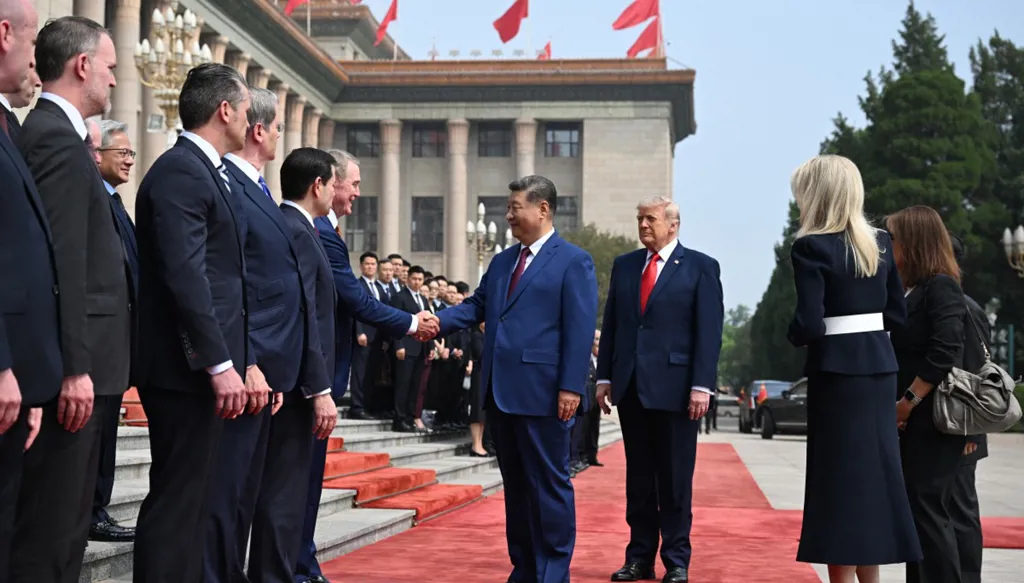


When Donald Trump’s plane landed in Beijing last week, marking the first visit by a sitting American president to China since his own 2017 trip, the delegation accompanying him stood out. Rather than traditional political figures, it included around 18 top executives from major U.S. technology and finance companies, whom the media dubbed “trillionaire men,” with a combined wealth estimated at roughly $27 trillion, surpassing China’s gross domestic product.
The delegation featured prominent figures such as Jensen Huang (NVIDIA), Elon Musk (Tesla and SpaceX), Tim Cook (Apple), and Larry Fink (BlackRock), along with leaders from Boeing, Citigroup, Cisco, Goldman Sachs, Visa, Mastercard, Qualcomm, Meta, and others. The clear goal was to ease obstacles facing American companies in the Chinese market.
New concepts of state and sovereignty
This configuration, crafted by Donald Trump himself, reflects a new phase in how the concepts of state and sovereignty are approached. We are no longer dealing with merely an unconventional politician, but with a deep entanglement of politics, capital, and technology. This dynamic is underscored by Elon Musk’s push at the outset of Trump’s second term to scale back the federal government, grounded in a “minimal state” vision in which the state’s primary function is to serve major Silicon Valley companies.
In his first term, Donald Trump came to power propelled by a strong populist narrative targeting the “establishment” and oligarchic elites in Washington. As he declared in his inauguration speech: “For too long, a small group in our nation's capital has reaped the rewards of government while the people bore the cost. Washington flourished, but the people did not share in that wealth. Politicians prospered, but jobs left and factories closed. The establishment protected itself, but not the citizens of our country.”
Trump’s narrative about the establishment and oligarchic elites resonated with many who were looking for a leader capable of confronting the entrenched, tailor-made power structures within traditional parties. This helped position him as a symbol of a broad populist current seeking a leader who appeared closer to ordinary people, an image that was further reinforced following an assassination attempt during the election campaign.
This aligns with Nadia Urbinati’s analysis of populism in her influential book I, the People: How Populism Is Changing Democracy, where she frames populism not only as a reaction to fatigue with entrenched “establishment” parties, but also as a legitimate claim to power by ordinary citizens who have endured years of low income and limited political influence.
Trump and Silicon Valley alliance
During his first term, Donald Trump clashed with leaders in Silicon Valley, Twitter suspended his account, Facebook was accused of mobilizing against him, and he openly rejected cryptocurrencies. Today, however, he is increasingly surrounded by major technology figures, including Elon Musk, Sam Altman, Jeff Bezos, Mark Zuckerberg, and Bill Gates. Some observers describe this convergence as a form of “broligarchic” rule, dominated by wealthy, predominantly white tech elites from Silicon Valley, as characterized by Martine Delvaux in Libération.
The French outlet Mediapart pointed to a deeper structural shift in Washington, where traditional financial capitalism, once dominated by Wall Street, has given way to a plutocracy led by independent billionaires seeking direct control over the state. Meanwhile, Michel Goldberg, writing in The Washington Post, argued that tech leaders, despite their earlier liberal leanings, are now embracing this new order after growing frustrated with Biden-era regulations on AI and encryption.
In summary, we are witnessing the emergence of “tech feudalism,” as described by economist Yanis Varoufakis in his book The New Slaves of the Economy, where the decline of traditional capitalism gives way to a new paradigm for both the economy and the state, one in which the internet is transformed from a free space into a technical fiefdom controlled by billionaires.
This new pyramid of power, reinforced by algorithms, artificial intelligence, and cryptocurrencies, poses an existential challenge to the very foundations of representative democracy and national sovereignty.
Disclaimer: The opinions expressed by the writers are their own and do not necessarily represent the views of Annahar.