

UK and GCC seal free trade agreement unlocking billions in trade growth and economic integration
UK and Gulf Cooperation Council conclude landmark free trade agreement in London, expanding trade, investment, and digital cooperation across seven key sectors



 Messenger
 Whatsapp
 Threads
 Email
Email
 Print
Print
 X
X
 Facebook
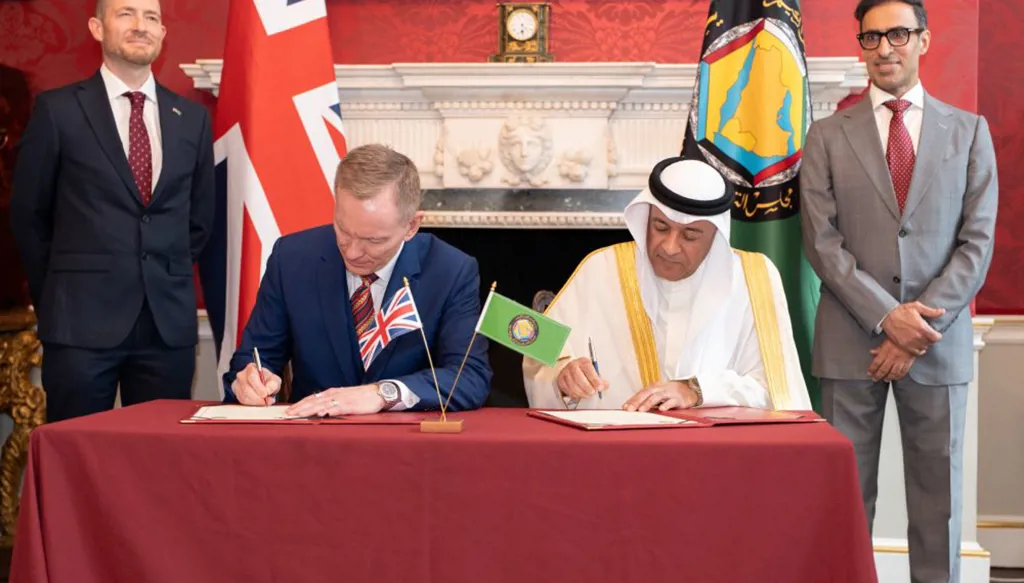


The British government and the Gulf Cooperation Council announced on Wednesday, May 20, 2026, in London, the conclusion of negotiations on a free trade agreement between the two sides and the signing of an official joint statement. The statement was signed by Jasem Mohammed Al-Budaiwi, Secretary General of the Gulf Cooperation Council, and Chris Bryant, Minister of State for Trade at the UK Department for Business and Trade.
This makes the United Kingdom the first country in the Group of Seven major economies to conclude such an agreement with the six Gulf countries: Bahrain, Kuwait, Oman, Qatar, Saudi Arabia, and the United Arab Emirates.
UK Prime Minister Keir Starmer said in the statement that the agreement is a major victory for British businesses and for workers, who will feel its benefits in the coming years through higher wages and broader opportunities. Minister of State for Trade and Business Peter Kyle said the agreement represents a step toward long term sustainable economic growth.
In a statement made during the signing ceremony, Al Budaiwi said that this moment was not a coincidence, but the result of years of continuous effort, firm political will, and the shared conviction of the six member states of the Gulf Cooperation Council and the United Kingdom that deepening economic integration between their peoples and economies is essential. He added that the agreement contains provisions designed to deliver tangible, sustainable, and measurable economic benefits for businesses, investors, and citizens across all seven participating economies.
Scope of the agreement
Al-Budaiwi explained that the agreement is “comprehensive and modern” and covers trade in goods and services, financial services, digital trade, investment protection, government procurement, telecommunications, and the movement of natural persons. He noted that “substantive and sector specific commitments” have been completed across all these pillars. These provisions align with what the UK government announced regarding the agreement giving British services companies guaranteed access to Gulf markets, including the first Gulf commitments on free data flows.
Abolition of customs duties
The agreement provides for the elimination of customs duties worth an estimated 779 million US dollars (580 million British pounds) annually on British exports to the Gulf Cooperation Council countries upon full implementation. Of these, around 484 million US dollars (360 million pounds) will be eliminated from the first day the agreement enters into force. Benefiting sectors include food, beverages, medical equipment, and advanced industries. The Gulf bloc imports more than 80 percent of its food needs, opening wide opportunities for British products such as cheese, chocolate, cereals, butter, and biscuits.
Services and digital data
Services account for about 80 percent of the UK economy and make up nearly half of its exports to the Gulf. The United Kingdom exported more than 26.9 billion US dollars (20 billion pounds sterling) in services to the GCC countries in 2024. The agreement allows British companies to store and process data outside the Gulf region for the first time, reducing the need for costly local data center infrastructure. It also facilitates the movement of British professionals, amid more than 400,000 business visits from the UK to the Middle East recorded in 2024.
Bilateral trade and investment
The value of bilateral trade between the two sides reached 71.2 billion US dollars (53 billion British pounds), while bilateral investment amounted to nearly 24.2 billion US dollars (18 billion pounds) in 2024. This investment supports major infrastructure projects, including Heathrow Airport. The agreement is expected to increase bilateral trade by 19.8 percent, potentially adding around 20.8 billion US dollars (15.5 billion pounds) annually, with forecasts suggesting an additional 4.97 billion US dollars (3.7 billion pounds) to UK GDP per year in the long term.
On the banking and financial side, George Elhedery, Chief Executive of HSBC Group, expressed the group’s readiness to “deepen economic ties and support companies in connecting, investing, and growing.” Anna Anthony, Regional Managing Partner of EY in the UK, said the agreement “creates greater opportunities for professional services firms in these fast growing markets.”
This agreement is considered the fifth major trade deal concluded by the current UK government, following agreements with India, the United States, the European Union, and South Korea. Together with the India agreement, the two deals are expected to add more than 10.75 billion US dollars (8 billion pounds) annually to UK GDP compared with projections for 2040.
Exchange rate used for US dollar conversion: 1 British pound = 1.3439 US dollars (May 20, 2026)
Five key facts
• The joint statement was signed in London between Al-Budaiwi and Chris Bryant on May 20, 2026
• The United Kingdom is the first G7 country to sign a free trade agreement with the Gulf Cooperation Council
• The agreement removes customs duties worth 779 million US dollars annually on UK exports upon full implementation
• The agreement covers seven pillars: goods, services, financial services, digital trade, investment protection, government procurement, and movement of persons
• Bilateral trade could rise by 19.8 percent, adding up to 20.8 billion US dollars annually