

China’s delicate game between Putin and the West
As the war in Ukraine drags on, Beijing treads a calculated middle path, avoiding full alignment with Moscow while resisting Washington’s pressure, all as it quietly shapes a new global order on its own terms




 Messenger
 Whatsapp
 Threads
 Email
Email
 Print
Print
 X
X
 Facebook


China denied the Financial Times report, but every denial raises a question: did the report’s content warrant a response in the first place?
The British newspaper cited what it described as “people familiar with Washington’s assessment of the Beijing summit,” claiming that Chinese President Xi Jinping told his American counterpart Donald Trump that Russian President Vladimir Putin might ultimately feel “regret” over the war in Ukraine. While Trump himself denied this, Foreign Policy did not rule out the possibility that the remark reflects Beijing’s growing impatience with the protracted conflict.
China and the War in Ukraine
Speculation about “regret,” if true, is hardly surprising. It is difficult to imagine that Putin himself has not felt this, given the prolonged stagnation of the war. Even if he succeeds in occupying the remainder of Donbas (roughly 20 percent) this year, the costs of the war will still outweigh the gains. Recently, U.S. Secretary of State Marco Rubio stated, “Russia loses 15,000 to 20,000 soldiers each month… not wounded, but killed.” Therefore, even if Xi did suggest that Putin might regret the war, he added nothing new.

Essentially, the war placed China in an awkward position. Reports suggested that Russia did not inform Beijing in advance of the invasion, prompting a swift evacuation of Chinese citizens from Ukraine. In 2024, it was particularly notable when Professor Feng Yujun of Peking University accepted an invitation from The Economist to write an opinion piece in which he argued that Russia would inevitably lose the war. China, for its part, continues to adopt a long-term approach in its dealings with Russia.
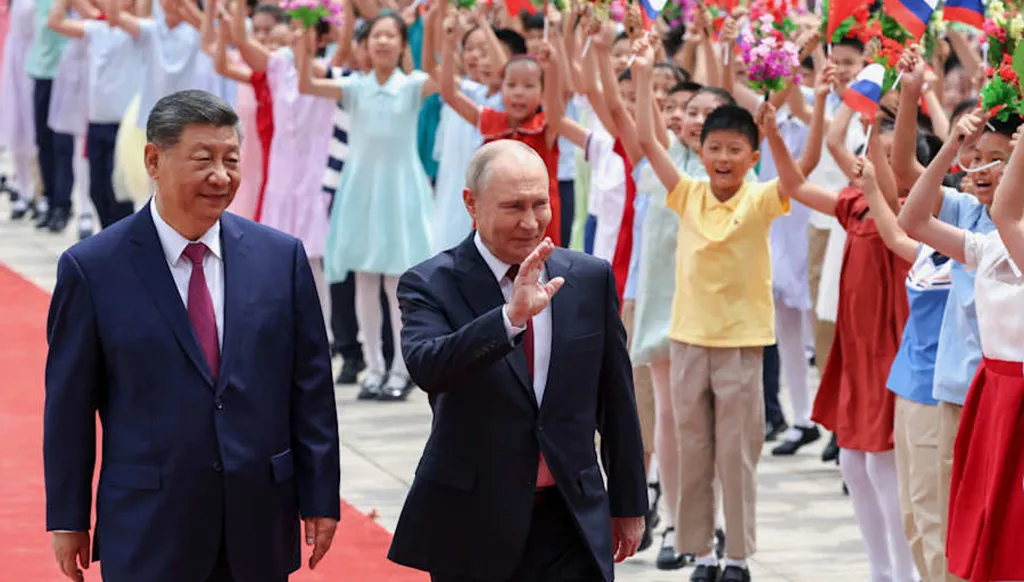
In his meetings with Putin, Xi has emphasized that the two countries will work together to build a more just global system. In 2023, as he was leaving Moscow, Xi told Putin, “Now there are changes that haven’t happened in 100 years. When we are together, we lead these changes.” On Wednesday, the two leaders signed a joint declaration aimed at advancing a “multipolar world” within international forums.
China: Between words and deeds
Ukraine became a gateway for reshaping the international system toward the much-discussed multipolar order. However, China did not support Russia in the war to the extent of tipping the balance in favor of the Russian army. Nevertheless, some reports have suggested that Russia supports China in certain military areas that could facilitate air landings in Taiwan.

Ultimately, China has consistently advanced efforts to reshape the international system at its own pace. On specific issues, its statements often reflect sensitivity to the other party’s position rather than a fixed articulation of intent. For instance, China speaks of “multipolarity” in Putin’s presence, and “bipolarity” in Trump’s. This was evident when Xi told the U.S. president during the recent summit that the stability of bilateral relations affects the interests of more than 8 billion people worldwide.
With or without Chinese talk of Putin’s “regret,” Xi’s relationship with Russia is likely to remain carefully balanced, neither distant nor fully aligned. Even the “Power of Siberia 2” gas project, which Putin has strongly promoted, showed no meaningful progress during the summit at the time of writing. Xi’s approach to Russia mirrors his view of the United States. Despite the advantages the relationship can offer China, he recognizes that tensions with Washington persist. As a result, he relies on a strategy of balance, maximizing benefits where possible while preparing for confrontation if and when it becomes unavoidable.