Dragons and Cowboys: Trust as the New Battlefield

Opinion 20-05-2026 | 11:22

Dragons and Cowboys: Trust as the New Battlefield

From diplomatic smiles in Beijing to fears of digital surveillance and data wars, the US–China rivalry is no longer about territory—but about control, information, and the uneasy sleep of two giants watching each other in the dark.


Dragons and Cowboys: Trust as the New Battlefield
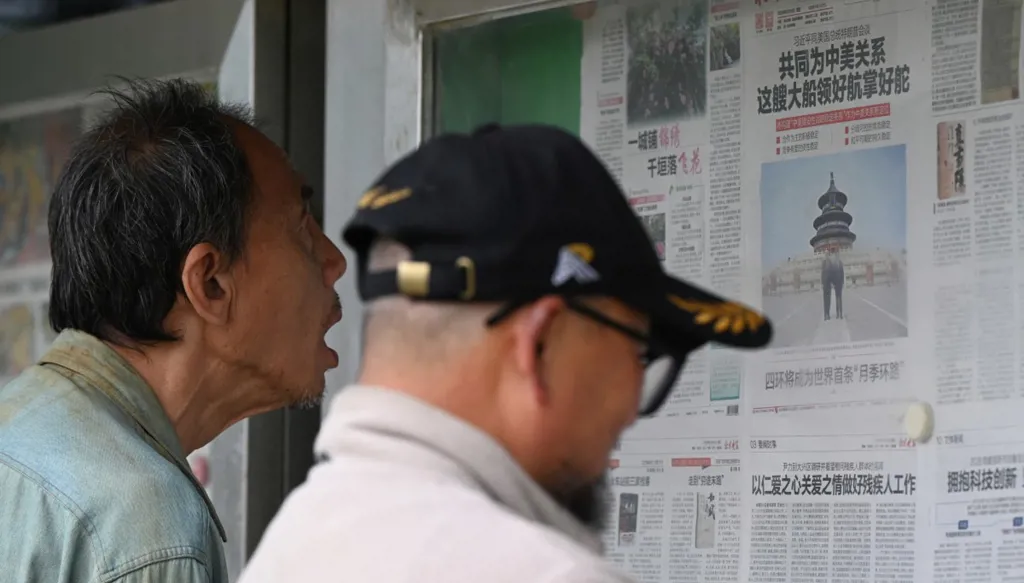
Two men reading what's been published in newspapers about Xi and Trump's meetings, with a picture of them during their visit to the Temple of Heaven on May 16, 2026. (AFP)
Smaller Bigger


Donald Trump left Beijing amid a reception-like farewell with a clear declaration that Taiwan should not wake the Chinese dragon.


The president’s visit was a global focal point, and the Chinese were keen to dazzle the international audience and impress the guest, from the reception ceremonies to the places visited. Yet a cloud of anxiety hovered over the visit, suspended between the dragon’s concern and the cowboy’s instinct.

In this world, dressed in a silk tie over a chest heavy with doubts, wars no longer begin with the roar of cannons, but with a whisper of suspicion and wary glances between two powers—each aware that the other smiles with a full set of teeth… yet hides sleepless calculations behind it.


They say the visit of Donald Trump to Beijing was “successful.” Success is measured in handshakes and camera flashes, not in the fears that boarded the departing plane with the entourage.


In Beijing, the dragon watched his guest with watchful eyes, knowing that the American cowboy only reaches into his pocket to make sure his weapon is still there.


And in Washington, the cowboy looked at the Chinese as if they were silent farmers tending the land in quiet patience—until one morning, he realizes they may already own the entire field.


What a paradox!

Before boarding Air Force One, the entire delegation allegedly discarded Chinese gifts, badges, pins, and souvenirs as if they carried electronic ghosts—or smiles capable of espionage.


Nothing “Made in China” was allowed on the plane. Even personal phones were left behind in America and replaced with temporary devices, as though the delegation were traveling to an unseen land rather than to the world’s second-largest economy.


Such is the irony of time but the anxiety of the virtual age!


The world’s strongest country fears a “pin,” trembles at a “souvenir,” and treats Chinese technology with more caution than explosive mail—not because it is consumed by paranoia, but because it understands how breaths are counted and whispers are recorded.


The battle is no longer about borders but about data—about who knows you better, not just your facial features, but the phone you carry in your pocket.


Concern about Chinese influence has become a full American obsession. China is no longer seen as the silent factory weaving cotton shirts for the world and assembling its electronic toys, but as a vast digital eye watching the world’s leading power—making it, for the first time in decades, feel as though it too is under surveillance.


And who can forget the TikTok war? An app enjoyed by millions, while Washington saw it as a modern Trojan horse.


America fought fiercely: buy or ban—not because teens were dancing too much, but because hundreds of millions had deposited their small secrets there: what they like, what they hate, what they fear, who they vote for, and even when they feel lonely.


In the age of artificial intelligence, such information is more dangerous than oil and more precious than fleets. It is a war of eroded trust—a war not fought with bullets, but with suspicions.


The Chinese dragon is wary of what it sees as the American cowboy’s duplicity—smiling before imposing sanctions. The cowboy, in turn, fears the quiet ingenuity of patient farmers: those who rarely raise their voices, yet build empires with the patience of knowing time is on their side.


A clash of philosophies

Today’s world is no longer witnessing a conflict between two countries alone, but between two philosophies: one seeks to remain at the top even by closing its doors, while the other climbs the ladder in silence, as if it is in no hurry to arrive—yet everyone can see it is steadily getting closer.

As for us, don’t ask. We are still the pioneers of lamentation over the ruins, repeating only: “weep, my beloved.”


In the end, no one trusts anyone. They smile before the cameras and exchange weighty diplomatic phrases, but the truth is simpler and more bitter: it is a relationship between two giants, each sleeping with one eye open—afraid to wake up and find the other has stolen the dream or redrawn the map.