

Aramco’s $35 billion asset sale drive accelerates amid war disruptions and foreign investment push
As regional conflict disrupts Gulf oil flows and diverts exports through Yanbu, Aramco advances a major privatization strategy to attract global capital, stabilize liquidity, and bridge the gap with Saudi Arabia’s Vision 2030 investment targets.



 Messenger
 Whatsapp
 Threads
 Email
Email
 Print
Print
 X
X
 Facebook


Just days after a consortium led by BlackRock’s Global Infrastructure Partners signed an $11 billion lease and leaseback agreement for the Jafurah gas field processing facilities, Aramco executives found themselves fielding a wave of calls from investment funds around the world competing for a stake in the company’s businesses, according to a Bloomberg report.
The deal was signed in August 2025 and finalized in October of the same year. Under the agreement, Aramco retained a 51% stake in the newly established company, while GIP and its partners acquired the remaining 49%.
Driven by this strong demand, and by a desire to strengthen the balance sheet, company executives developed what informed sources describe as the largest privatization plan in the company’s history, aimed at raising up to $35 billion. Aramco declined to comment on these reports.
According to Bloomberg, the ongoing transactions include sale and leaseback deals involving real estate assets, which could extend to the main campus housing the company’s headquarters in the Eastern Province. They also include the sale of a stake in oil export and storage terminals, as well as deals related to gas fired power plants and the water infrastructure sector. Bankers and market participants expect Aramco to open up additional assets to private equity funds and global infrastructure funds, while maintaining full control over upstream assets, Bloomberg reported, citing sources who requested anonymity.
War and Oil Exports
War broke out in the region on February 28, 2026, causing major disruptions to Gulf exports. Aramco redirected most of its shipments through the East West pipeline to the port of Yanbu on the Red Sea, allowing exports to continue despite the sharp decline in shipping traffic through the Strait of Hormuz. However, the strategic pipeline itself was not spared from attacks, as it was targeted by Iranian strikes in April 2026 before its full capacity of around 7 million barrels per day was restored.
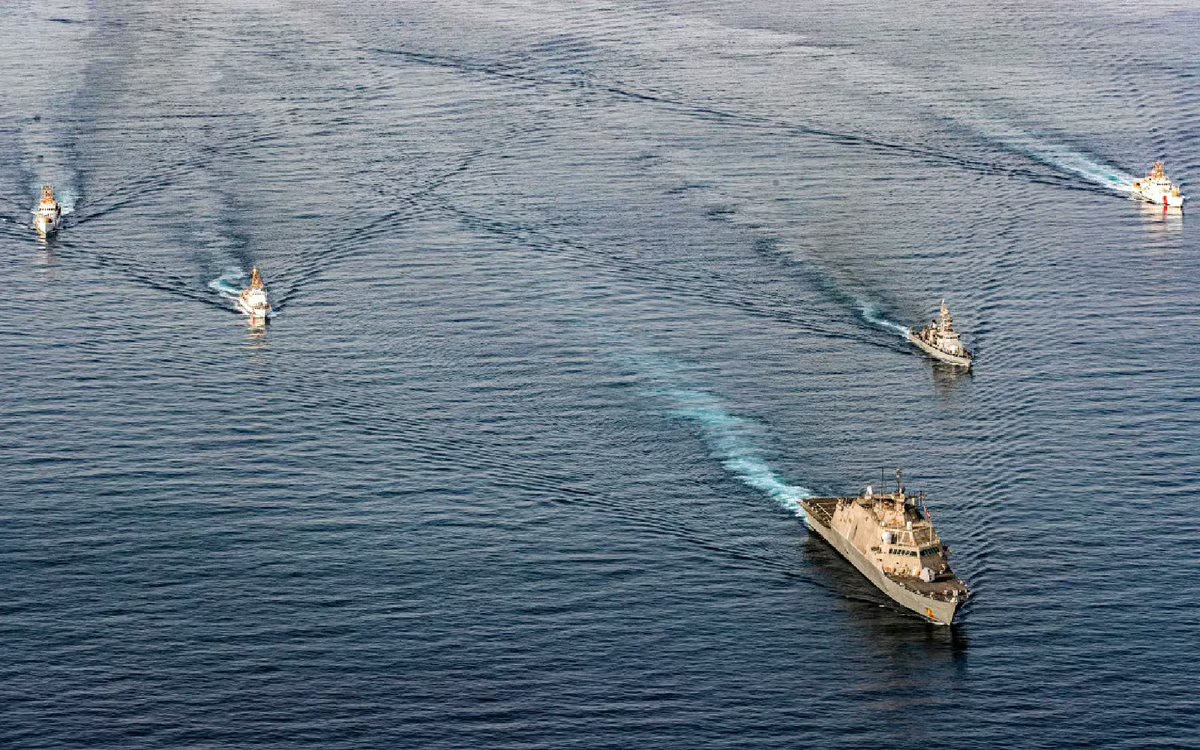
According to vessel tracking data compiled by Bloomberg, although no official figures have been released by Aramco, the rerouting of exports through Yanbu helped the kingdom restore around 60% of its prewar oil export volumes.
A Strategic Move Rather Than a Necessity
Analysts believe these deals serve a dual purpose: boosting liquidity on one hand and demonstrating the kingdom’s ability to attract foreign capital even amid war on the other. Hasnain Malik, Head of Equity Strategy for Emerging Markets and Geopolitical Risk Analysis at Tellimer, told Bloomberg: “Before the spending cuts on mega projects and the impact of the Iran war on export volumes, this approach could have been interpreted as Aramco reducing its exposure to non core assets. Now, however, it will be viewed as an effort to maximize access to liquidity for both itself and its sovereign shareholder.”
This strategy is consistent with Aramco’s long standing approach of maximizing value from its vast asset base through infrastructure sales and leverage to finance expansion while preserving liquidity for the state. The company previously sold stakes in its oil and gas pipeline networks, listed one of its subsidiaries on the Riyadh stock exchange, and is currently working on selling a stake in a local refinery to a Chinese partner.
The Foreign Investment Challenge
The deals are also driven by the need to strengthen foreign direct investment, which remains far below the Vision 2030 target of $100 billion annually by the end of the decade, while actual recent inflows have not exceeded $10 billion to $15 billion per year. Rachel Ziemba, Senior Fellow at the Center for a New American Security and founder of Ziemba Insights, told Bloomberg: “Foreign direct investment will remain a challenge,” adding that “the Saudi state needs more liquidity than ever before,” which can be partially provided through Aramco’s massive profits, taxes, and royalties from oil revenues.
Within the broader picture, Salah Shamma, Head of Investment and Portfolio Manager at Franklin Templeton Investments (ME) Limited, told Bloomberg that “the key question for investors is not the individual transaction, but the cumulative long term impact: how much future cash flow is being converted into liquidity today, and what does that mean for Aramco’s long term free cash flow profile?”
Five Key Facts
• 35 billion dollars: expected size of the entire asset sale program according to informed sources, with no official announcement from Aramco bloomberg
• 11 billion dollars: value of the lease and leaseback deal for the Jafurah gas field processing facilities with the GIP group belonging to BlackRock argaam
• 60 percent: share of oil exports restored through Yanbu according to Bloomberg vessel tracking data, with no official figures bloomberg
• 100 billion dollars: annual foreign direct investment target by the end of the decade, compared to actual inflows not exceeding 10 to 15 billion vision2030
• 28 February 2026: date of outbreak of the regional war that disrupted Gulf exports and reshaped Aramco financial priorities argusmedia