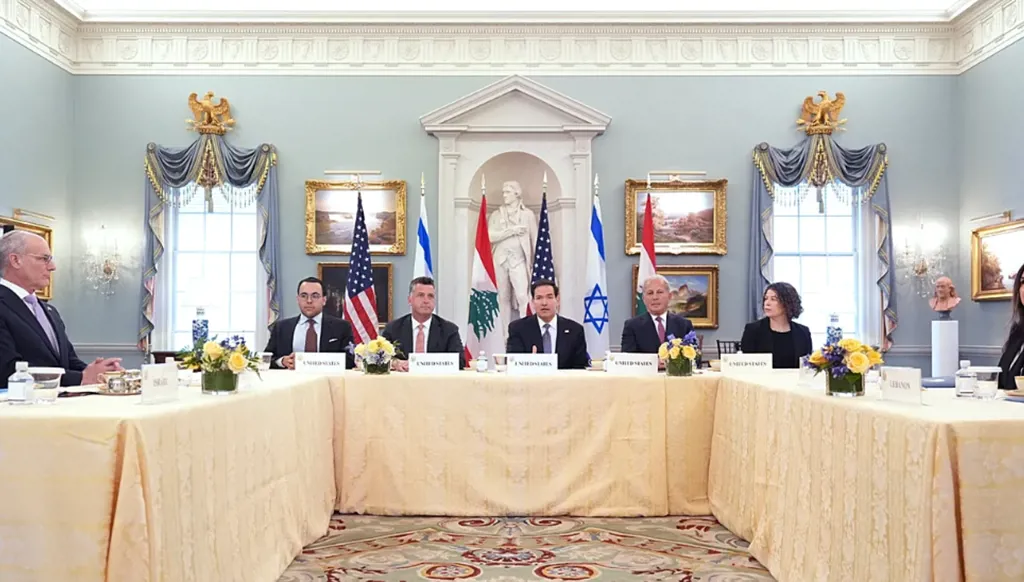
U.S.-led security talks in Washington: Lebanon-Israel negotiations move toward parallel political and military tracks

Opinion 18-05-2026 | 11:03

U.S.-led security talks in Washington: Lebanon-Israel negotiations move toward parallel political and military tracks

A U.S.-hosted framework advances dual-track negotiations in Washington, linking ceasefire arrangements, border withdrawal, and security mechanisms under American coordination.


U.S.-led security talks in Washington: Lebanon-Israel negotiations move toward parallel political and military tracks
A round of negotiations between Lebanon and Israel (Archive - AFP).
Smaller Bigger


Using two different formulations but conveying the same content, statements from the U.S. State Department and the Lebanese negotiating delegation in Washington outlined the agenda for the upcoming phase along two tracks. The first is a security track beginning at the Pentagon on the 29th of this month, while the second is the political track on June 2nd and 3rd at the U.S. State Department, continuing talks to reflect Lebanon’s “constructive engagement in negotiations” and enhance the chances of reaching a lasting peaceful settlement.


The Lebanese and American statements summarize two days of political and security negotiations, with each side reaffirming its official position and outlining the expected outcomes. This can be summarized in the following points:


1- Formally, the United States will continue to host the Lebanese-Israeli negotiations, reflecting its political support and commitment to achieving practical results.


2- Lebanon’s commitment to the objective of the negotiations, aimed at reaching a peace agreement that ensures lasting stability.


3- The launch of parallel-track talks reflects the seriousness and urgency shared by all parties to reach a settlement through both the political track related to the agreement itself and the security track focused on the arrangements required for its final implementation.


The security track session will precede the political track sessions, underscoring the importance of establishing security arrangements first. Lebanon seeks to secure measures that guarantee the ceasefire and the cessation of hostilities, with a return to the recognized international borders and the deployment of the army along these borders, before moving on to other terms concerning the return of displaced persons, the release of prisoners, and reconstruction.


A crucial point for the Israeli side concerns the guarantees demanded by Tel Aviv before any discussion of withdrawal from the occupied territories.


The guarantees primarily concern the disarmament of Hezbollah and the elimination of any threats the party may pose to Israel’s security, particularly to northern settlements. At this stage, discussions will focus on mechanisms for disarmament through the Lebanese army, which would be tasked with independently maintaining security and stability, while international support will be a key point of negotiation regarding its structure, financing, equipment, and authority—going beyond the previous mandate of UNIFIL.


Information indicates that the security track session will discuss the formation of a military committee composed of Lebanese, Israeli, and American officers under U.S. leadership to oversee the implementation and maintenance of the ceasefire, affirming both parties’ commitment. Notably, Speaker Nabih Berri informed President Joseph Aoun that the party would commit, provided Israel does the same.


The formation of such a committee would, in practical terms, confirm Washington’s central role, much like its handling of the maritime border dossier. Informed sources do not rule out the possibility of merging the maritime border dossier into this committee’s mandate, which would also oversee Israel’s withdrawal to internationally recognized borders.


The establishment of the committee would effectively eliminate the need for the Mechanism Committee and replace the role of UNIFIL, as Washington continues to reject any French or broader European involvement.