Hormuz crisis and the Beijing summit: How the strait became a Sino-American geopolitical flashpoint

Opinion 18-05-2026 | 11:51

Hormuz crisis and the Beijing summit: How the strait became a Sino-American geopolitical flashpoint

A tense confrontation in the Strait of Hormuz and the Beijing summit expose a new global order where maritime security, trade routes, and superpower rivalry collide, turning a regional chokepoint into a mirror of 21st-century geopolitics.


Hormuz crisis and the Beijing summit: How the strait became a Sino-American geopolitical flashpoint
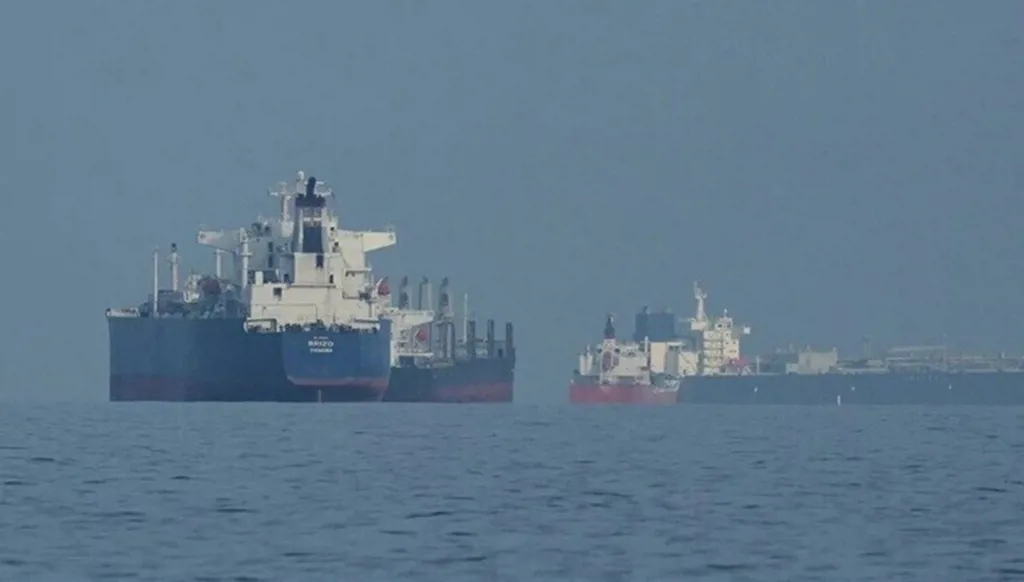
Ships in the Strait of Hormuz
Smaller Bigger

While the two leaders shook hands across the table, battleships traded blows beneath it.


This is no exaggeration, but rather a concise depiction of a moment that exposed what diplomacy sought to obscure: the Hormuz crisis is no longer a contained American-Iranian confrontation or a regional conflict kept within limits, but an open test of the rules governing maritime power in the 21st century.


Shortly before the Trump–Xi summit on May 13, 2026, in the Arabian Sea, a Chinese destroyer accompanied by support vessels veered sharply toward an American carrier strike group. The maneuver was neither accidental nor ambiguous: in one of the world’s most sensitive maritime corridors, forces from both sides stood only a single miscalculation away from confrontation.


Hormuz: a Sino-American conflict?

Within thirty minutes, the Strait of Hormuz had become a volatile theater of confrontation extending far beyond Iran and the Gulf itself. Beijing sought to signal its presence to Washington, while Washington aimed to demonstrate that its deterrence remained credible and that its commitment to Gulf allies had not weakened.


No grand settlement!

The Beijing summit did not produce a grand settlement. Instead, it served as a cold reflection of an era increasingly shaped by the managed escalation of global rivalries. The two superpowers sat at the same table, yet each arrived carrying a different map.


Washington sees Hormuz as part of a maritime system it is determined to dominate, while Beijing views the American definition of “maritime security” as a precedent that might later open the door in Taiwan and the South China Sea. Precedents in politics are prone to spread and propagate.


China has sought a delicate trade-off. While it may assist in calming Iran, it will not do so for free. It will demand a price in trade, technology, sanctions, and Taiwan. But it will ensure it does not appear as an auxiliary police officer in the American war.


Iran plays a more dangerous card. It would not be able to sustain it for more than a week or two. It bets that the rise in insurance costs, and the way traders, refineries, and governments begin recalculating risk, will be enough. Iranian deterrence does not aim to win, but to shake global confidence. Ironically, Iran’s rogue behavior compels the world to treat it as a kind of rogue gatekeeper, holding the lifeblood of global energy.


Trump believes he can absorb the repercussions of closing Hormuz. As the world’s largest oil producer at present, the United States would be among the least directly harmed. At worst, it would have to restrict oil exports to stabilize domestic prices and limit internal political fallout for Trump.


Americans believe that closing the strait would strike China at the core of its economy within six months. Beijing understands that such a crisis would quickly spill into energy and food supply chains, industrial output, exports, agriculture, and access to critical raw materials. For this reason, China does not seek Iran’s victory, but rather its containment in a form that keeps it as a manageable nuisance, sufficiently dependent on Beijing, yet restrained enough not to destabilize the entire system.


This is the Chinese equation: an open strait, but without an explicit American victory; pressure on Iran, but from behind the scenes; cooperation with Washington, but in exchange for gains.


The American equation is sharper and clearer: to use China’s influence without granting it the right to participate in shaping the system.


While the Gulf Arab states focus on containing Iranian aggression, they fear two contradictory outcomes: prolonged conflict or an escalation into intensified war.


The Chinese ships’ incident was not an isolated military detail. It was a warning bell, signaling that the crisis does not require a grand decision to widen.


A summit of symbols

If any actual skirmish had occurred on the eve of the summit, Beijing would have protested and described it as aggression against its trade. Washington would reply that it is enforcing sanctions and protecting navigation. China would then send escort ships or monitoring capabilities to the Gulf of Oman. At that point, the crisis would no longer be Iranian; instead, it would become a live test of who has the right to define maritime security.


In this sense, the Beijing summit did not close the Gulf war; it revealed its expansion. Although it may produce communication channels, undisclosed Chinese pressures, and potentially a calculated easing of some sanctions on Chinese refineries buying Iranian oil, it has not created a new framework for managing the conflict with Iran, nor a solid understanding on inspections, nor a final trade-off regarding Taiwan, or a settlement on rare metals or technology.


The summit was rich in symbols but poor in tools.


Will the crisis end with a clean victory or full peace? Or with managed attrition: Hormuz open enough to prevent collapse, yet risky enough to remain a pressure card; limited strikes that do not turn into invasion; unnamed Chinese pressure; and deeper Gulf fortifications across air, sea, and intelligence domains.


Then the question becomes not: Has the war ended? but: at what cost will it be prevented from exploding?


Will Washington ease its sanctions on Chinese companies or refineries? Will China’s purchases of Iranian oil decrease, or be restructured through intermediaries? Will maritime insurance costs fall? Will Chinese naval escorts appear in the western Indian Ocean? Will Washington postpone sensitive decisions regarding Taiwan?


What happened in Hormuz and later surfaced in Beijing indicates that the Strait is no longer merely a passage between Iran and Oman; rather, it has become a mirror of the international system, contested by two major powers.


In maritime strategy, as in ancient fire, a disaster does not need a forest; a matchstick and a gust of wind are enough.