

Lebanon’s negotiation test: Can diplomacy outpace regional conflict?
As negotiations continue under Washington’s watch, Beirut faces a defining test of state authority, Hezbollah’s influence, and regional realignment.



 Messenger
 Whatsapp
 Threads
 Email
Email
 Print
Print
 X
X
 Facebook
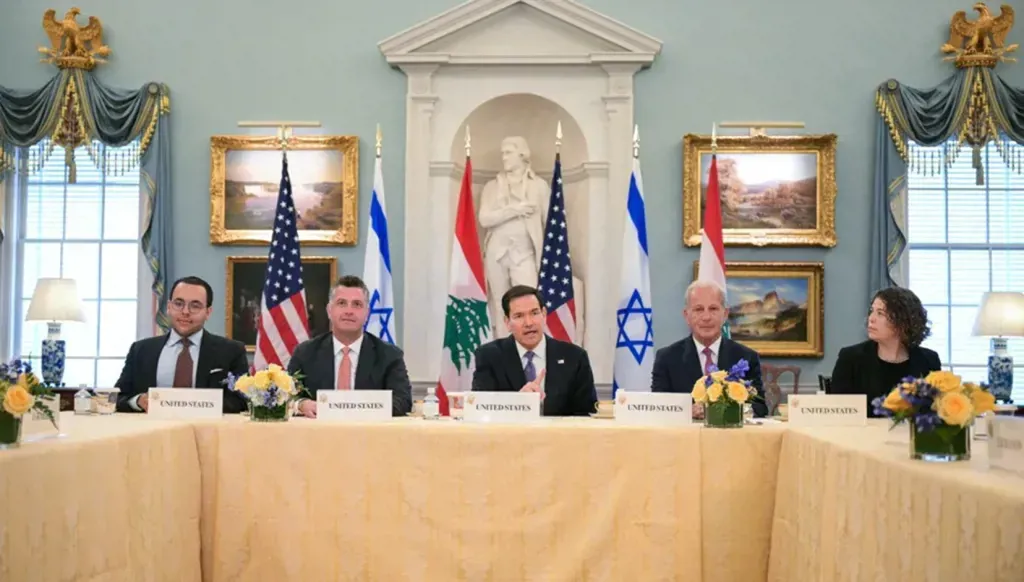


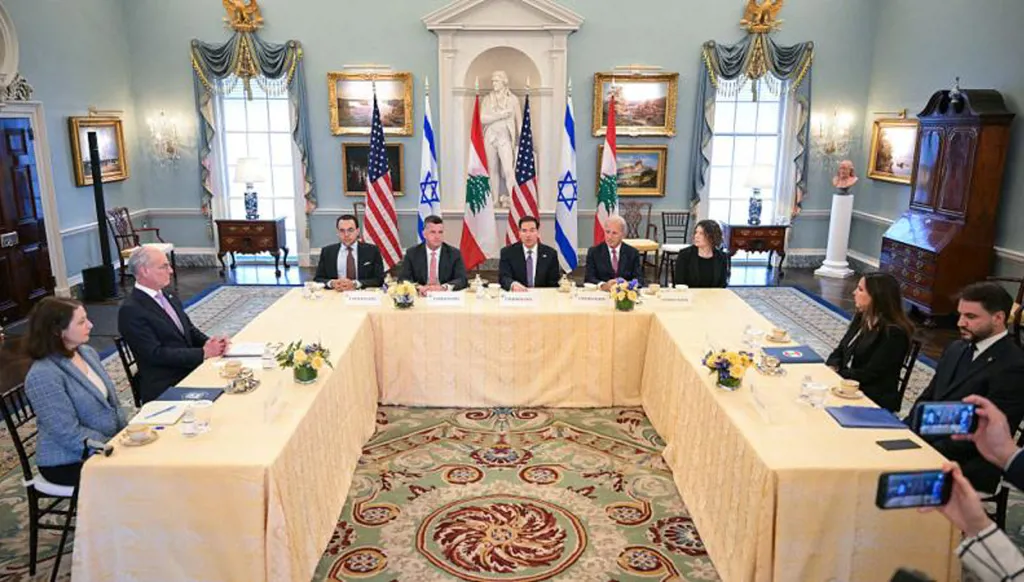
The phrase “restoration of sovereignty” is intended to embarrass the Shiite duo should it object to its inclusion in the statement, while leaving room to keep the issue, at least ostensibly and in principle, to be addressed away from public media sparring. At the same time, it also implies the restoration of sovereignty from the Israeli occupation of the south, although the phrase itself was not included among the five points the Lebanese state reportedly set as the ceiling for negotiations with Israel. This reflects an effort to minimize the causes of internal division and avoid inflaming them through rhetoric that neither serves Lebanon’s interests nor exposes such disputes to the public.
Meanwhile, Lebanon’s pursuit of restoring state sovereignty — meaning the exclusive possession of arms under state control and preventing the party or any group from holding weapons outside its authority, thereby threatening it, as well as monopolizing decisions of war and peace, particularly when backed by Iranian support — differs from the Israeli approach, which seeks the disarmament of the party because of the risks it poses to its security and the stability of the border between the two countries, alongside Israel’s attempt to prevent any Iranian “influence” or extension along its northern border.
It was frivolous to speak of a lack of tangible breakthrough in the first round of Lebanese-Israeli negotiations, as though progress were guaranteed simply by both parties sitting at the negotiating table, while overlooking the countless complexities surrounding the process. Such expectations place a burden on the negotiations greater than they can realistically bear at this stage and oversimplify the matter inappropriately.
The more fundamental issue, which surpasses the significance of these negotiations themselves, lies in the effort to save and preserve the Lebanese state amid the dangerous transformations unfolding across the region, in a way that prevents it from being swept away in the broader confrontation — much like Israel’s clearing of its southern villages — in the elephantine struggle between Israel and the United States on one side and Iran on the other.
The main positive development, aside from extending the truce by 45 days — after Lebanon had requested on April 26 an extension of one month or more and was granted only three weeks — and announcing the continuation of dialogue and negotiations between the two sides, lies in demonstrating the Lebanese state’s courageous decision to sit at the negotiating table and in underscoring its ability to launch a distinct Lebanese track that does not wait for other tracks, particularly the American-Iranian one. Although connected to it in some way, this track seeks to move alongside it in a manner that allows Lebanon to reap its benefits when the timing is right.
The most significant aspect of the direct negotiation process is that it was initiated despite the party’s strong objections and in disregard of its accusations of treason against the pillars of the state, reflecting its desire to subordinate Lebanon’s decision-making and political-security reality to Iran. Lebanon has neither received — nor may it receive — full and comprehensive guarantees of a ceasefire in exchange for continuing negotiations, just as the precondition of a ceasefire before the talks began was not met. This is despite Washington’s understanding of the importance of granting such leverage to the Lebanese negotiating delegation, whose Speaker of Parliament, Nabih Berri, stressed the necessity of securing a ceasefire, in what appeared to be an implicit acknowledgment of reliance on direct negotiations in Washington, unlike his Shiite ally.
Disclaimer: The opinions expressed by the writers are their own and do not necessarily represent the views of Annahar.