

Lebanon between the Armistice Agreement and the lines of conflict
The legal and political significance of the 1949 Armistice Agreement, and the risks surrounding any amendments that could threaten Lebanon’s borders, sovereignty, and international protections.



 Messenger
 Whatsapp
 Threads
 Email
Email
 Print
Print
 X
X
 Facebook


Gebran Soufan
Former Ambassador of Lebanon to the United Nations in Geneva
In the artistic works of the Rahbani brothers and the noble lady Fairouz, there are prophecies about Lebanon and the region, about those who “hope from afar,” as Imam Ali peace be upon him said, and thus they fall headlong into a fierce struggle between rosy dreams, unrestrained wishes, and disappointed hopes. And if the Prophet Isaiah, as stated in the Encyclopaedia Britannica, “called his wife a prophetess and then the circle of prophetic work expanded to include the school of Isaiah,” then in the school of the Rahbani brothers everyone is aware of visions, in the joy of their happiness and the sorrow of their grief.
It is no coincidence that Fairouz sang in 1962: “The moon shines upon the people, yet they choose to fight,” for we fight each other, Israel kills us, and the moon of time has grown weary of our neighborhood, while loitering drones have occupied our skies. We no longer have stones, bridges, or trees, only a stranger neighboring another stranger in a homeland of oddities. I say this while Lebanon is beginning negotiations with Israel after being dragged into a fierce war between the United States, Israel, and Iran, where advanced weapons used from air, sea, and missiles, along with diplomatic efforts, have failed to end the regional war or address its root causes and driving factors, a situation described by a political commentator in Le Monde as “like trying to empty the sea with a spoon.”
Lebanon is not in its best condition amid economic decline, social misery, psychological exhaustion, internal division, moral and educational failure, and political delusion. Nor does it seem familiar or encouraging to negotiate internally in parallel with negotiating externally, reflecting the depth of the divide and the government’s attempt to gather the fragments of this exhausted country through the conduct of its politicians as much as through its enemies. Despite the delicacy and seriousness of the situation and Israel’s superior destructive military capabilities, the Lebanese state still holds two strong cards in negotiations, its legal legitimacy and the General Armistice Agreement between Lebanon and Israel signed on March 23, 1949.
What is meant here is not merely the General Armistice Agreement as a legal document, but also its connection to the United Nations Security Council, which, despite Israeli violations, occupations, and breaches, and despite Palestinians crossing the Lebanese Israeli borders against the will of the state, has remained keen to uphold the armistice agreement. This is evident in its adoption as a reference in its resolutions concerning Lebanon, and it did not leave it to be an easy target for brothers, guests, or enemies. The reason may be that it does not possess a magic wand to solve the Middle East problem and its repercussions on Lebanon. Since Lebanon has begun negotiations with Israel, the agreement, which includes provisions related to its entity, requires utmost care, especially as we live in a time of transformations affecting the entire world and the concept of international peace and security.
I have read in the media about caution and vigilance due to Israel’s abandonment of the General Armistice Agreement and its persistence in violating its provisions and undermining its implementation, especially since 1967. This sentiment is met by positions calling for adherence to the agreement and for its revival, alongside public opinions suggesting improving some of its provisions or modifying and amending certain clauses.
I am not an expert in diplomatic affairs, although I practiced diplomatic work for nearly four decades, nor am I an expert in legal matters despite having studied law for years in the office of the two eminent figures Fouad Boutros and Bahij Tabbara, may God prolong his life, where law has its sanctity and standing. However, in light of my professional experience, I would like to shed light on some points linked to my convictions, and accordingly I present the following:
Second – Multiple Committees, Lines, and “Colored” Policies
Lebanon’s international issue is chronic and complex, as evidenced by the multiplicity of committees and related lines, including the following:
1 – The “Mixed Armistice Commission” (1949), whose mission is to supervise the implementation of the provisions of the Armistice Agreement, adjudicate complaints and claims submitted to it, and interpret the agreement’s provisions in case of disagreement.
2 – A joint liaison committee arising from the 17 May 1984 agreement (cancelled on 5 March 1984), within which operates a security arrangements committee.
3 – The committee for monitoring the implementation of the April Understanding (27 April 1996), which receives complaints, and a consultative group “aimed at helping meet Lebanon’s reconstruction needs.”
4 – The UNIFIL Tripartite Mechanism following the issuance of Resolution 1701 (2006).
The UNIFIL command chairs this mechanism, with Lebanon and Israel as members. It used to meet at UNIFIL headquarters in Naqoura, with military representation from both sides. The committee has become an integral part of UNIFIL’s work “in seeking to facilitate coordination, keep tensions low, and build trust between the Lebanese and Israeli sides” (periodic reports of the UN Secretary-General). UNIFIL’s leadership was the first among UN peacekeeping forces to establish such a committee following Resolution 1701 (2006), and it is highly regarded by the UN Security Council and the UN Secretariat.
5 – The Lebanon Military Technical Committee (MTC4L) (2024).
It is mentioned in Articles 8 and 9 of the “Declaration on the Cessation of Hostilities and Related Commitments… for the implementation of Resolution 1701” dated 27 November 2024, within which the United States and France operate to enable the Lebanese Army to deploy its forces and to cooperate with the international community in strengthening its capabilities in an effort to implement Resolution 1701.
6 – The “Mechanism” committee, tasked with monitoring, verification, and assisting in the implementation of obligations, receiving notifications of violations, and coordinating the implementation by Israeli forces and the Lebanese Army of the detailed phased withdrawal and redeployment plan within a maximum period of 60 days (Articles 9, 10, and 12). In my view, it assumes UNIFIL’s responsibilities in an enhanced form, yet it is neither active nor effective when measured against the gravity of events.
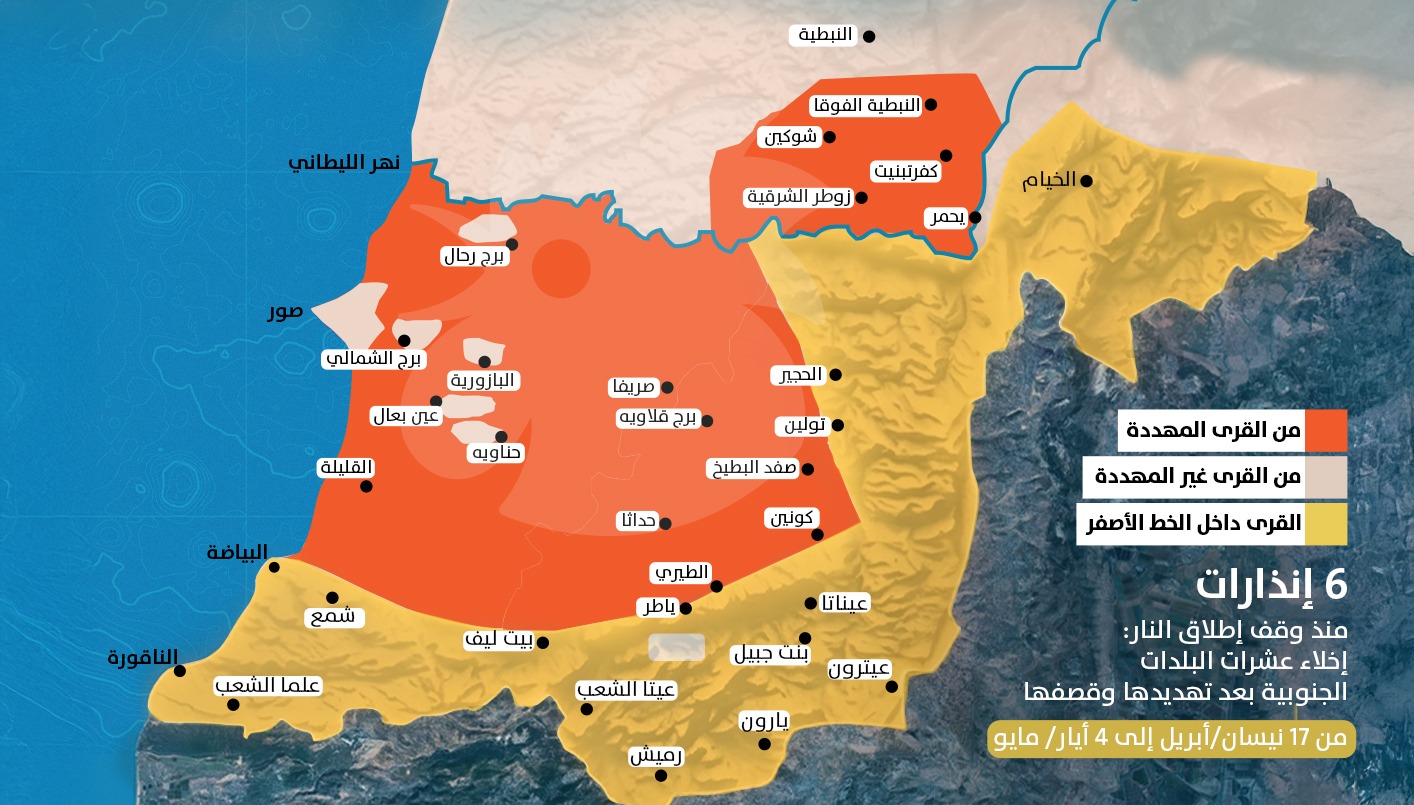
Alongside this proliferation of committees, the colors associated with the various lines also multiply; the South is not adorned by them, but rather fragmented by them.
Disclaimer: The opinions expressed by the writers are their own and do not necessarily represent the views of Annahar