

Why is Xi Jinping the one leader Trump can’t ignore?
Beyond the bravado, Donald Trump encounters in Xi Jinping a rival he neither dominates nor fully understands, making China the ultimate test of American confidence.



 Messenger
 Whatsapp
 Threads
 Email
Email
 Print
Print
 X
X
 Facebook
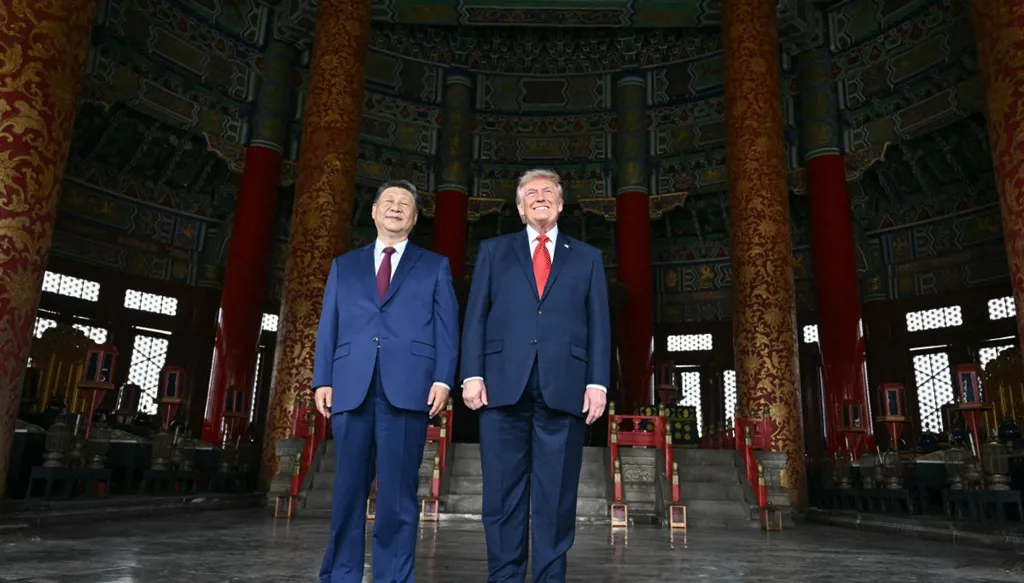


Donald Trump was born on June 14, 1946, in New York into a wealthy family, the son of a successful real estate developer, often described as having been born with a silver spoon in his mouth. Exactly seven years and one day later, on June 15, 1953, Xi Jinping was born on the other side of the world into a prominent political family, the son of a senior Communist leader shaped by the era of Mao Zedong.
The Cultural Revolution certainly did not affect Trump, and Xi did not know what McDonald’s was until later in life. Both struggled through life in their own country’s way: Trump as we know him, and Xi as the Chinese narrative presents him, an exiled teenager during the Revolution in the late sixties, sent to a remote village, performing hard manual labor, eating simple peasant food, and living for seven years in a primitive cave dug into a mountain, before emerging from the experience a committed communist and joining the Communist Party. Meanwhile, Trump’s journey progressed along its own path until both men reached the peaks of the world’s greatest powers. Xi preceded Trump, so when the latter arrived for the first time, he found Xi already established as China’s elder; and when he returned four years later, he found him still there.
The two men belong to the same zodiac sign, sharing similar height and build, as well as an interest in concealing their gray hair, each according to his preferred dye. Any search for similarities between the two leaders ends there; beyond that, the comparison becomes one of pure contrast. Xi’s carefully composed, ironclad smile, revealing little as to whether it is welcoming, threatening, or shaped by sardonic thoughts, stands in stark contrast to Trump’s Hollywood-style expressions, which shift with his moods and make his thoughts easy to read. Not only does his verbosity give him away, but his facial expressions do as well, rendering him a losing gambler at any poker table.
Each serves as a mirror image of his country: Trump, with his overflowing self-expression, and Xi, with his stoic restraint. Although this is not their first meeting, it remains an intriguing spectacle, particularly in Trump’s case, one that may not recur for the Chinese president with any future successor in the White House.
But China is another story...
Xi is the one leader Trump does not look down upon from the high hill from which he views America, and himself. Vladimir Putin? King Charles III? Pope Francis? None fully command the gaze of the proud American. China, however, is a different matter. This vast economic, industrial, and commercial experiment, achieved without moving a single warship across any sea or ocean, becomes a source of both fascination and deep envy for the American president. A true dragon, one Trump understands cannot be tamed; an octopus whose arms multiply upon themselves, so that each time he attempts to sever one, many more emerge from its root.
Going to China and meeting its leader is a challenging task for Donald Trump, one in which his confidence in his country appears unsettled, prompting him to amplify his displays by bringing along CEOs whose companies carry a combined market value of tens of trillions, almost as if to say, “my father is stronger than yours.” In return, Xi Jinping offers a characteristically enigmatic smile, neither fully welcoming, nor threatening, nor mocking, yet one that unmistakably suggests a multitude of thoughts moving through the Chinese leader’s mind, thoughts he is careful to keep concealed from this readily expressive American.