

Thirty years after Oslo, Israel may be closing the door on Palestinian statehood
From the Rabin–Arafat handshake to today’s political divisions and settlement expansion, a look at how the Oslo framework has been eroded amid shifting Israeli politics, Palestinian fragmentation, and limited international pressure.



 Messenger
 Whatsapp
 Threads
 Email
Email
 Print
Print
 X
X
 Facebook
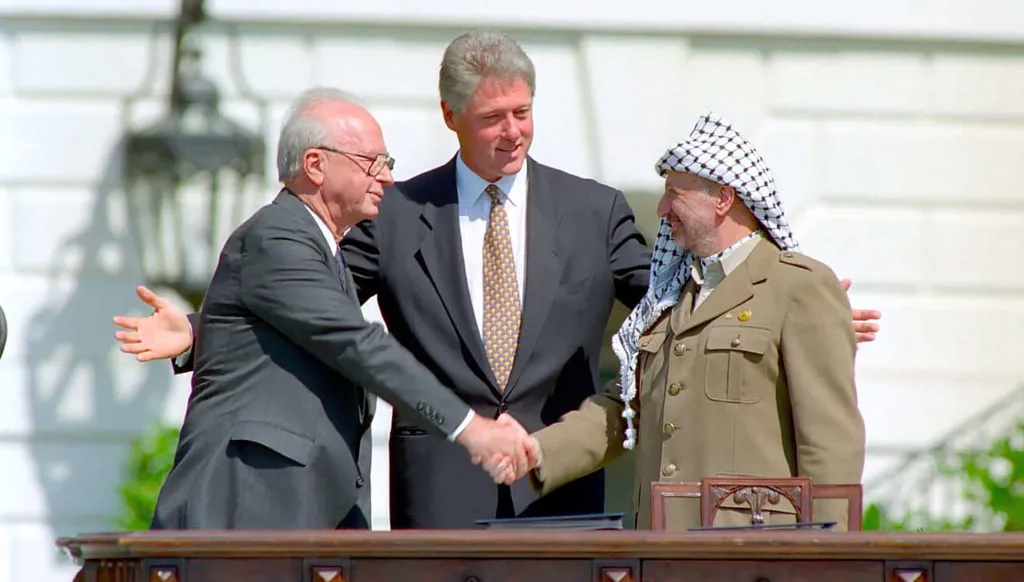


Practically, Israel has begun a gradual plan to annul the Oslo Accord, signed on September 13, 1993, between Israel and the Palestine Liberation Organization, which aimed to end decades of conflict by establishing a transitional Palestinian self-rule in the West Bank and Gaza. The agreement emerged within a broader U.S.-sponsored peace process between Arabs and Israel, whose first major step was the Camp David Accord between Egypt and Israel in 1978, which referred to pursuing similar peace agreements with Jordan and establishing self-governance for Palestinians in Gaza and the West Bank.
Rabin-Arafat handshake
The handshake between Israeli Prime Minister at the time, Yitzhak Rabin, and the head of the Palestine Liberation Organization, Yasser Arafat, was intended to symbolize the end of a bloody conflict that arose from the occupation of Palestine and the displacement of its people in 1948. However, the agreement received its first violation two years later, when an extremist jew shot Rabin, killing him. This marked the beginning of a series of shocks, most notably the assassination of Palestinian leader Arafat by poisoning in 2004, according to many reports that held Israel responsible for his assassination following his long siege at the Palestinian presidency in Ramallah.
Israel’s legal annulment plan began with a bill submitted by the far-right “Jewish Power” party, led by the extremist security minister Itamar Ben Gvir. Prime Minister Benjamin Netanyahu delayed discussing it but did not reject it, indicating a wait for a more appropriate timing until Israel finishes its military battles.
The facts on the ground confirm that Israel, whose far-right rejected the agreement from the start, did not adhere to its implementation, exploiting ambiguities in some of its clauses, particularly those related to the authorities of the Palestinian Authority, internal security, and the final status and situation of Jerusalem, among other contentious issues.
Policy of gradual encroachment
Israeli governments, especially those of Benjamin Netanyahu, adopted a policy of gradual land encroachment after withdrawing from Gaza and handing over civilian administration to the Palestinian Authority in the West Bank and Gaza. This was done alongside isolating Palestinian communities from each other through settlements and bypass roads under military control, while eroding the Palestinian Authority's powers, particularly after Yasser Arafat’s demise and under the leadership of Mahmoud Abbas in Ramallah. In a fragmented region, especially after the Iraq invasion in 2003 and the subsequent Arab Spring uprisings, the Israeli right intensified its dismantling of the accord, employing a strategy based on two parallel lines: increasing violence against Palestinians in the West Bank and Gaza and suppressing successive uprisings using excessive force, and on the other hand, deepening divisions among Palestinians by “allowing” Hamas to control Gaza, thereby undermining the Palestinian Authority’s negotiation leverage. This led Netanyahu and other government leaders to observe the “Fatah”–“Hamas” political and occasionally violent conflict.
The Ben Itamar bill calls for annulling all agreements signed between Israel and the Palestine Liberation Organization, and later with the Palestinian Authority, as well as all executive legislations, effectively returning the conflict politically, security-wise, and militarily to the pre-1993 stage. This implies the complete elimination of the Palestinian Authority, the re-occupation of the West Bank and Gaza Strip, and the legal legitimization of settlement activity rather than what is described as the current de facto situation. It is also presented as effectively removing the Palestinian state project from consideration amid the current regional circumstances and the ongoing Israeli campaign extending from Lebanon and Palestine to Iran.
The long-standing experience with Israeli governments indicates that they may retreat a step in negotiations in order to advance two on the ground, and since the 1947 decision to partition Palestine, namely the UN Partition Plan for Palestine 1947, they have pursued a policy of encroachment, seizing lands when possible through laws enacted for territories under their control, as occurred with the Syrian Golan and as is happening now with West Bank lands and parts of Gaza, whose future remains uncertain. While some view the proposal to annul the agreement as electoral grandstanding ahead of the upcoming general elections in Israel, this argument is challenged by the claim that Israeli society as a whole is increasingly leaning toward far-right extremism, and that demagogic slogans often materialize over time, especially when U.S. President Donald Trump, seen as a close ally of Netanyahu, had previously given him an important diplomatic gift by moving the U.S. Embassy to Jerusalem, an action associated with the US Embassy relocation to Jerusalem 2018, thereby reinforcing Jerusalem as the “eternal capital” of Israel according to Zionist doctrine, regardless of whether the governing leadership is far-right or a leftist equally characterized as violent and bloody.
The Western world, which was in one way or another a sponsor of the agreement and viewed it as an acceptable compensation for Palestinians equivalent to a full-fledged state, cannot prevent Israel from annulling it. Its measures, limited to condemnation, denunciation, and the imposition of some timid sanctions on illegal settlements and extremist settlers, have no real influence on Israeli decision-making.
Whether the agreement is officially annulled or not, Israel has effectively nullified it, as it has with all international resolutions from 1947 to the present day.
Disclaimer: The opinions expressed by the writers are their own and do not necessarily represent the views of Annahar.