Why the Palestinian Nakba is still unfolding after eight decades

Opinion 15-05-2026 | 11:52

Why the Palestinian Nakba is still unfolding after eight decades

From 1948 to Gaza today, the Palestinian struggle reveals a history of displacement, fragmentation, and unresolved political failure.


Why the Palestinian Nakba is still unfolding after eight decades
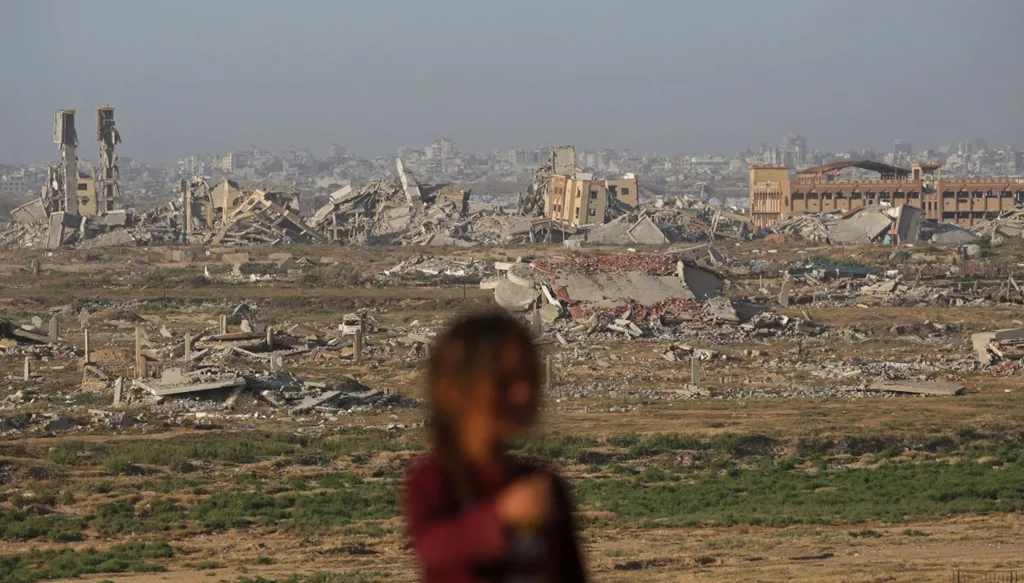
A Palestinian girl stands in front of destroyed buildings in Deir al-Balah, central Gaza Strip, on May 13, 2026. (AFP)
Smaller Bigger


It seems that the tragic fate of the Palestinians is to live between one Nakba and another for nearly eight decades, ever since the establishment of Israel at their expense as a Jewish state in the Middle East, which led to the loss of their homeland, the erosion of their social unity as a people, and their transformation into refugees, deprived of their right to self-determination through a political entity that represents them, like any other people in the world.


There are three foundational Nakbas in Palestinian history. The first Nakba (1948) laid the foundation of the Palestinian historical narrative and shaped the collective national identity of the Palestinian people. The second Nakba, which followed the June 1967 war and became known as the “Naksa,” enabled Israel to occupy the remaining Palestinian territories (the West Bank and Gaza Strip) thereby asserting its dominance over Palestinians from the river to the sea. As for the third Nakba, ongoing since October 2023, it has resulted in the destruction of Gaza, rendering it uninhabitable, with more than two million Palestinians deprived of water, electricity, food, fuel, medicine, and shelter as a result of the genocidal war waged by Israel against them for two and a half years.

Erasure, disappearance, and marginalization


The implication is that Israel has done everything in its attempt to erase, displace, or marginalize the Palestinians—across place, time, and meaning—in its quest to perpetuate its existence and affirm its legitimacy, according to religious myth, the realities of power, and international and regional dynamics, all at once.


However, the Palestinian issue in its Nakbas does not stop at what Israel has done to the Palestinians, as there is also an Arab reality that facilitated or allowed the establishment of this state as a result of weakness, division, and fragmentation at both the state and societal levels. It is impossible to explain the emergence of Israel as a foreign state with its colonial, settler, and religious character, and consequently its stability, development, and transformation into a major regional power in the Middle East, without taking into account that unfortunate Arab reality.


Furthermore, there is also within the Arab reality what exacerbated the tragedies of the Palestinians, as it not only failed to enable them to remain on their land during the first Nakba, but also worked to prevent their existence as a people thereafter. This included obstructing the establishment of their own political entity by aborting the project of the “All-Palestine Government” (1/10/1948) and depriving them of the ability to express themselves politically. This coincided with the goal of the Zionist movement, and later Israel, to make the Palestinian people disappear and remove their cause from the Arab and international agenda.


Iran took up the role


In addition to the above, the Arab regime, despite its differences and disparities, has dealt with the Palestinian issue and its people as a means of political investment or merely a bargaining chip in regional and international politics, using it as a tool for negotiation and pressure. To a large extent, Iran later assumed that role, invoking the issue against Arab regimes to cover its own policies and legitimize the interventions of its sectarian militias in the countries of the Arab world.


For their part, the Palestinians, through their political forces and national movement, bear some responsibility for their current condition, as they failed to formulate a reasonable and effective political and struggle strategy that would enable them to preserve their identity as a people and assert their reality within prevailing power dynamics. They were also unable to safeguard the national achievements made since the emergence of their contemporary national movement, due to the deterioration, factionalism, and divisions that have marked this movement over the past six decades.


Moreover, it became apparent in many cases that Palestinian factions acted as extensions of the policies of various Arab regimes toward the Palestinian issue, a pattern that later came to include regional powers as well. This turned the Palestinian cause into a card for political consumption or leverage in the hands of one regime or another, undermining the justice and legitimacy of the cause and diminishing the value of the sacrifices made by its people.


Faced with Israel, the Palestinians were unable to penetrate Israeli society in a way that would allow them to invest in its internal contradictions, whether between religious and secular groups, Easterners and Westerners, moderates and extremists, or the left and the right. This comes as the extreme nationalist and religious right has come to dominate Israeli society, reflected in its support for brutal genocidal policies and racist measures against Palestinians from the river to the sea.


Ultimately, the situation of the Palestinians today, on this ongoing anniversary of the Nakba, appears extremely difficult and complex, as though the Nakba is reproducing itself. The Palestinian national movement is at its weakest point, following the failure of the political and struggle options it pursued, as well as the divisions and differences among its factions. Meanwhile, the Palestinian people appear fragmented, almost as though they are multiple peoples, with differing priorities and divergent choices.


And the greatest problem in all of this is that no Palestinian party appears to be acting on the basis of an understanding of these realities, challenges, and dangers, nor working to change them, confront them, or mitigate their negative consequences.


Disclaimer: The opinions expressed by the writers are their own and do not necessarily represent the views of Annahar.