

Lebanon at a breaking point: internal divisions, Iran’s influence, and the Washington talks
As Lebanon navigates indirect and direct negotiations amid regional tensions, deep internal political fractures and accusations of external alignment raise fears that the country’s sovereignty and stability are at risk, unless decisive internal unity prevails.




 Messenger
 Whatsapp
 Threads
 Email
Email
 Print
Print
 X
X
 Facebook


The majority of the Lebanese political scene did not stop at the striking manifestation of ties between Iran’s proxies and its leadership, especially after information leaked about Hezbollah’s direct participation in the delegation accompanying the Iranian negotiators during the Islamabad round.
However, this in no way diminished the growing astonishment across the entire Lebanese political scene, including the official presidential, governmental, constitutional, and parliamentary party sectors, at the “refrain” repeatedly invoked by Parliament Speaker Nabih Berri, as he continues to stake his position on the Islamabad track while refusing to grant any legitimacy, leverage, or negotiating mandate to the Lebanese negotiator with Israel. This equation has come close to surpassing, in its adversarial implications toward the option of direct negotiations adopted by the Lebanese presidency and state, even the atmosphere of military hostility that prevailed during the negotiations over the May 17 Agreement in 1983, following Israel’s invasion of Lebanon and its advance to the capital, Beirut.
The harshest experience
The implication behind highlighting this aspect of the complexities facing the Lebanese negotiator, who embarked yesterday on what is expected to be the most difficult and severe experience of direct negotiations under American auspices in Washington, is that the Lebanese faction represented by the Shiite duo, “Amal Movement” and “Hezbollah,” by intensifying the internal complications confronting the negotiating Lebanese state, strongly seeks to align its battle against the Lebanese option with the Iranian complications surrounding the American-Iranian negotiation track. In doing so, the Shiite duo aims to repeatedly obstruct major agreements between Lebanon and Israel and preserve Iran’s long, active, and influential reach within Lebanon.
The Lebanese state has been besieged throughout this negotiating journey, both on the ground and diplomatically, in an overwhelmingly suffocating manner. Finding a way out of these dual sieges has become akin to searching for a needle in a haystack.
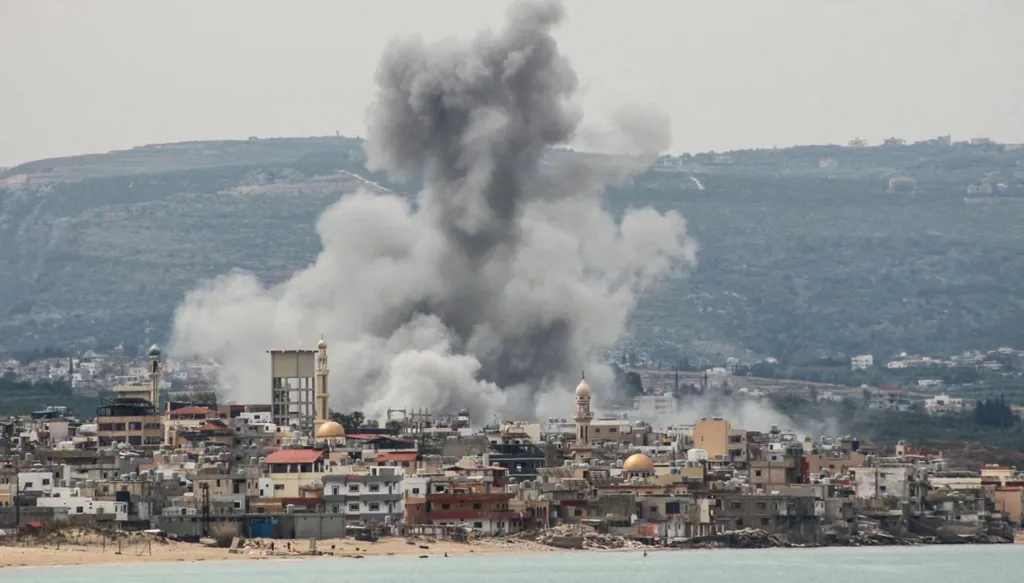
There is no difference whatsoever between the escalating military aggression in the south, and, through it, in areas vulnerable to an expansion of the war, and the political aggression directed against the state, which continues to withstand the overwhelming Lebanese anger toward the party that serves Iran until the last Shiite and Lebanese individual, while allowing Israel unrestricted, incendiary, and occupation-driven incursions without any red lines.
The culture of treason accusations
In parallel with the scathing campaigns launched by this party, known for what its critics describe as a deeply entrenched culture of accusations of treason, against the Presidency and the Cabinet, and particularly against the foreign minister, not to mention its traditional opponents, who now effectively include everyone outside the Shiite duo, including those within the Shiite community who oppose the duo’s dominance, the outlines of a crisis greater than the current war and its repercussions begin to emerge. This becomes evident when the unavoidable question is raised: what about the day after the war, in terms of the system, politics, and governance of the devastated Lebanon that Hezbollah, in service to Iran, has helped bring about?
This is a catastrophic test unless the Lebanese majority stands on equal footing in confronting this challenge and contains those who are besieging it within a strategy that has become more urgent and pressing. Lebanon’s continued dependence in this manner on a war that is difficult to halt, or on the ambitions of a faction aligned with Iran, will lead this time to the obliteration of Lebanon as a state, in a far worse form than what accompanied the collapse of the May Agreement and the developments of the 1980s.
History repeats itself when this kind of subordination prevails, and the only cure for it lies in internal resolution, first and foremost.
Disclaimer: The opinions expressed by the writers are their own and do not necessarily represent the views of Annahar.