

Inside Trump’s China visit: Trade, technology, and global power
Washington arrives divided as it faces Beijing in a world defined by conflict, AI competition, and fragile balance.



 Messenger
 Whatsapp
 Threads
 Email
Email
 Print
Print
 X
X
 Facebook
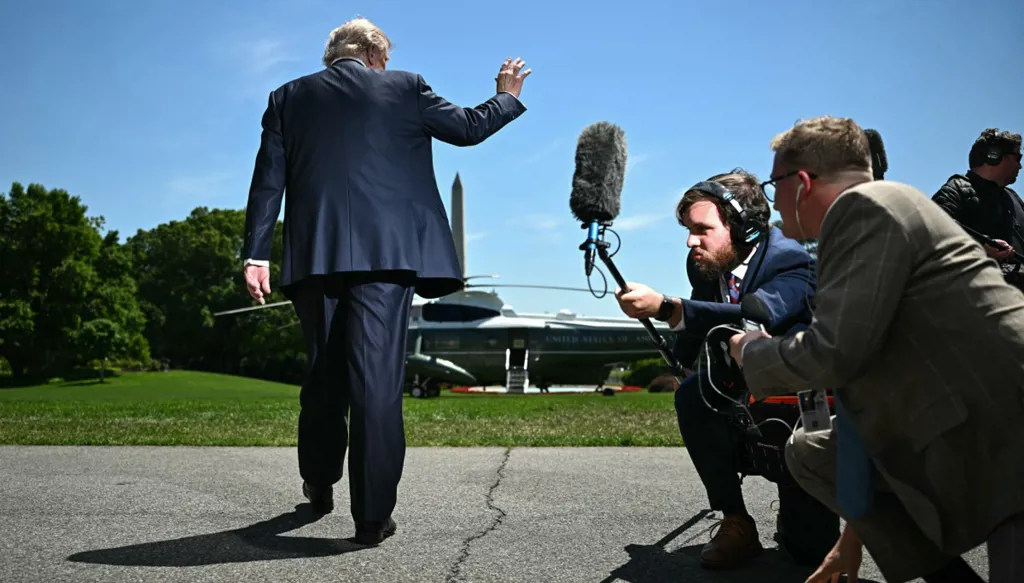


Nine years ago, he entered China carrying the certainty of American power, the belief that the world was still governed solely from Washington. Today, Donald Trump returns to Beijing for a full three days, not merely as a president visiting a trade rival, but as a leader who understands that the century his country tried to shape alone has begun to write itself in two languages.
This is Trump’s second visit to China since his first trip during his previous term in office, but it differs from it as much as the world before pandemics, wars, and sanctions differs from the world today. Back then, Washington spoke confidently about containing China. Now, it arrives in Beijing amid a war draining the Middle East, a disrupted global economy, and a technological race that looks more like a survival contest than a struggle for dominance.
Trade will be the first issue on the table. The United States remains China’s largest economic partner despite all the talk about decoupling. Between the two countries stand massive tariffs imposed by Trump on Chinese goods years ago during the trade war, in an attempt to slow Beijing’s economic rise and reshape global supply chains. But the question hovering above the numbers is not how high the tariffs are, but whether they have truly succeeded in restraining China, or merely pushed it to accelerate its economic self-reliance.
However, the Middle East will be present in closed-door meetings more than it will appear in official photographs. The war with Iran, and the risk of its expansion, have made Washington realize a truth it was reluctant to quickly acknowledge: major regional crises cannot be managed without China. Beijing is not only a geopolitical rival, but also the largest buyer of Iranian energy and a holder of economic influence capable of applying pressure or easing tensions. Here, the irony is striking. The United States, which spent years putting pressure on China, now finds itself needing it to help manage escalation in the Middle East.
But the visit, despite all its weight, does not guarantee outcomes as its surface might suggest. There is a possibility that is not often discussed: that these three days could shift from an attempt to reduce tensions into a moment that reveals the limits of American power itself.
In high politics, visits do not fail because the sides do not talk, but because they talk extensively without ever agreeing on a shared definition of the world. Beijing and Washington may leave this table not with a new agreement, but with a deeper conviction: that the gap between them is no longer being managed but merely observed until the moment of either explosion or gradual separation.
“Two wings…”
What makes the picture even more complex is that Trump’s own team is not a single bloc. Between an economic wing that seeks de-escalation with China to protect markets, and a security wing that sees any rapprochement as a strategic concession, the visit itself could become an internal test as much as an external one. This raises a more dangerous question: is Washington going to Beijing with one voice… or with multiple voices negotiating against each other before they even negotiate with China?
But the most critical file may not be oil or war, but artificial intelligence and semiconductors. The presence of tech leaders within Trump’s delegation is not a matter of protocol; it is an acknowledgment that the real battle is no longer only over ports, but over the future itself. Semiconductors have become the new language of power, and whoever controls them controls the economy, weapons systems, and artificial intelligence all at once.
That is why the question quietly following the visit is this: has Washington shifted from a policy of “preventing China’s rise” to a policy of “managing China’s rise”? Because the difference between the two is like the difference between trying to stop a river and trying only to redirect its course.
From there, the shadow of Taiwan looms over the entire table. But Taiwan’s significance does not lie only in its political dimension; it is also a silent hub of the modern global economy.
From smartphones to aircraft to defense systems, the world runs through supply chains that cannot be separated from the island that produces the most advanced semiconductors in the world. Taiwan is not merely a sovereignty dispute; it is a technological choke point.
Here lies the contradiction: the more Washington and Beijing speak about “decoupling,” the more tightly global industry remains bound to Taiwan. It is as if the world is building its new system on ground it knows is the most fragile point in the balance of power.
And the question that is never asked openly is this: what happens to the global system if this small island becomes a single point of failure for AI, weapons, and economic supply chains all at once?
Beyond a truce
For this reason, the visit appears larger than a meeting between two presidents, and deeper than a simple trade truce. It is an attempt to test a more dangerous question: is it still possible to manage competition between the two largest powers without sliding into a confrontation that reshapes the world by force?
Perhaps Beijing will not emerge with a historic announcement that immediately changes the world. But what happens during these three days may reveal something more important: how the new century thinks about itself. Because the world is not only waiting for what Trump and Xi Jinping will say, but for whether the major powers have finally reached a disturbing conclusion… that breaking the other is impossible, and that coexisting with it, however fragile, may be the only option to save this century from itself.
Disclaimer: The opinions expressed by the writers are their own and do not necessarily represent the views of Annahar