

Starmer faces party revolt as Britain confronts political and strategic pressure
Labour divisions deepen at home while Britain navigates electoral backlash and rising tensions linked to developments in the Strait of Hormuz.



 Messenger
 Whatsapp
 Threads
 Email
Email
 Print
Print
 X
X
 Facebook
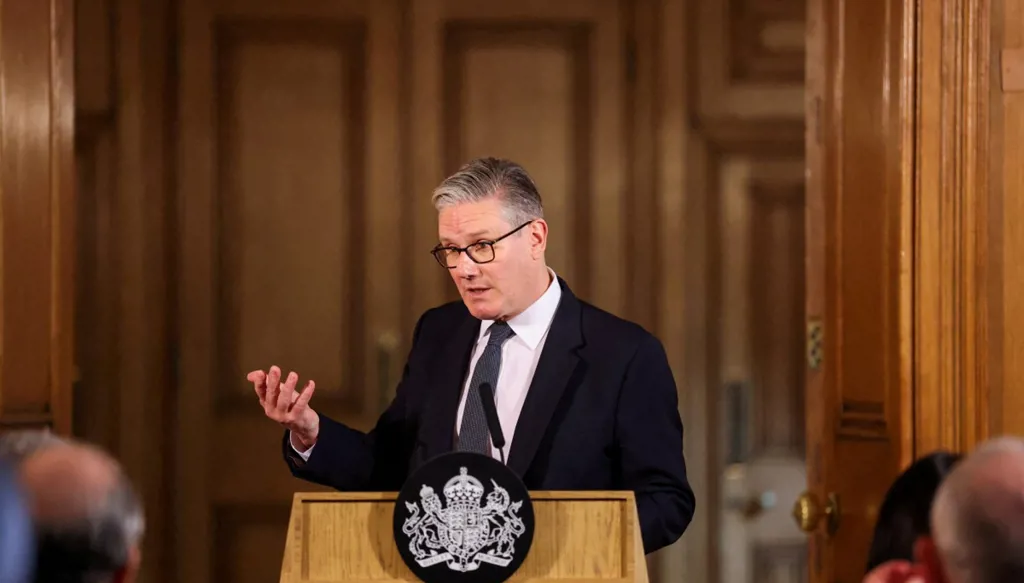


While British Defence Minister John Healey was chairing, together with his French counterpart, a virtual meeting on Monday with counterparts from around 40 countries to discuss the Strait of Hormuz “campaign,” his country’s government was going through its worst crisis threatening the ruling Labour Party and its leader Keir Starmer. Days earlier, on Thursday, the country had held comprehensive local elections that ended in a defeat for Labour, which had brought them to power through the 2024 legislative elections.
These are local elections with their own regional calculations, and they come three years ahead of the major legislative elections in 2029 that determine which party will govern the country. Although voters’ opinions can change and circumstances are constantly evolving, a mood within the party has released anger against its leader.
Admission...
Starmer admitted defeat. He announced that he takes responsibility. He acknowledged that mistakes were made that could have been avoided and should be corrected. While he promised to listen carefully to voters’ messages and take appropriate action, a “rebellion” broke out within the party leadership ranks. Resignations piled up inside the government, and the number of Labour MPs calling for him to resign and choose a new party leader increased.
Days before the event, London had deployed the HMS Dragon destroyer to operational areas near the Strait of Hormuz. The destroyer specializes in air defense against missiles and drones, making it suitable for escorting ships in the strait. London’s announcement came after a similar one from Paris revealing that the French aircraft carrier Charles de Gaulle had passed through the Suez Canal, coming from its mission in the Eastern Mediterranean toward the operational zone of the strait in preparation to take part in the same operation.
It appeared that the “coalition of the willing” not formally engaged in a war with Iran was beginning to shift from a theoretical political and media workshop, independent of the United States’ decisions and those of President Donald Trump (and perhaps in defiance of him), into an operation deploying military resources that Iran is threatening.
Earlier, at the end of last month, the Wall Street Journal published a leaked cable from the US State Department indicating that the administration had instructed its embassies around the world to work on persuading allied countries to join a new international coalition aimed at securing the Strait of Hormuz. Days earlier, Trump threatened Iran with a “Project Freedom Plus” to open the strait, and it appeared that London and Paris may have become part of an alliance possibly led by Washington.
Starmer defies dissent
The British Defence Minister went on to support his Prime Minister, Keir Starmer, warning against dragging the country and the Labour Party into a leadership war and internal divisions at a time of major geopolitical crises—one in Ukraine, where Britain plays a pivotal role, and another in Iran, where the Strait of Hormuz is effectively under pressure as London and its partners prepare for a venture that could turn from an exercise into involvement in a new war. Britain fears falling into the same “farce” it saw in the Conservative Party years ago, when its structures split and leadership multiplied until it lost power and slid into a decline it has not recovered from.
In contrast to this “rebellion,” Starmer stands defiant, barely believing that his historic party is being defeated while the right-wing populist Reform UK party, led by Nigel Farage, is achieving a sweeping victory. Labour voters have drifted leftward toward the Green Party and the Liberal Democrats, while others, including some from the working class, have shifted further right to support Farage and his party. It appears that voters, out of frustration with the traditional major parties (Labour and Conservative), have turned to a populist right-wing party that holds barely eight seats in the House of Commons and distributes promises without certainty.
In the surreal nature of the scene, one can imagine Vladimir Putin smiling, who dislikes Britain, its system, and its leaders, and Donald Trump smiling, who dislikes Starmer, who refused to join his war on Iran, with even King Charles III’s visit to Washington failing to repair strained relations. One can also imagine Iranian leaders smiling, buying time in the hope that their adversaries and rivals weaken, awaiting the eventual departure of Trump from the White House.
Disclaimer: The opinions expressed by the writers are their own and do not necessarily represent the views of Annahar