GCC Railway mega project: 2,186 km Gulf rail network linking Kuwait to Oman targets 2030 launch

Business Tech 14-05-2026 | 11:40

GCC Railway mega project: 2,186 km Gulf rail network linking Kuwait to Oman targets 2030 launch

A landmark regional railway connecting six Gulf countries is advancing past 50% completion, with major infrastructure contracts, rising freight ambitions, and full operations targeted for 2030.


GCC Railway mega project: 2,186 km Gulf rail network linking Kuwait to Oman targets 2030 launch
Smaller Bigger


The Saudi Railway Company (SAR) launched a tender on May 7 for design consultancy services for the Saudi segment of the Gulf Cooperation Council railway project, which extends 672 kilometers from Khafji near the Kuwaiti border to Al Batha at the UAE border. The deadline for bid submissions is June 30.


The magazine “Meed” reported that the consultation includes reviewing and updating the existing preliminary design in preparation for the construction phase. This coincides with Kuwait signing a contract worth 2.5 million Kuwaiti dinars (about 8.1 million dollars) with the Turkish company “Proyapi” to design the Kuwaiti section, which measures 111 kilometers, according to reports issued by the Kuwaiti Public Authority for Roads and Land Transport.


Engineer Mohammed bin Fahd Al Shubrami, Director General of the Gulf Railway Authority, announced that the project’s progress has surpassed the 50% mark, with full operation targeted by December 2030. Al Shubrami described the project as one of the most significant joint infrastructure projects among the council countries, enhancing economic integration, strengthening supply chains, contributing to the localization of industries linked to the railway sector, and creating new job opportunities.


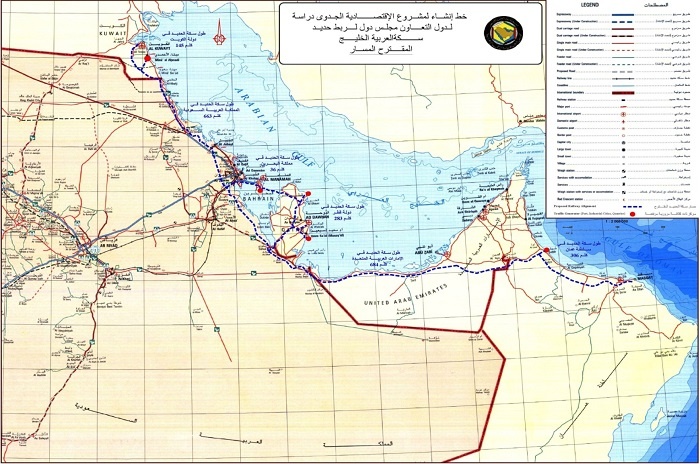
A detailed map of the project (Gulf Cooperation Council official website).


The main line extends 2,186 kilometers from Kuwait, passing through Dammam in Saudi Arabia, then continuing to Bahrain via a planned bridge, and from there to Qatar and the UAE, ultimately reaching Muscat via Sohar in Oman. Train speeds are designed to reach 220 kilometers per hour for passenger services and 80–120 kilometers per hour for freight services.

According to data from the GCC General Secretariat, the number of passengers is expected to exceed eight million by 2045, while freight transport is estimated at around 95 million tons in the same year. The project is politically rooted in the momentum of the AlUla Declaration issued in January 2021, as well as Qatar’s subsequent approval of the Saudi linkage route.