The Conceptual Framework
The conflict in the Arab World cannot be read solely through the lens of ideology, nor can it be reduced to religious narratives or political slogans. The real picture emerges at the intersection of three governing layers: the logic of power, the structure of geography, and the weight of demographics.
A realistic approach affirms that a state acts according to its interests first, with ideology serving merely as a language that accompanies political action. Conversely, the constructivist approach shows that these interests themselves are shaped within historical narratives and identities that produce a state's self-image. Discourse analysis reveals that ideology is not a description of reality but a tool for constructing and justifying it.
In this interaction, ideology is not the origin of the conflict but its mobilizing layer, while its essence remains governed by the structure of power, the boundaries of geography, and the weight of population.
1) "Greater Israel" and "Greater Iran": Between narrative and state function
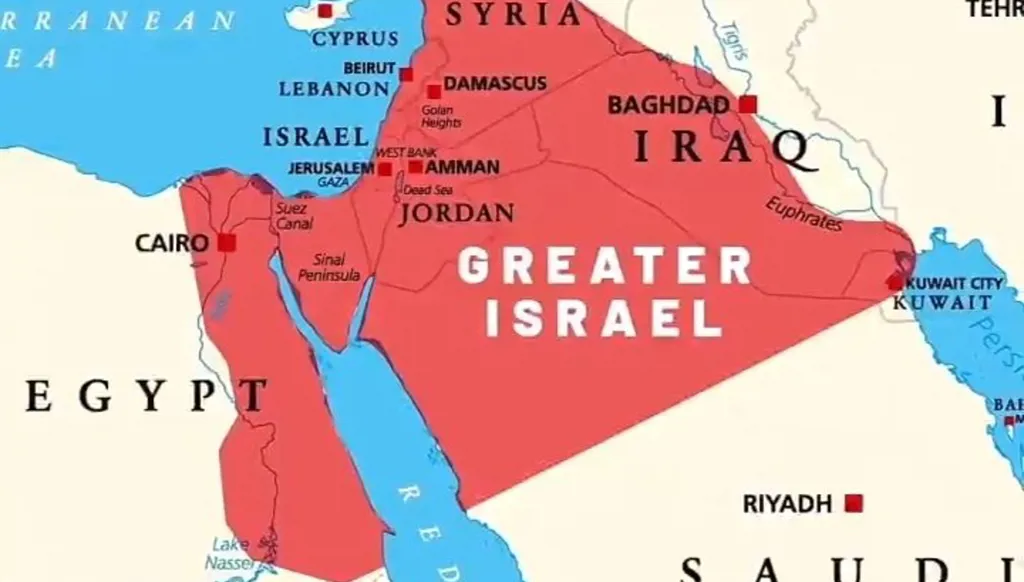
Concepts such as “Greater Israel” and “Greater Iran” operate in the Arab World as ideological narratives rather than fully formed political projects. They do not function as direct, executable plans, but rather as symbolic frameworks used to interpret political action and mobilize internal and external arenas.
In the Israeli case, some of these perceptions appear within nationalist-religious currents, but official action remains governed by the logic of the modern state, deterrence balances, and international alliances. In the Iranian case, revolutionary-religious discourse merges with a regional influence strategy based on managing a wide network of indirect actors, where ideology and pragmatism coexist without direct contradiction.
But the crucial point is not the credibility of these narratives, but their function: they are used to solidify legitimacy, shape internal discourse, and justify expansion or containment in a highly fluid regional environment.
2) The stubborn geography: When the place becomes a strategic constraint
Geography in the Arab World is not a backdrop to the conflict but one of its key actors. It defines movement paths, imposes constraints on diffusion, and redraws boundaries of influence, regardless of how ambitious the actors are.
Every expansionist project ultimately collides with the intransigence of place: borders, terrain, international overlap, and interlocking theaters of conflict. Here the question is not “Where can expansion go?” but “What can truly be stabilized?”
In this sense, geography does not overturn ideological projects but instead forcibly resets them within the limits of what is possible, transforming them from open-ended ambition into a continuous management of reality.
3) Demography: The silent constraint that cannot be defeated
If geography restricts movement, demography restricts stability. Societies are not neutral spaces but living structures that reproduce resistance or acceptance toward any political project.
Any expansion that surpasses its demographic environment encounters a complex equation: rising security and political costs versus the difficulty of producing stable legitimacy. The population is not a mass that can be permanently controlled, but a continuous interactive factor that reshapes power outcomes.
Over time, demography becomes a form of slow resistance: it is not defeated militarily, but it exhausts any project that does not align with it. And when it intersects with geography, it becomes the final threshold for any expansionist ambition.
The impact of demography is not limited to its numerical aspect or geographic distribution, but extends to what can be called the collective memory embedded within these societies. The populations of the Arab World do not interact with place as merely a physical space, but as a carrier of accumulated historical experiences of conflict, occupation, and political restructuring.
Collective memory: When history becomes behavior
This memory, with its accumulated experiences, contributes to forming patterns of collective behavior that tend to resist long-term subjugation, even under imbalanced power relations. Thus, demography becomes not only a demographic constraint but a temporal-psychological structure that reproduces rejection or adaptation according to its own context, helping explain the limited ability of expansionist projects to consolidate their outcomes, despite temporary military or political superiority.
4) Reshaping the domain: From control to engineering reality
In the face of geographical and demographic constraints, regional actors do not rely solely on traditional power but sometimes move toward reshaping the domain itself.
This is manifested in attempts to modify the urban structure of strategic areas and redistribute centers of gravity within them, changing the political and identity functions of place without changing its legal boundaries. It also appears in population management policies, through resettlement, replacement, or the reshaping of internal balances, reflecting an understanding that sustainable control depends on engineering the relationship between land and people.
In the Iranian case specifically, an additional dimension appears in the use of sectarian structure as a tool for regional influence, through extended networks across more than one Arab arena, making the conflict transcend geography to reshape the symbolic domain of identity itself.
Yet these tools, despite their partial effectiveness, remain constrained by the limits of geography and demography and do not abolish them.
5) Testing reality: When narratives clash with domain boundaries
Field experiences in the Arab World reveal that the conflict is not resolved at the level of discourse, but at the level of the ability to establish facts.
In the Israeli case, the dynamics of war in Gaza demonstrate that spatial control, even with widespread destruction of urban infrastructure, does not automatically lead to the dismantling of the population structure or the end of its ability to remain cohesive within the domain. This means that demography remains a long-term resistant element, even under extreme pressure conditions.
In the Iranian case, expanding influence through indirect regional networks does not necessarily guarantee sustainable control. Local rebalancing in several arenas of the Arab World, most prominently Syria, has reshaped the boundaries of influence and produced a state of repositioning rather than continuous expansion.
Syria gains a central position as a geopolitical node connecting Lebanon, Iraq, Jordan, and Palestine, making any shift within it directly affect the region. Thus, changes in this domain do not remain localized but instead redistribute power balances across the entire region.
6) Conclusions: The limits of ideology within the power structure
Conflict in the Arab World does not operate under pure ideological logic but within a complex structure governed by geography and demography as structural constraints that cannot be surpassed.





 Messenger
 Whatsapp
 Threads
 Email
Email
 Print
Print
 X
X
 Facebook