

Egypt’s rising military power alarms Israel
From military drills near the border to fears of new regional alliances, Israeli officials and analysts are increasingly warning that Egypt’s expanding military capabilities could reshape the balance of power in the Middle East.



 Messenger
 Whatsapp
 Threads
 Email
Email
 Print
Print
 X
X
 Facebook
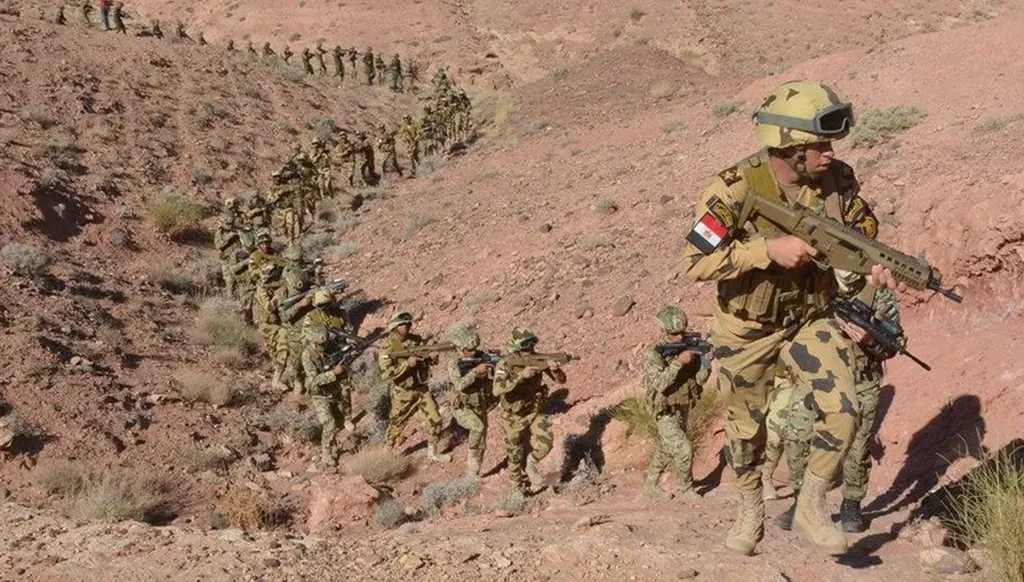


In a closed discussion at the Knesset, Israeli Prime Minister Benjamin Netanyahu warned about the growing capabilities of the Egyptian army and called for preventing what he described as an “excessive buildup” of its strength.
Cairo’s response was silent yet loud in its implications. Military exercises involving live ammunition were conducted just meters away from the border between the two countries, according to Hebrew media outlets. The drills sparked widespread debate within Israeli circles, with some comparing their seriousness to the events of October 6, 1973 and October 7, 2023, signaling rising tensions between Egypt and Israel. So what lies behind this escalation?
An Uncalculated Escalation
Knesset member Amit Halevi said the exercises constitute a violation of the peace agreement signed between the two countries more than four decades ago and could open the door to a dangerous and uncalculated escalation.
This comes at a time when tensions between Cairo and Tel Aviv have intensified over the Gaza war, Israeli expansion in Lebanon and Syria, strikes on Iran, and support for Ethiopia regarding the Grand Ethiopian Renaissance Dam issue. The two sides stand on opposite ends in many matters, which is why Israeli discussions reflect growing concern over the increasing capabilities of the Egyptian army. Analysts point out that Egypt now possesses a combination of conventional military power and modern technology due to the diversification of its weapons suppliers, the development of command and control systems, and the strengthening of its naval and air forces. Israeli analysts explained that this military growth, even if not currently directed against Tel Aviv, requires a reassessment of the balance of power between the two countries.
In the decades following the peace agreement, the Egyptian army relied almost entirely on American weapons, which represented a source of reassurance for Tel Aviv because the specifications were known and the equipment was monitored. This has begun to change. Egypt has turned to other sources of weaponry including France, Russia, Germany, Italy, China, and Turkey. The question now is how do you confront an army when you do not fully understand the limits of its integrated systems and capabilities?
Israeli research centers are also wary of Egypt’s openness to military partnerships and exercises with regional and international powers, especially China, Turkey, and Pakistan. This has enhanced the operational expertise of the Egyptian army and given it greater flexibility in the use of force. Cairo is no longer limiting itself to a traditional defensive role. Instead, it is building an integrated force capable of operating across multiple theaters, reinforcing its position as a central regional power rather than merely a state committed to the balances established after the peace agreement.
The Bullet and the Capability
Israel does not fear the “bullet” itself, but rather the “capability.” In its security doctrine, stability is built on the principle of maintaining “absolute qualitative superiority over all potential enemies.” Its concern is not tied to any immediate Egyptian hostility, but to underlying intentions and future capabilities. Tel Aviv believes that any shift in Cairo’s military strength requires strategic preparedness.
The newspaper Israel Hayom quoted Netanyahu as saying: “We have a relationship with Egypt, but we must prevent the buildup of its military power.” Meanwhile, retired General Yitzhak Brik warned in the newspaper Maariv that the pattern of Egyptian military exercises before the October 1973 war amounted to a form of “strategic deception.” At the time, the repeated drills created a false sense of routine within the Israeli military establishment, which contributed to lowering its level of readiness.
Brik offered a pessimistic assessment of the future balance of power in the region, arguing that current developments point toward new strategic alignments that could carry direct consequences, particularly the possibility of strategic cooperation between Cairo and Ankara extending into military production and defense integration. He views this as a significant transformation in the structure of regional relations, one that could redraw deterrence dynamics and place Israel before security challenges requiring a reassessment of its military doctrine and defense strategies.
Brik believes that Israeli decision-making circles have not yet fully grasped the scale of the ongoing transformations, warning that this “strategic blindness” could lead to unforeseen surprises in the future, such as the emergence of a “regional NATO” comprising Egypt, Saudi Arabia, Turkey, and Pakistan that would redistribute military influence across the Middle East. He did not rule out the possibility of Israel becoming involved in a difficult war against what he described as a Turkish Egyptian alliance.
A Terrifying Deal!
Some observers believe that Israel’s announcement of a massive, arguably terrifying, deal with the United States to purchase 50 highly advanced F-35 stealth fighter jets along with another 50 F-15 air superiority aircraft guarantees Tel Aviv overwhelming superiority and dominance over the region’s skies. This comes in light of the lessons learned from the confrontation with Iran and is seen as a reaction to the growing political and military rapprochement between Cairo, Ankara, Riyadh, and Islamabad.
Despite the heavy rhetoric raised by Tel Aviv regarding the growing capabilities of the Egyptian army, the reality on the ground reveals that Israel is the most heavily armed state in the region, possessing vast arsenals of conventional and unconventional weapons, including nuclear, chemical, and biological capabilities. It acquires the most advanced weaponry from the United States and Europe and also manufactures some of the world’s most sophisticated weapons systems itself. This creates an overwhelming imbalance in the balance of power in Israel’s favor, which makes its repeated warnings about the strength of the Egyptian army seem surprising. In such an unequal equation, who is really supposed to fear the other?
Disclaimer: The opinions expressed by the writers are their own and do not necessarily represent the views of Annahar