

Has Algeria Changed? Insights on Middle East Dynamics
As regional alliances shift after Syria’s break from Iranian influence, Algeria faces growing pressure to redefine its foreign policy, its ties with Tehran, and its relationship with Morocco and the Gulf states.



 Messenger
 Whatsapp
 Threads
 Email
Email
 Print
Print
 X
X
 Facebook


The ongoing war involving the Islamic Republic of Iran on one side and the United States and Israel on the other has created a new situation in the region. This situation has made it necessary for several countries, including Algeria, to adapt to this changing scenario, especially following Syria’s exit from Iranian hegemony.
It is clear that President Abdelmadjid Tebboune’s recent visit to Ankara was part of Algeria’s repositioning. This repositioning cannot be separated from a shift in Algerian policy, which still needs to demonstrate its ability to reconcile with its immediate surroundings before considering increasing trade exchanges with Turkey to around 10 billion dollars annually.
Algeria, for instance, is turning toward Turkey while continuing to insist on keeping its borders with Morocco closed since 1994. Moreover, Algeria used the occasion of Tebboune’s visit to Turkey to urge the separatist Polisario Front to launch an attack on the Moroccan city of Samara, located in the Sahara. It is difficult to reconcile Algerian diplomacy’s attempt to present itself as having adapted to regional changes while failing to acknowledge the new reality shaped by international recognition of the Moroccan Sahara on one hand, and the fact that, according to UN Security Council Resolution 2797, Algeria itself is the main party involved in this conflict on the other.
Has Algeria really changed?
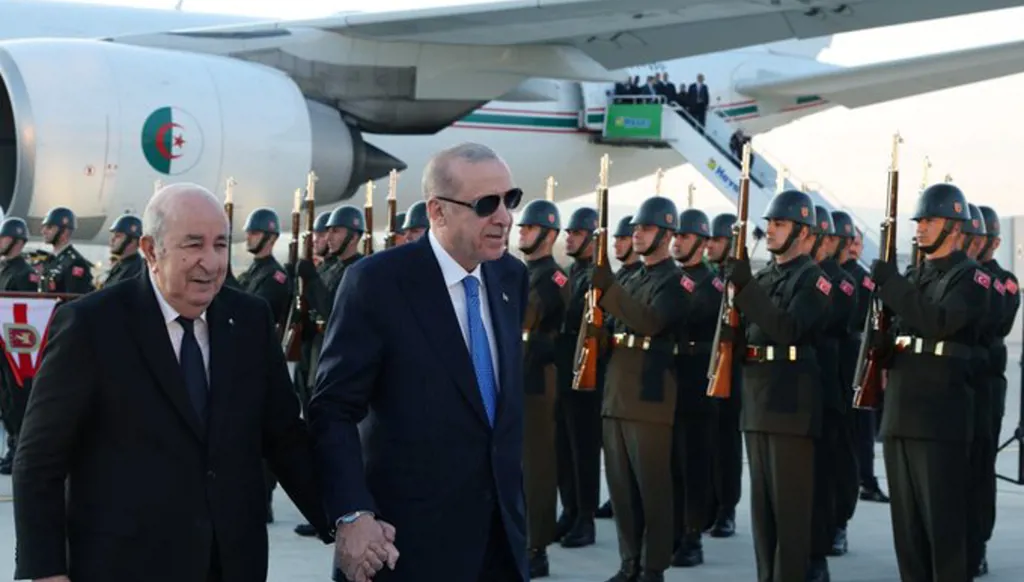
Tebboune received a warm welcome at Ankara airport from President Recep Tayyip Erdoğan, but the persistent question remains whether Algeria can seize this opportunity to demonstrate that it has truly changed. The Algerian regime cannot turn to Turkey as a way of avoiding recognition of the new reality that the room for using the Polisario Front has significantly narrowed.
The world, especially the countries of the Gulf Cooperation Council, understands very well that change in Algeria begins with improving relations with Morocco, which, through King Mohammed VI, has repeatedly extended invitations at the highest levels to discuss all pending issues between the two neighboring countries without preconditions.
It is possible to set aside the Sahara issue and the Morocco complex, including the unique historical relations that have linked the Algerian regime on one side and the Alawite regime in Syria on the other. The Algerian regime never took a position against the Assad regime, neither during the father’s era nor the son’s. Mutual services were consistently exchanged between the two sides, particularly in relation to Hezbollah training Polisario elements on Lebanese and Syrian territory.
The nature of Algerian-Iranian relations
Setting aside this issue does not eliminate the need to examine the nature of Algerian-Iranian relations. It is no secret that Algeria has maintained a close relationship with the Islamic Republic since its establishment 47 years ago.
The role Algeria played in seeking to resolve the hostage crisis at the US embassy in Tehran, where Iranian authorities held hostages for 444 days beginning in November 1979, is well known. At the time, Algeria had a distinguished diplomat serving as ambassador in Tehran, Abdel Karim Gharib, who later moved to Beirut after successfully carrying out his mission in Iran.
In 2026, much has changed both regionally and internationally. Tebboune visited Ankara in what was his second visit of its kind since succeeding Abdelaziz Bouteflika in late 2019. The visit ultimately aimed to benefit from the strong relationship between Recep Tayyip Erdoğan and Donald Trump. What could improve Algerian relations with Washington is the Algerian regime’s understanding of the significance of Resolution 2797 regarding the Sahara. This would require ending the exploitation of events in Mali to encourage separatist movements in the Sahel region. It is impossible to officially declare support for Mali’s territorial integrity while secretly backing separatist movements within the country.
One crucial point remains. It concerns the Iranian attacks targeting the Gulf Arab countries, including Saudi Arabia, the United Arab Emirates, Bahrain, Qatar, Kuwait, and even Oman. What is Algeria’s position on these attacks, which demonstrate that Arab security is interconnected and that responding to the United States and Israel should not come at the expense of threatening the Gulf Arab states? Where does Algeria stand regarding these attacks?
Disclaimer: The opinions expressed by the writers are their own and do not necessarily represent the views of Annahar.